

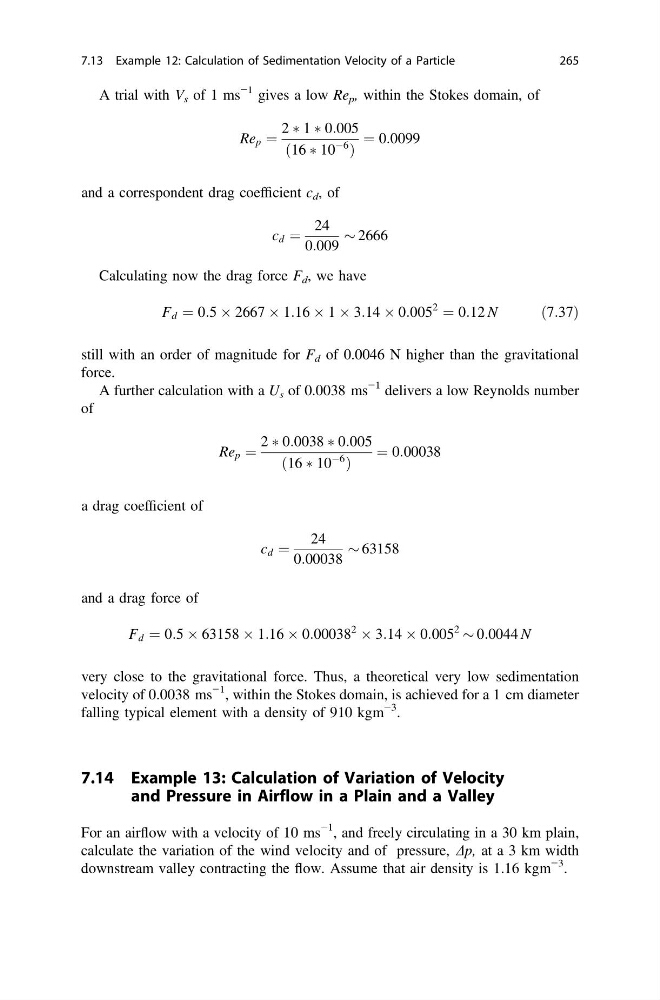
A trial with V s of 1 ms
−1 gives a low Re p , within the Stokes domain, of
Re p ¼
2 Ã 1 Ã 0:005
ð16 Ã 10
À6
Þ
¼ 0:0099
and a correspondent drag coefficient c d , of
c d ¼
24
0:009
$ 2666
Calculating now the drag force F d , we have
F d ¼ 0:5 Â 2667 Â 1:16 Â 1 Â 3:14 Â 0:005
2
¼ 0:12 N
ð7:37Þ
still with an order of magnitude for F d of 0.0046 N higher than the gravitational
force.
A further calculation with a U s of 0.0038 ms
−1 delivers a low Reynolds number
of
Re p ¼
2 Ã 0:0038 Ã 0:005
ð16 Ã 10
À6
Þ
¼ 0:00038
a drag coefficient of
c d ¼
24
0:00038
$ 63158
and a drag force of
F d ¼ 0:5 Â 63158 Â 1:16 Â 0:00038
2
 3:14  0:005
2
$ 0:0044 N
very close to the gravitational force. Thus, a theoretical very low sedimentation
velocity of 0.0038 ms
−1 , within the Stokes domain, is achieved for a 1 cm diameter
falling typical element with a density of 910 kgm
−3 .
7.14 Example 13: Calculation of Variation of Velocity
and Pressure in Airflow in a Plain and a Valley
For an airflow with a velocity of 10 ms
−1 , and freely circulating in a 30 km plain,
calculate the variation of the wind velocity and of pressure, Dp, at a 3 km width
downstream valley contracting the flow. Assume that air density is 1.16 kgm
−3 .
7.13 Example 12: Calculation of Sedimentation Velocity of a Particle
265
−1 gives a low Re p , within the Stokes domain, of
Re p ¼
2 Ã 1 Ã 0:005
ð16 Ã 10
À6
Þ
¼ 0:0099
and a correspondent drag coefficient c d , of
c d ¼
24
0:009
$ 2666
Calculating now the drag force F d , we have
F d ¼ 0:5 Â 2667 Â 1:16 Â 1 Â 3:14 Â 0:005
2
¼ 0:12 N
ð7:37Þ
still with an order of magnitude for F d of 0.0046 N higher than the gravitational
force.
A further calculation with a U s of 0.0038 ms
−1 delivers a low Reynolds number
of
Re p ¼
2 Ã 0:0038 Ã 0:005
ð16 Ã 10
À6
Þ
¼ 0:00038
a drag coefficient of
c d ¼
24
0:00038
$ 63158
and a drag force of
F d ¼ 0:5 Â 63158 Â 1:16 Â 0:00038
2
 3:14  0:005
2
$ 0:0044 N
very close to the gravitational force. Thus, a theoretical very low sedimentation
velocity of 0.0038 ms
−1 , within the Stokes domain, is achieved for a 1 cm diameter
falling typical element with a density of 910 kgm
−3 .
7.14 Example 13: Calculation of Variation of Velocity
and Pressure in Airflow in a Plain and a Valley
For an airflow with a velocity of 10 ms
−1 , and freely circulating in a 30 km plain,
calculate the variation of the wind velocity and of pressure, Dp, at a 3 km width
downstream valley contracting the flow. Assume that air density is 1.16 kgm
−3 .
7.13 Example 12: Calculation of Sedimentation Velocity of a Particle
265