

Solution:
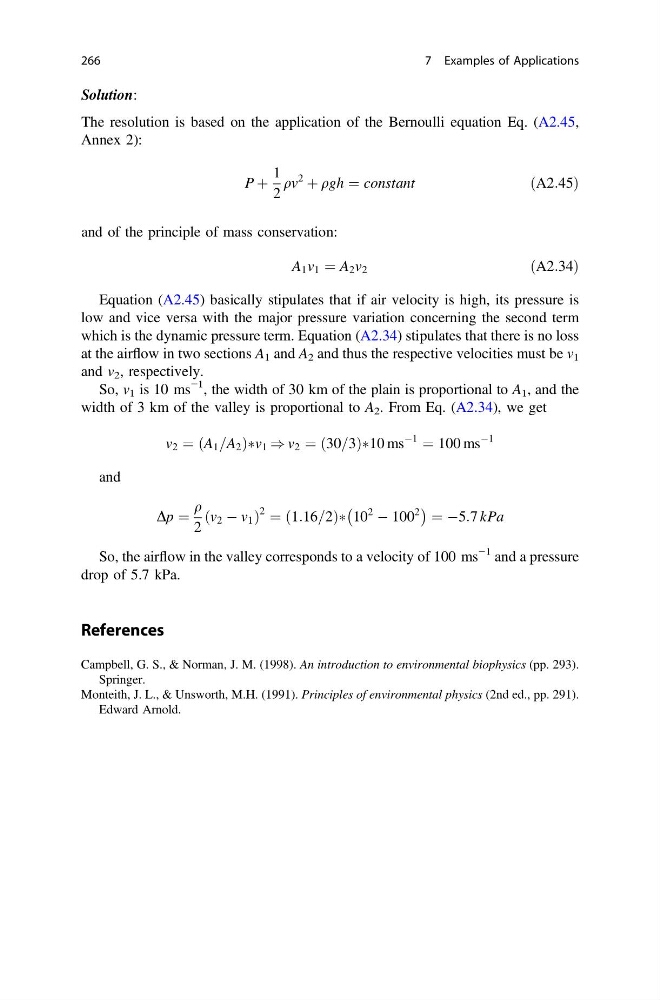
The resolution is based on the application of the Bernoulli equation Eq. (A2.45,
Annex 2):
P þ
1
2
qv
2
þ qgh ¼ constant
ðA2:45Þ
and of the principle of mass conservation:
A 1 v 1 ¼ A 2 v 2
ðA2:34Þ
Equation (A2.45) basically stipulates that if air velocity is high, its pressure is
low and vice versa with the major pressure variation concerning the second term
which is the dynamic pressure term. Equation (A2.34) stipulates that there is no loss
at the airflow in two sections A 1 and A 2 and thus the respective velocities must be v 1
and v 2 , respectively.
So, v 1 is 10 ms
−1 , the width of 30 km of the plain is proportional to A 1 , and the
width of 3 km of the valley is proportional to A 2 . From Eq. (A2.34), we get
v 2 ¼ A 1 =A 2
ð
ÞÃv 1 ) v 2 ¼ 30=3
ð
ÞÃ10 ms
À1
¼ 100 ms
À1
and
Dp ¼
q
2
ðv 2 À v 1 Þ
2 ¼ 1:16=2
ð
ÞÃ 10
2
À 100
2
À
Á ¼ À5:7 kPa
So, the airflow in the valley corresponds to a velocity of 100 ms
−1 and a pressure
drop of 5.7 kPa.
References
Campbell, G. S., & Norman, J. M. (1998). An introduction to environmental biophysics (pp. 293).
Springer.
Monteith, J. L., & Unsworth, M.H. (1991). Principles of environmental physics (2nd ed., pp. 291).
Edward Arnold.
266
7 Examples of Applications
The resolution is based on the application of the Bernoulli equation Eq. (A2.45,
Annex 2):
P þ
1
2
qv
2
þ qgh ¼ constant
ðA2:45Þ
and of the principle of mass conservation:
A 1 v 1 ¼ A 2 v 2
ðA2:34Þ
Equation (A2.45) basically stipulates that if air velocity is high, its pressure is
low and vice versa with the major pressure variation concerning the second term
which is the dynamic pressure term. Equation (A2.34) stipulates that there is no loss
at the airflow in two sections A 1 and A 2 and thus the respective velocities must be v 1
and v 2 , respectively.
So, v 1 is 10 ms
−1 , the width of 30 km of the plain is proportional to A 1 , and the
width of 3 km of the valley is proportional to A 2 . From Eq. (A2.34), we get
v 2 ¼ A 1 =A 2
ð
ÞÃv 1 ) v 2 ¼ 30=3
ð
ÞÃ10 ms
À1
¼ 100 ms
À1
and
Dp ¼
q
2
ðv 2 À v 1 Þ
2 ¼ 1:16=2
ð
ÞÃ 10
2
À 100
2
À
Á ¼ À5:7 kPa
So, the airflow in the valley corresponds to a velocity of 100 ms
−1 and a pressure
drop of 5.7 kPa.
References
Campbell, G. S., & Norman, J. M. (1998). An introduction to environmental biophysics (pp. 293).
Springer.
Monteith, J. L., & Unsworth, M.H. (1991). Principles of environmental physics (2nd ed., pp. 291).
Edward Arnold.
266
7 Examples of Applications