

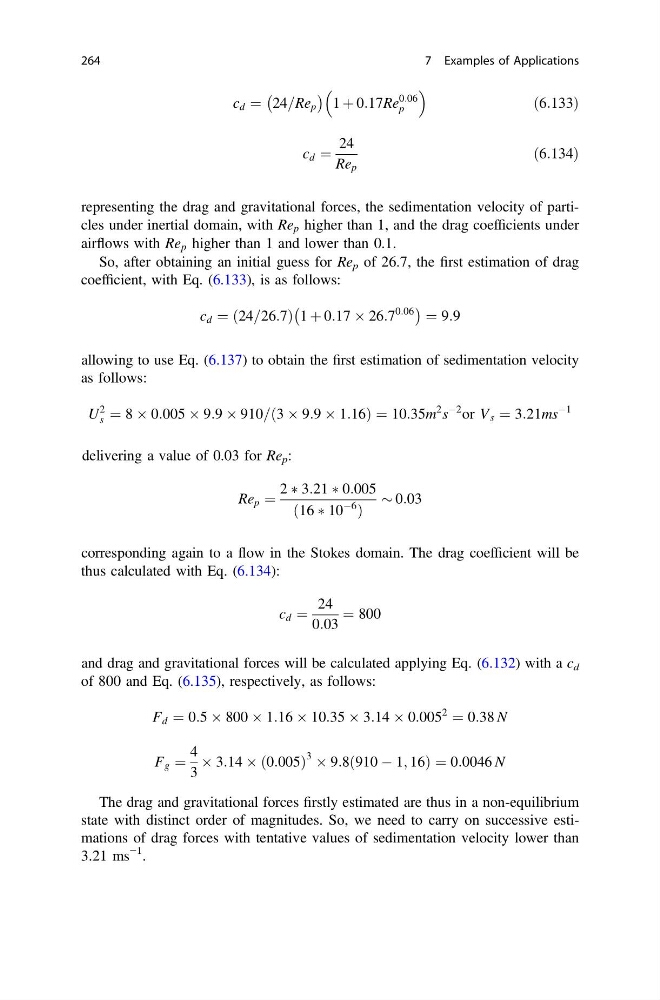
c d ¼ 24=Re p
À
Á 1 þ 0:17Re
0:06
p
ð6:133Þ
c d ¼
24
Re p
ð6:134Þ
representing the drag and gravitational forces, the sedimentation velocity of particles under inertial domain, with Re p higher than 1, and the drag coefficients under
airflows with Re p higher than 1 and lower than 0.1.
So, after obtaining an initial guess for Re p of 26.7, the first estimation of drag
coefficient, with Eq. (6.133), is as follows:
c d ¼ 24=26:7
ð
Þ 1 þ 0:17 Â 26:7
0:06
À
Á ¼ 9:9
allowing to use Eq. (6.137) to obtain the first estimation of sedimentation velocity
as follows:
U
2
s ¼ 8 Â 0:005 Â 9:9 Â 910= 3 Â 9:9 Â 1:16
ð
Þ ¼ 10:35m
2 s
À2 or V s ¼ 3:21ms
À1
delivering a value of 0.03 for Re p :
Re p ¼
2 Ã 3:21 Ã 0:005
ð16 Ã 10
À6
Þ
$ 0:03
corresponding again to a flow in the Stokes domain. The drag coefficient will be
thus calculated with Eq. (6.134):
c d ¼
24
0:03
¼ 800
and drag and gravitational forces will be calculated applying Eq. (6.132) with a c d
of 800 and Eq. (6.135), respectively, as follows:
F d ¼ 0:5 Â 800 Â 1:16 Â 10:35 Â 3:14 Â 0:005
2
¼ 0:38 N
F g ¼
4
3
 3:14  ð0:005Þ
3 Â 9:8 910 À 1; 16
ð
Þ¼0:0046 N
The drag and gravitational forces firstly estimated are thus in a non-equilibrium
state with distinct order of magnitudes. So, we need to carry on successive estimations of drag forces with tentative values of sedimentation velocity lower than
3.21 ms
−1 .
264
7 Examples of Applications
À
Á 1 þ 0:17Re
0:06
p
ð6:133Þ
c d ¼
24
Re p
ð6:134Þ
representing the drag and gravitational forces, the sedimentation velocity of particles under inertial domain, with Re p higher than 1, and the drag coefficients under
airflows with Re p higher than 1 and lower than 0.1.
So, after obtaining an initial guess for Re p of 26.7, the first estimation of drag
coefficient, with Eq. (6.133), is as follows:
c d ¼ 24=26:7
ð
Þ 1 þ 0:17 Â 26:7
0:06
À
Á ¼ 9:9
allowing to use Eq. (6.137) to obtain the first estimation of sedimentation velocity
as follows:
U
2
s ¼ 8 Â 0:005 Â 9:9 Â 910= 3 Â 9:9 Â 1:16
ð
Þ ¼ 10:35m
2 s
À2 or V s ¼ 3:21ms
À1
delivering a value of 0.03 for Re p :
Re p ¼
2 Ã 3:21 Ã 0:005
ð16 Ã 10
À6
Þ
$ 0:03
corresponding again to a flow in the Stokes domain. The drag coefficient will be
thus calculated with Eq. (6.134):
c d ¼
24
0:03
¼ 800
and drag and gravitational forces will be calculated applying Eq. (6.132) with a c d
of 800 and Eq. (6.135), respectively, as follows:
F d ¼ 0:5 Â 800 Â 1:16 Â 10:35 Â 3:14 Â 0:005
2
¼ 0:38 N
F g ¼
4
3
 3:14  ð0:005Þ
3 Â 9:8 910 À 1; 16
ð
Þ¼0:0046 N
The drag and gravitational forces firstly estimated are thus in a non-equilibrium
state with distinct order of magnitudes. So, we need to carry on successive estimations of drag forces with tentative values of sedimentation velocity lower than
3.21 ms
−1 .
264
7 Examples of Applications