

Solution: Firstly, solar declination, d, between 23.5º and −23.5º needs to be calculated using Eq. (6.75), as per Sect. 6.3.3.2:
sin d ¼ 0:39 sin 278:97 þ 0:985t j þ 1:92 sinð356:6 þ 0:986t j Þ
Â
Ã
ð6:75Þ
where t j is the 28th Julian day. The solar declination angle is calculated at −20.73º.
At 10 h, the solar hourly angle h can be calculated using Eqs. (6.74), (7.5), (7.6),
and (7.7). The calculation for h gives −41.77º.
The zenithal angle is calculated using Eq. (6.72):
cos w ¼ sin / sin d þ cos / cos d cosh
ð6:72Þ
where / is the location latitude. Substituting /, h, and d with their values gives
the zenithal angle w at 10 h as 71.19º.
Solar radiation at the surface is then calculated using Eq. (6.88):
S t ¼ S 0 s
m cos w þ S d 0:271 À 0:294t
m
ð
Þ cos w
ð6:88Þ
Substituting the values of the variables, the direct solar radiation components
(first on the right side) and diffuse (second on the right side) are given, respectively,
by 151.06 and 79.33 Wm
−2 . The total solar radiation is 230.39 Wm
−2 .
For the calculation of the radiation incident at long wavelengths, firstly calculate
the atmospheric emissivity of long-wavelength radiation, using Eqs. (7.9) and
(7.10). The empirical Eq. (7.9) gives the saturation vapor pressure (kPa):
e s T
ð Þ ¼ aexp
bT
T þ c
ð7:9Þ
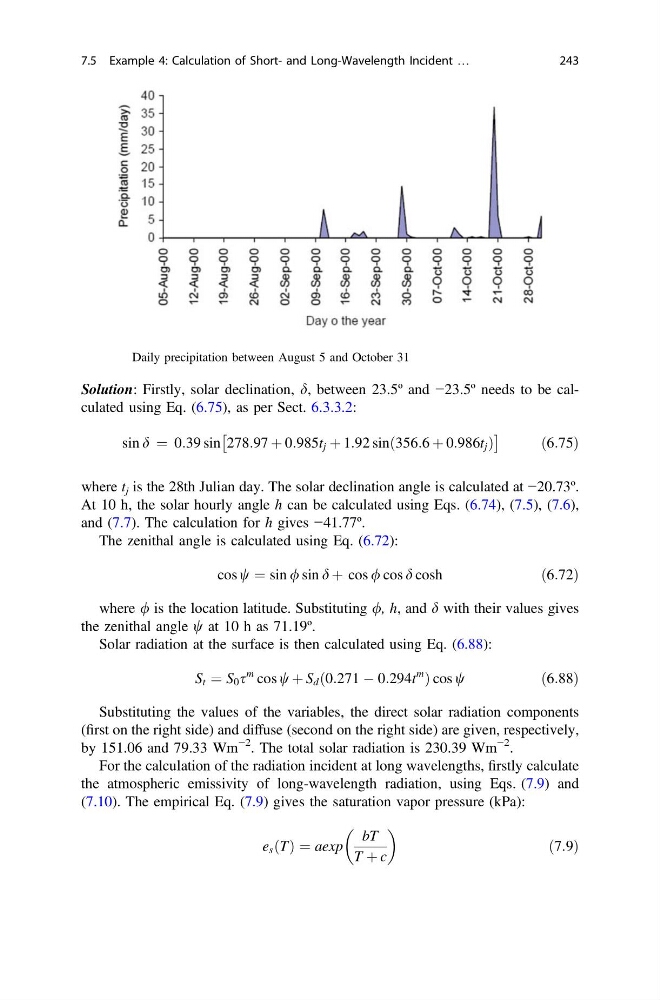
Fig. 7.3 Daily precipitation between August 5 and October 31
7.5 Example 4: Calculation of Short- and Long-Wavelength Incident …
243
sin d ¼ 0:39 sin 278:97 þ 0:985t j þ 1:92 sinð356:6 þ 0:986t j Þ
Â
Ã
ð6:75Þ
where t j is the 28th Julian day. The solar declination angle is calculated at −20.73º.
At 10 h, the solar hourly angle h can be calculated using Eqs. (6.74), (7.5), (7.6),
and (7.7). The calculation for h gives −41.77º.
The zenithal angle is calculated using Eq. (6.72):
cos w ¼ sin / sin d þ cos / cos d cosh
ð6:72Þ
where / is the location latitude. Substituting /, h, and d with their values gives
the zenithal angle w at 10 h as 71.19º.
Solar radiation at the surface is then calculated using Eq. (6.88):
S t ¼ S 0 s
m cos w þ S d 0:271 À 0:294t
m
ð
Þ cos w
ð6:88Þ
Substituting the values of the variables, the direct solar radiation components
(first on the right side) and diffuse (second on the right side) are given, respectively,
by 151.06 and 79.33 Wm
−2 . The total solar radiation is 230.39 Wm
−2 .
For the calculation of the radiation incident at long wavelengths, firstly calculate
the atmospheric emissivity of long-wavelength radiation, using Eqs. (7.9) and
(7.10). The empirical Eq. (7.9) gives the saturation vapor pressure (kPa):
e s T
ð Þ ¼ aexp
bT
T þ c
ð7:9Þ
Fig. 7.3 Daily precipitation between August 5 and October 31
7.5 Example 4: Calculation of Short- and Long-Wavelength Incident …
243