

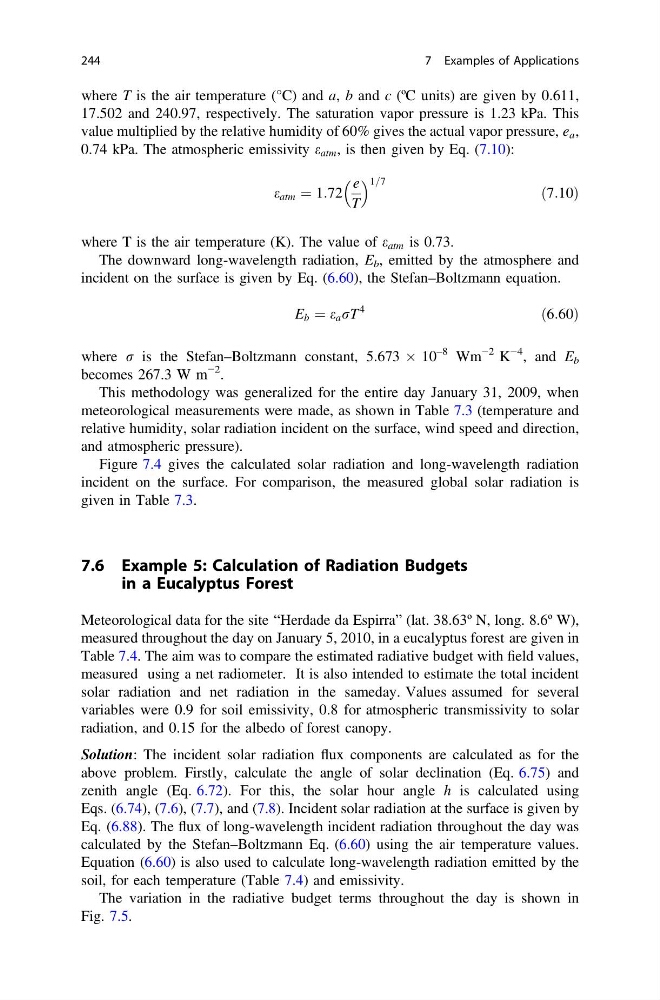
where T is the air temperature (°C) and a, b and c (ºC units) are given by 0.611,
17.502 and 240.97, respectively. The saturation vapor pressure is 1.23 kPa. This
value multiplied by the relative humidity of 60% gives the actual vapor pressure, e a ,
0.74 kPa. The atmospheric emissivity e atm , is then given by Eq. (7.10):
e atm ¼ 1:72
e
T
1=7
ð7:10Þ
where T is the air temperature (K). The value of e atm is 0.73.
The downward long-wavelength radiation, E b , emitted by the atmosphere and
incident on the surface is given by Eq. (6.60), the Stefan–Boltzmann equation.
E b ¼ e a rT
4
ð6:60Þ
where r is the Stefan–Boltzmann constant, 5.673 Â 10
–8 Wm
−2 K
−4 , and E b
becomes 267.3 W m
−2 .
This methodology was generalized for the entire day January 31, 2009, when
meteorological measurements were made, as shown in Table 7.3 (temperature and
relative humidity, solar radiation incident on the surface, wind speed and direction,
and atmospheric pressure).
Figure 7.4 gives the calculated solar radiation and long-wavelength radiation
incident on the surface. For comparison, the measured global solar radiation is
given in Table 7.3.
7.6 Example 5: Calculation of Radiation Budgets
in a Eucalyptus Forest
Meteorological data for the site “Herdade da Espirra” (lat. 38.63º N, long. 8.6º W),
measured throughout the day on January 5, 2010, in a eucalyptus forest are given in
Table 7.4. The aim was to compare the estimated radiative budget with field values,
measured using a net radiometer. It is also intended to estimate the total incident
solar radiation and net radiation in the sameday. Values assumed for several
variables were 0.9 for soil emissivity, 0.8 for atmospheric transmissivity to solar
radiation, and 0.15 for the albedo of forest canopy.
Solution: The incident solar radiation flux components are calculated as for the
above problem. Firstly, calculate the angle of solar declination (Eq. 6.75) and
zenith angle (Eq. 6.72). For this, the solar hour angle h is calculated using
Eqs. (6.74), (7.6), (7.7), and (7.8). Incident solar radiation at the surface is given by
Eq. (6.88). The flux of long-wavelength incident radiation throughout the day was
calculated by the Stefan–Boltzmann Eq. (6.60) using the air temperature values.
Equation (6.60) is also used to calculate long-wavelength radiation emitted by the
soil, for each temperature (Table 7.4) and emissivity.
The variation in the radiative budget terms throughout the day is shown in
Fig. 7.5.
244
7 Examples of Applications
17.502 and 240.97, respectively. The saturation vapor pressure is 1.23 kPa. This
value multiplied by the relative humidity of 60% gives the actual vapor pressure, e a ,
0.74 kPa. The atmospheric emissivity e atm , is then given by Eq. (7.10):
e atm ¼ 1:72
e
T
1=7
ð7:10Þ
where T is the air temperature (K). The value of e atm is 0.73.
The downward long-wavelength radiation, E b , emitted by the atmosphere and
incident on the surface is given by Eq. (6.60), the Stefan–Boltzmann equation.
E b ¼ e a rT
4
ð6:60Þ
where r is the Stefan–Boltzmann constant, 5.673 Â 10
–8 Wm
−2 K
−4 , and E b
becomes 267.3 W m
−2 .
This methodology was generalized for the entire day January 31, 2009, when
meteorological measurements were made, as shown in Table 7.3 (temperature and
relative humidity, solar radiation incident on the surface, wind speed and direction,
and atmospheric pressure).
Figure 7.4 gives the calculated solar radiation and long-wavelength radiation
incident on the surface. For comparison, the measured global solar radiation is
given in Table 7.3.
7.6 Example 5: Calculation of Radiation Budgets
in a Eucalyptus Forest
Meteorological data for the site “Herdade da Espirra” (lat. 38.63º N, long. 8.6º W),
measured throughout the day on January 5, 2010, in a eucalyptus forest are given in
Table 7.4. The aim was to compare the estimated radiative budget with field values,
measured using a net radiometer. It is also intended to estimate the total incident
solar radiation and net radiation in the sameday. Values assumed for several
variables were 0.9 for soil emissivity, 0.8 for atmospheric transmissivity to solar
radiation, and 0.15 for the albedo of forest canopy.
Solution: The incident solar radiation flux components are calculated as for the
above problem. Firstly, calculate the angle of solar declination (Eq. 6.75) and
zenith angle (Eq. 6.72). For this, the solar hour angle h is calculated using
Eqs. (6.74), (7.6), (7.7), and (7.8). Incident solar radiation at the surface is given by
Eq. (6.88). The flux of long-wavelength incident radiation throughout the day was
calculated by the Stefan–Boltzmann Eq. (6.60) using the air temperature values.
Equation (6.60) is also used to calculate long-wavelength radiation emitted by the
soil, for each temperature (Table 7.4) and emissivity.
The variation in the radiative budget terms throughout the day is shown in
Fig. 7.5.
244
7 Examples of Applications