

where S t is the total instantaneous solar radiation to the surface, S 0 the solar constant
(1373 W m
−2 ), w the zenith angle, and m the air mass number, given by sec w in
Eq. (6.81). As previously mentioned, transmissivity is influenced by the quality of
air in terms of suspended particles and gases (including water vapor) as well as by
solar and height location coordinates. This needs to be considered when calculating
atmospheric transmissivity, in this case for a period of 4 months (July to October
2000).
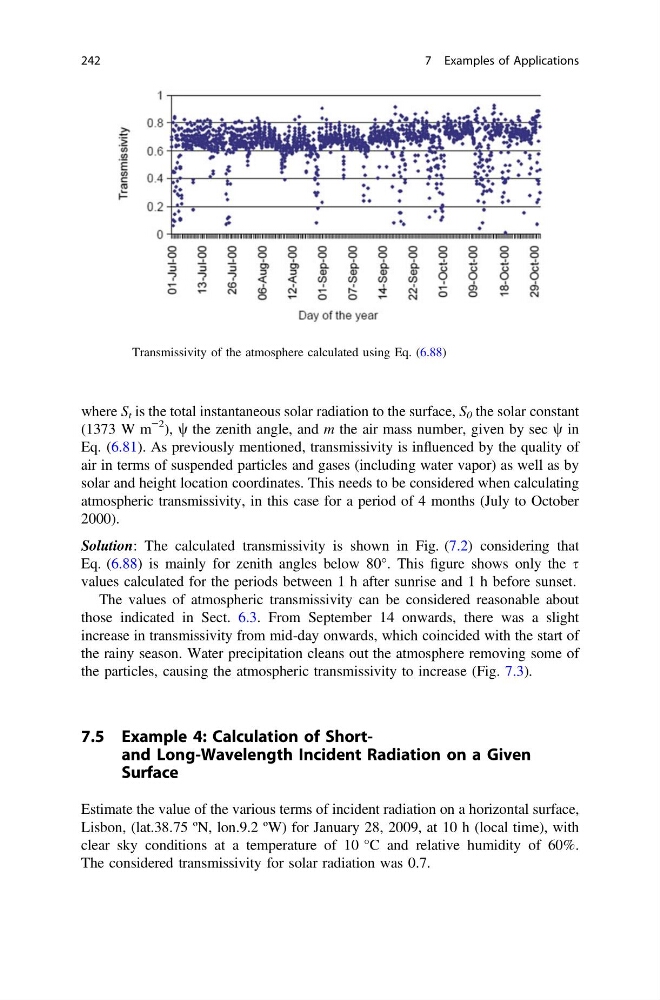
Solution: The calculated transmissivity is shown in Fig. (7.2) considering that
Eq. (6.88) is mainly for zenith angles below 80°. This figure shows only the s
values calculated for the periods between 1 h after sunrise and 1 h before sunset.
The values of atmospheric transmissivity can be considered reasonable about
those indicated in Sect. 6.3. From September 14 onwards, there was a slight
increase in transmissivity from mid-day onwards, which coincided with the start of
the rainy season. Water precipitation cleans out the atmosphere removing some of
the particles, causing the atmospheric transmissivity to increase (Fig. 7.3).
7.5 Example 4: Calculation of Shortand Long-Wavelength Incident Radiation on a Given
Surface
Estimate the value of the various terms of incident radiation on a horizontal surface,
Lisbon, (lat.38.75 ºN, lon.9.2 ºW) for January 28, 2009, at 10 h (local time), with
clear sky conditions at a temperature of 10 °C and relative humidity of 60%.
The considered transmissivity for solar radiation was 0.7.
Fig. 7.2 Transmissivity of the atmosphere calculated using Eq. (6.88)
242
7 Examples of Applications
(1373 W m
−2 ), w the zenith angle, and m the air mass number, given by sec w in
Eq. (6.81). As previously mentioned, transmissivity is influenced by the quality of
air in terms of suspended particles and gases (including water vapor) as well as by
solar and height location coordinates. This needs to be considered when calculating
atmospheric transmissivity, in this case for a period of 4 months (July to October
2000).
Solution: The calculated transmissivity is shown in Fig. (7.2) considering that
Eq. (6.88) is mainly for zenith angles below 80°. This figure shows only the s
values calculated for the periods between 1 h after sunrise and 1 h before sunset.
The values of atmospheric transmissivity can be considered reasonable about
those indicated in Sect. 6.3. From September 14 onwards, there was a slight
increase in transmissivity from mid-day onwards, which coincided with the start of
the rainy season. Water precipitation cleans out the atmosphere removing some of
the particles, causing the atmospheric transmissivity to increase (Fig. 7.3).
7.5 Example 4: Calculation of Shortand Long-Wavelength Incident Radiation on a Given
Surface
Estimate the value of the various terms of incident radiation on a horizontal surface,
Lisbon, (lat.38.75 ºN, lon.9.2 ºW) for January 28, 2009, at 10 h (local time), with
clear sky conditions at a temperature of 10 °C and relative humidity of 60%.
The considered transmissivity for solar radiation was 0.7.
Fig. 7.2 Transmissivity of the atmosphere calculated using Eq. (6.88)
242
7 Examples of Applications