

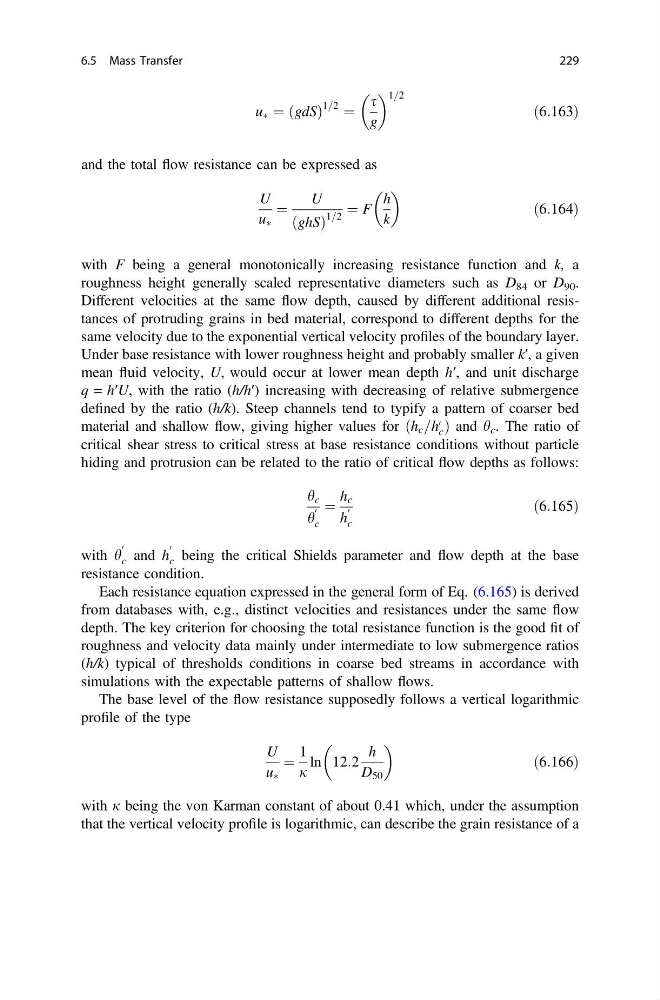
u à ¼ ðgdSÞ
1=2 ¼
s
g
1=2
ð6:163Þ
and the total flow resistance can be expressed as
U
u Ã
¼
U
ðghSÞ
1=2
¼ F
h
k
ð6:164Þ
with F being a general monotonically increasing resistance function and k, a
roughness height generally scaled representative diameters such as D 84 or D 90 .
Different velocities at the same flow depth, caused by different additional resistances of protruding grains in bed material, correspond to different depths for the
same velocity due to the exponential vertical velocity profiles of the boundary layer.
Under base resistance with lower roughness height and probably smaller k′, a given
mean fluid velocity, U, would occur at lower mean depth h′, and unit discharge
q = h′U, with the ratio (h/h′) increasing with decreasing of relative submergence
defined by the ratio (h/k). Steep channels tend to typify a pattern of coarser bed
material and shallow flow, giving higher values for ðh c =h
0
c Þ and h c . The ratio of
critical shear stress to critical stress at base resistance conditions without particle
hiding and protrusion can be related to the ratio of critical flow depths as follows:
h c
h
0
c
¼
h c
h
0
c
ð6:165Þ
with h
0
c and h
0
c being the critical Shields parameter and flow depth at the base
resistance condition.
Each resistance equation expressed in the general form of Eq. (6.165) is derived
from databases with, e.g., distinct velocities and resistances under the same flow
depth. The key criterion for choosing the total resistance function is the good fit of
roughness and velocity data mainly under intermediate to low submergence ratios
(h/k) typical of thresholds conditions in coarse bed streams in accordance with
simulations with the expectable patterns of shallow flows.
The base level of the flow resistance supposedly follows a vertical logarithmic
profile of the type
U
u Ã
¼
1
j
ln 12:2
h
D 50
ð6:166Þ
with j being the von Karman constant of about 0.41 which, under the assumption
that the vertical velocity profile is logarithmic, can describe the grain resistance of a
6.5 Mass Transfer
229
1=2 ¼
s
g
1=2
ð6:163Þ
and the total flow resistance can be expressed as
U
u Ã
¼
U
ðghSÞ
1=2
¼ F
h
k
ð6:164Þ
with F being a general monotonically increasing resistance function and k, a
roughness height generally scaled representative diameters such as D 84 or D 90 .
Different velocities at the same flow depth, caused by different additional resistances of protruding grains in bed material, correspond to different depths for the
same velocity due to the exponential vertical velocity profiles of the boundary layer.
Under base resistance with lower roughness height and probably smaller k′, a given
mean fluid velocity, U, would occur at lower mean depth h′, and unit discharge
q = h′U, with the ratio (h/h′) increasing with decreasing of relative submergence
defined by the ratio (h/k). Steep channels tend to typify a pattern of coarser bed
material and shallow flow, giving higher values for ðh c =h
0
c Þ and h c . The ratio of
critical shear stress to critical stress at base resistance conditions without particle
hiding and protrusion can be related to the ratio of critical flow depths as follows:
h c
h
0
c
¼
h c
h
0
c
ð6:165Þ
with h
0
c and h
0
c being the critical Shields parameter and flow depth at the base
resistance condition.
Each resistance equation expressed in the general form of Eq. (6.165) is derived
from databases with, e.g., distinct velocities and resistances under the same flow
depth. The key criterion for choosing the total resistance function is the good fit of
roughness and velocity data mainly under intermediate to low submergence ratios
(h/k) typical of thresholds conditions in coarse bed streams in accordance with
simulations with the expectable patterns of shallow flows.
The base level of the flow resistance supposedly follows a vertical logarithmic
profile of the type
U
u Ã
¼
1
j
ln 12:2
h
D 50
ð6:166Þ
with j being the von Karman constant of about 0.41 which, under the assumption
that the vertical velocity profile is logarithmic, can describe the grain resistance of a
6.5 Mass Transfer
229