

plane bed. The logarithmic equation can be written as a power law equation as
follows:
U
u Ã
¼ a 0
h
D 50
1=6
ð6:167Þ
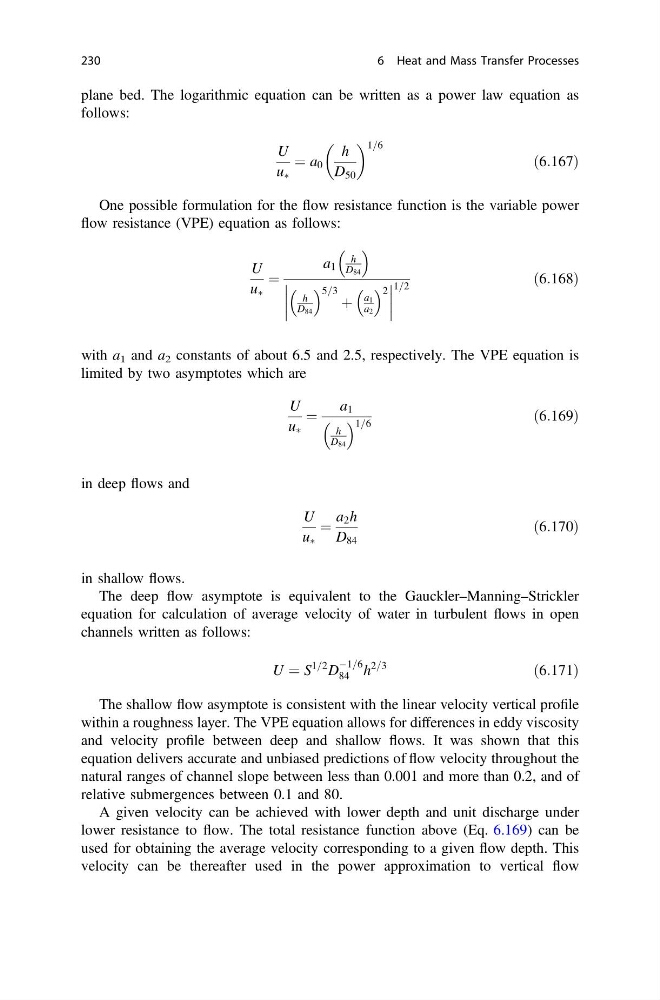
One possible formulation for the flow resistance function is the variable power
flow resistance (VPE) equation as follows:
U
u Ã
¼
a 1
h
D 84
h
D 84
5=3 þ
a 1
a 2
2
1=2
ð6:168Þ
with a 1 and a 2 constants of about 6.5 and 2.5, respectively. The VPE equation is
limited by two asymptotes which are
U
u Ã
¼
a 1
h
D 84
1=6
ð6:169Þ
in deep flows and
U
u Ã
¼
a 2 h
D 84
ð6:170Þ
in shallow flows.
The deep flow asymptote is equivalent to the Gauckler–Manning–Strickler
equation for calculation of average velocity of water in turbulent flows in open
channels written as follows:
U ¼ S
1=2 D
À1=6
84 h
2=3
ð6:171Þ
The shallow flow asymptote is consistent with the linear velocity vertical profile
within a roughness layer. The VPE equation allows for differences in eddy viscosity
and velocity profile between deep and shallow flows. It was shown that this
equation delivers accurate and unbiased predictions of flow velocity throughout the
natural ranges of channel slope between less than 0.001 and more than 0.2, and of
relative submergences between 0.1 and 80.
A given velocity can be achieved with lower depth and unit discharge under
lower resistance to flow. The total resistance function above (Eq. 6.169) can be
used for obtaining the average velocity corresponding to a given flow depth. This
velocity can be thereafter used in the power approximation to vertical flow
230
6 Heat and Mass Transfer Processes
follows:
U
u Ã
¼ a 0
h
D 50
1=6
ð6:167Þ
One possible formulation for the flow resistance function is the variable power
flow resistance (VPE) equation as follows:
U
u Ã
¼
a 1
h
D 84
h
D 84
5=3 þ
a 1
a 2
2
1=2
ð6:168Þ
with a 1 and a 2 constants of about 6.5 and 2.5, respectively. The VPE equation is
limited by two asymptotes which are
U
u Ã
¼
a 1
h
D 84
1=6
ð6:169Þ
in deep flows and
U
u Ã
¼
a 2 h
D 84
ð6:170Þ
in shallow flows.
The deep flow asymptote is equivalent to the Gauckler–Manning–Strickler
equation for calculation of average velocity of water in turbulent flows in open
channels written as follows:
U ¼ S
1=2 D
À1=6
84 h
2=3
ð6:171Þ
The shallow flow asymptote is consistent with the linear velocity vertical profile
within a roughness layer. The VPE equation allows for differences in eddy viscosity
and velocity profile between deep and shallow flows. It was shown that this
equation delivers accurate and unbiased predictions of flow velocity throughout the
natural ranges of channel slope between less than 0.001 and more than 0.2, and of
relative submergences between 0.1 and 80.
A given velocity can be achieved with lower depth and unit discharge under
lower resistance to flow. The total resistance function above (Eq. 6.169) can be
used for obtaining the average velocity corresponding to a given flow depth. This
velocity can be thereafter used in the power approximation to vertical flow
230
6 Heat and Mass Transfer Processes