

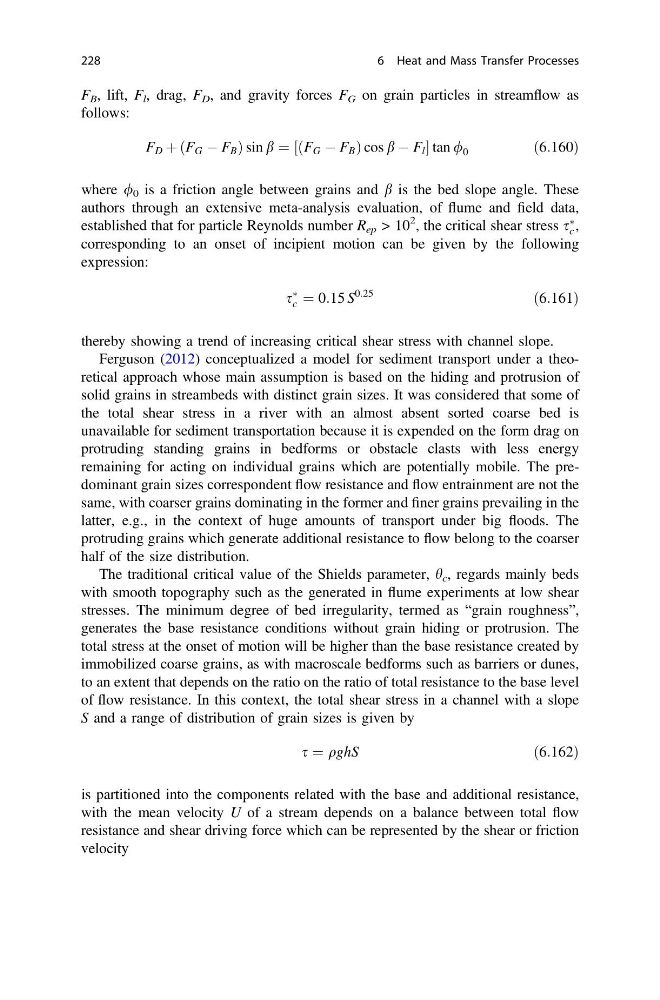
F B , lift, F l , drag, F D , and gravity forces F G on grain particles in streamflow as
follows:
F D þ F G À F B
ð
Þsin b ¼ F G À F B
ð
Þcos b À F l
½
tan / 0
ð6:160Þ
where / 0 is a friction angle between grains and b is the bed slope angle. These
authors through an extensive meta-analysis evaluation, of flume and field data,
established that for particle Reynolds number R ep > 10
2
, the critical shear stress s
Ã
c ,
corresponding to an onset of incipient motion can be given by the following
expression:
s
Ã
c ¼ 0:15 S
0:25
ð6:161Þ
thereby showing a trend of increasing critical shear stress with channel slope.
Ferguson (2012) conceptualized a model for sediment transport under a theoretical approach whose main assumption is based on the hiding and protrusion of
solid grains in streambeds with distinct grain sizes. It was considered that some of
the total shear stress in a river with an almost absent sorted coarse bed is
unavailable for sediment transportation because it is expended on the form drag on
protruding standing grains in bedforms or obstacle clasts with less energy
remaining for acting on individual grains which are potentially mobile. The predominant grain sizes correspondent flow resistance and flow entrainment are not the
same, with coarser grains dominating in the former and finer grains prevailing in the
latter, e.g., in the context of huge amounts of transport under big floods. The
protruding grains which generate additional resistance to flow belong to the coarser
half of the size distribution.
The traditional critical value of the Shields parameter, h c , regards mainly beds
with smooth topography such as the generated in flume experiments at low shear
stresses. The minimum degree of bed irregularity, termed as “grain roughness”,
generates the base resistance conditions without grain hiding or protrusion. The
total stress at the onset of motion will be higher than the base resistance created by
immobilized coarse grains, as with macroscale bedforms such as barriers or dunes,
to an extent that depends on the ratio on the ratio of total resistance to the base level
of flow resistance. In this context, the total shear stress in a channel with a slope
S and a range of distribution of grain sizes is given by
s ¼ qghS
ð6:162Þ
is partitioned into the components related with the base and additional resistance,
with the mean velocity U of a stream depends on a balance between total flow
resistance and shear driving force which can be represented by the shear or friction
velocity
228
6 Heat and Mass Transfer Processes
follows:
F D þ F G À F B
ð
Þsin b ¼ F G À F B
ð
Þcos b À F l
½
tan / 0
ð6:160Þ
where / 0 is a friction angle between grains and b is the bed slope angle. These
authors through an extensive meta-analysis evaluation, of flume and field data,
established that for particle Reynolds number R ep > 10
2
, the critical shear stress s
Ã
c ,
corresponding to an onset of incipient motion can be given by the following
expression:
s
Ã
c ¼ 0:15 S
0:25
ð6:161Þ
thereby showing a trend of increasing critical shear stress with channel slope.
Ferguson (2012) conceptualized a model for sediment transport under a theoretical approach whose main assumption is based on the hiding and protrusion of
solid grains in streambeds with distinct grain sizes. It was considered that some of
the total shear stress in a river with an almost absent sorted coarse bed is
unavailable for sediment transportation because it is expended on the form drag on
protruding standing grains in bedforms or obstacle clasts with less energy
remaining for acting on individual grains which are potentially mobile. The predominant grain sizes correspondent flow resistance and flow entrainment are not the
same, with coarser grains dominating in the former and finer grains prevailing in the
latter, e.g., in the context of huge amounts of transport under big floods. The
protruding grains which generate additional resistance to flow belong to the coarser
half of the size distribution.
The traditional critical value of the Shields parameter, h c , regards mainly beds
with smooth topography such as the generated in flume experiments at low shear
stresses. The minimum degree of bed irregularity, termed as “grain roughness”,
generates the base resistance conditions without grain hiding or protrusion. The
total stress at the onset of motion will be higher than the base resistance created by
immobilized coarse grains, as with macroscale bedforms such as barriers or dunes,
to an extent that depends on the ratio on the ratio of total resistance to the base level
of flow resistance. In this context, the total shear stress in a channel with a slope
S and a range of distribution of grain sizes is given by
s ¼ qghS
ð6:162Þ
is partitioned into the components related with the base and additional resistance,
with the mean velocity U of a stream depends on a balance between total flow
resistance and shear driving force which can be represented by the shear or friction
velocity
228
6 Heat and Mass Transfer Processes