

threshold shear velocity u Ãt for initiation of particle motion. The threshold shear
velocity can vary with sediment moisture or the presence of vegetation.
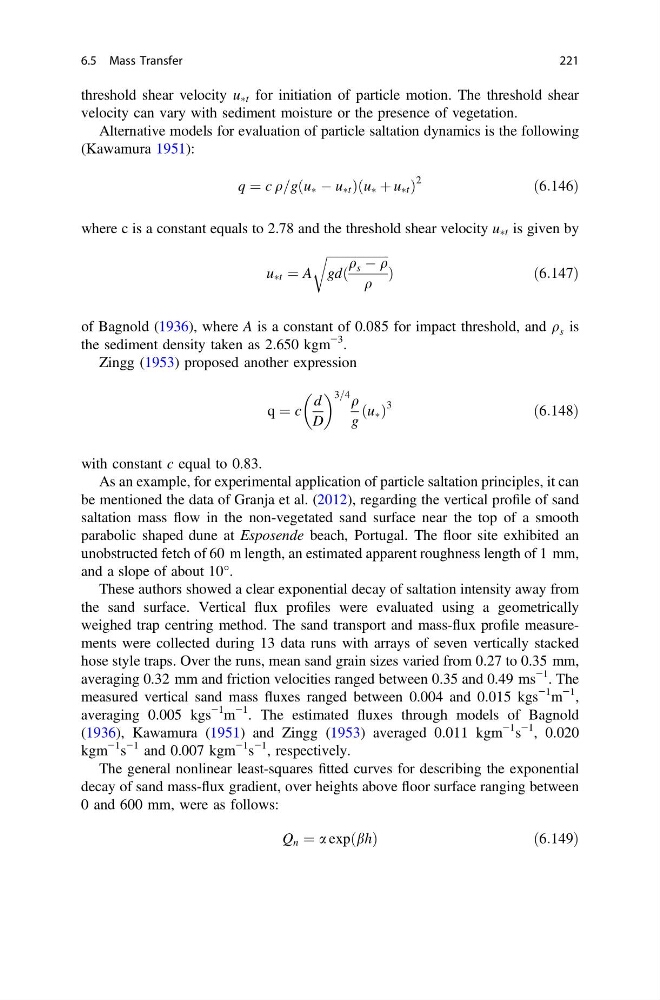
Alternative models for evaluation of particle saltation dynamics is the following
(Kawamura 1951):
q ¼ c q=g u à À u Ãt
ð
Þu à þ u Ãt
ð
Þ
2
ð6:146Þ
where c is a constant equals to 2.78 and the threshold shear velocity u Ãt is given by
u Ãt ¼ A
ffiffiffiffiffiffiffiffiffiffiffiffiffiffiffiffiffiffiffi ffi
gdð
q s À q
q
r
Þ
ð 6:147Þ
of Bagnold (1936), where A is a constant of 0.085 for impact threshold, and q s is
the sediment density taken as 2.650 kgm
−3 .
Zingg (1953) proposed another expression
q ¼ c
d
D
3=4 q
g
u Ã
ð Þ
3
ð6:148Þ
with constant c equal to 0.83.
As an example, for experimental application of particle saltation principles, it can
be mentioned the data of Granja et al. (2012), regarding the vertical profile of sand
saltation mass flow in the non-vegetated sand surface near the top of a smooth
parabolic shaped dune at Esposende beach, Portugal. The floor site exhibited an
unobstructed fetch of 60 m length, an estimated apparent roughness length of 1 mm,
and a slope of about 10°.
These authors showed a clear exponential decay of saltation intensity away from
the sand surface. Vertical flux profiles were evaluated using a geometrically
weighed trap centring method. The sand transport and mass-flux profile measurements were collected during 13 data runs with arrays of seven vertically stacked
hose style traps. Over the runs, mean sand grain sizes varied from 0.27 to 0.35 mm,
averaging 0.32 mm and friction velocities ranged between 0.35 and 0.49 ms
−1 . The
measured vertical sand mass fluxes ranged between 0.004 and 0.015 kgs
−1 m
−1 ,
averaging 0.005 kgs
−1
m
−1 . The estimated fluxes through models of Bagnold
(1936), Kawamura (1951) and Zingg (1953) averaged 0.011 kgm
−1 s
−1 , 0.020
kgm
−1 s
−1 and 0.007 kgm
−1 s
−1 , respectively.
The general nonlinear least-squares fitted curves for describing the exponential
decay of sand mass-flux gradient, over heights above floor surface ranging between
0 and 600 mm, were as follows:
Q n ¼ a expðbhÞ
ð 6:149Þ
6.5 Mass Transfer
221
velocity can vary with sediment moisture or the presence of vegetation.
Alternative models for evaluation of particle saltation dynamics is the following
(Kawamura 1951):
q ¼ c q=g u à À u Ãt
ð
Þu à þ u Ãt
ð
Þ
2
ð6:146Þ
where c is a constant equals to 2.78 and the threshold shear velocity u Ãt is given by
u Ãt ¼ A
ffiffiffiffiffiffiffiffiffiffiffiffiffiffiffiffiffiffiffi ffi
gdð
q s À q
q
r
Þ
ð 6:147Þ
of Bagnold (1936), where A is a constant of 0.085 for impact threshold, and q s is
the sediment density taken as 2.650 kgm
−3 .
Zingg (1953) proposed another expression
q ¼ c
d
D
3=4 q
g
u Ã
ð Þ
3
ð6:148Þ
with constant c equal to 0.83.
As an example, for experimental application of particle saltation principles, it can
be mentioned the data of Granja et al. (2012), regarding the vertical profile of sand
saltation mass flow in the non-vegetated sand surface near the top of a smooth
parabolic shaped dune at Esposende beach, Portugal. The floor site exhibited an
unobstructed fetch of 60 m length, an estimated apparent roughness length of 1 mm,
and a slope of about 10°.
These authors showed a clear exponential decay of saltation intensity away from
the sand surface. Vertical flux profiles were evaluated using a geometrically
weighed trap centring method. The sand transport and mass-flux profile measurements were collected during 13 data runs with arrays of seven vertically stacked
hose style traps. Over the runs, mean sand grain sizes varied from 0.27 to 0.35 mm,
averaging 0.32 mm and friction velocities ranged between 0.35 and 0.49 ms
−1 . The
measured vertical sand mass fluxes ranged between 0.004 and 0.015 kgs
−1 m
−1 ,
averaging 0.005 kgs
−1
m
−1 . The estimated fluxes through models of Bagnold
(1936), Kawamura (1951) and Zingg (1953) averaged 0.011 kgm
−1 s
−1 , 0.020
kgm
−1 s
−1 and 0.007 kgm
−1 s
−1 , respectively.
The general nonlinear least-squares fitted curves for describing the exponential
decay of sand mass-flux gradient, over heights above floor surface ranging between
0 and 600 mm, were as follows:
Q n ¼ a expðbhÞ
ð 6:149Þ
6.5 Mass Transfer
221