

Under wind speeds above a critical value, termed as impact or fluid threshold,
the drag forces exerted by the airflow are enough to lift some particles from the
ground surface generating the termed saltation process. Saltation is a type of particle transport, e.g., by wind or water, consisting of a detachment of loose materials
from a floor surface and transport by a fluid before returning to the surface.
Particle saltation is a combination of aerodynamic entrainment, wind field
change, particle bed splashing impacts, and variable particle trajectories (Cheng
et al. 2012). Aeolian saltation includes three main steps which are: (i) the acceleration by wind and gravity developing an arcing trajectory over the ground surface; (ii) progressive transfer of momentum from airflow with an increase of the
quantity of sand/dust involved in saltation, insofar that the airflow becomes
dependent of the course of saltation; and (iii) saltation grains, with some incipient
creeping, hitting the ground surface with ejection or splashing of additional particles which become engaged in saltation dynamics and propagating thereby the
transport process (Mitha et al. 1986).
Saltation particles are accelerated by fluid flow and pulled downward by gravity,
causing them to travel in roughly arc ballistic trajectories. These trajectories are
modified parabolas with initial angles close to 45° and smaller impact angles of
about 10°.
Small particles, with characteristic dimensions smaller than 20 lm are entrained
into the air stream, e.g., from the impact of saltation of sandy particles and carried
out by large eddies over long-term suspension with potential convective advection
up to great heights and long distances. For very small particles, vertical drag forces
due to turbulent fluctuations in the fluid are similar in magnitude to the weight of
the particle. The smaller the particle, the less important is the downward pull of
gravity, and the longer the particle is likely to stay in suspension. For particles of
characteristic dimensions ranging between 20 and 70 lm, these processes are
moderate and suspension in airflow lasts for shorter-term periods. Particles with
diameters ranging between 70 and 500 lm are prone to saltation processes, such as
sand-drift over desert surfaces, snowdrift over smooth surfaces, soil blowing over
fields, or pebble transport by rivers. Creeping occurs under very low fluid velocity
or with particles with a diameter bigger than 500 lm or protected physically from
strong influence with the fluids.
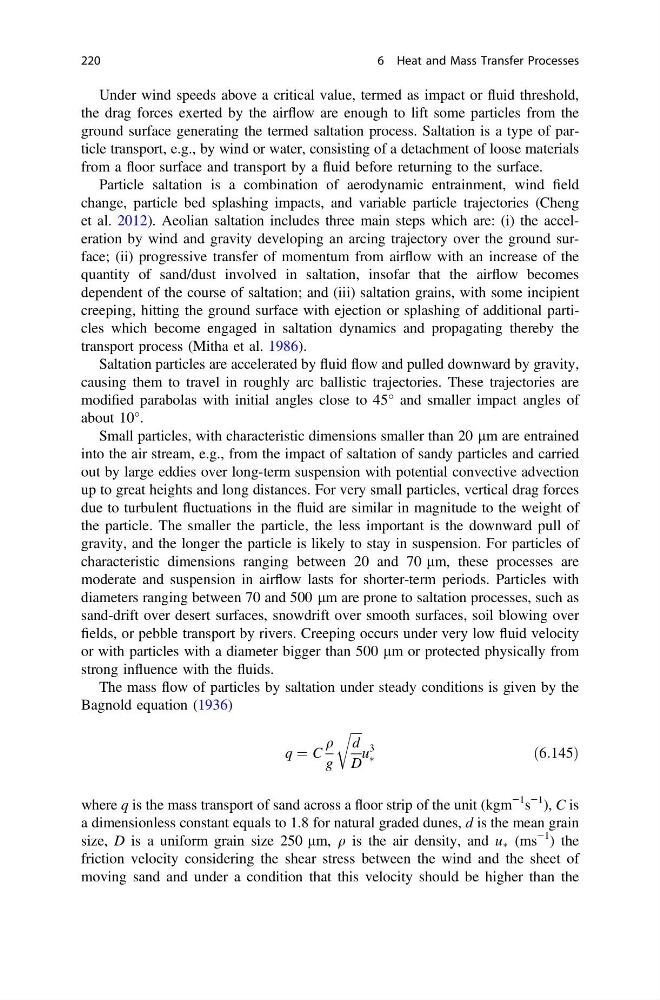
The mass flow of particles by saltation under steady conditions is given by the
Bagnold equation (1936)
q ¼ C
q
g
ffiffiffi ffi
d
D
r
u
3
Ã
ð6:145Þ
where q is the mass transport of sand across a floor strip of the unit (kgm
−1 s
−1 ), C is
a dimensionless constant equals to 1.8 for natural graded dunes, d is the mean grain
size, D is a uniform grain size 250 lm, q is the air density, and u à (ms
−1 ) the
friction velocity considering the shear stress between the wind and the sheet of
moving sand and under a condition that this velocity should be higher than the
220
6 Heat and Mass Transfer Processes
the drag forces exerted by the airflow are enough to lift some particles from the
ground surface generating the termed saltation process. Saltation is a type of particle transport, e.g., by wind or water, consisting of a detachment of loose materials
from a floor surface and transport by a fluid before returning to the surface.
Particle saltation is a combination of aerodynamic entrainment, wind field
change, particle bed splashing impacts, and variable particle trajectories (Cheng
et al. 2012). Aeolian saltation includes three main steps which are: (i) the acceleration by wind and gravity developing an arcing trajectory over the ground surface; (ii) progressive transfer of momentum from airflow with an increase of the
quantity of sand/dust involved in saltation, insofar that the airflow becomes
dependent of the course of saltation; and (iii) saltation grains, with some incipient
creeping, hitting the ground surface with ejection or splashing of additional particles which become engaged in saltation dynamics and propagating thereby the
transport process (Mitha et al. 1986).
Saltation particles are accelerated by fluid flow and pulled downward by gravity,
causing them to travel in roughly arc ballistic trajectories. These trajectories are
modified parabolas with initial angles close to 45° and smaller impact angles of
about 10°.
Small particles, with characteristic dimensions smaller than 20 lm are entrained
into the air stream, e.g., from the impact of saltation of sandy particles and carried
out by large eddies over long-term suspension with potential convective advection
up to great heights and long distances. For very small particles, vertical drag forces
due to turbulent fluctuations in the fluid are similar in magnitude to the weight of
the particle. The smaller the particle, the less important is the downward pull of
gravity, and the longer the particle is likely to stay in suspension. For particles of
characteristic dimensions ranging between 20 and 70 lm, these processes are
moderate and suspension in airflow lasts for shorter-term periods. Particles with
diameters ranging between 70 and 500 lm are prone to saltation processes, such as
sand-drift over desert surfaces, snowdrift over smooth surfaces, soil blowing over
fields, or pebble transport by rivers. Creeping occurs under very low fluid velocity
or with particles with a diameter bigger than 500 lm or protected physically from
strong influence with the fluids.
The mass flow of particles by saltation under steady conditions is given by the
Bagnold equation (1936)
q ¼ C
q
g
ffiffiffi ffi
d
D
r
u
3
Ã
ð6:145Þ
where q is the mass transport of sand across a floor strip of the unit (kgm
−1 s
−1 ), C is
a dimensionless constant equals to 1.8 for natural graded dunes, d is the mean grain
size, D is a uniform grain size 250 lm, q is the air density, and u à (ms
−1 ) the
friction velocity considering the shear stress between the wind and the sheet of
moving sand and under a condition that this velocity should be higher than the
220
6 Heat and Mass Transfer Processes