

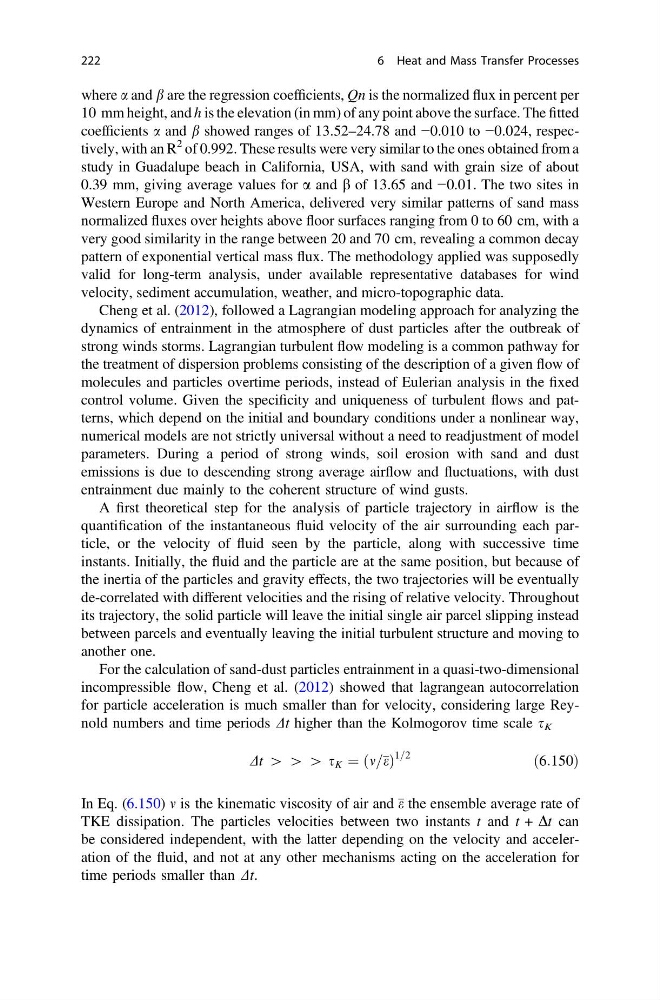
where a and b are the regression coefficients, Qn is the normalized flux in percent per
10 mm height, and h is the elevation (in mm) of any point above the surface. The fitted
coefficients a and b showed ranges of 13.52–24.78 and −0.010 to −0.024, respectively, with an R
2 of 0.992. These results were very similar to the ones obtained from a
study in Guadalupe beach in California, USA, with sand with grain size of about
0.39 mm, giving average values for a and b of 13.65 and −0.01. The two sites in
Western Europe and North America, delivered very similar patterns of sand mass
normalized fluxes over heights above floor surfaces ranging from 0 to 60 cm, with a
very good similarity in the range between 20 and 70 cm, revealing a common decay
pattern of exponential vertical mass flux. The methodology applied was supposedly
valid for long-term analysis, under available representative databases for wind
velocity, sediment accumulation, weather, and micro-topographic data.
Cheng et al. (2012), followed a Lagrangian modeling approach for analyzing the
dynamics of entrainment in the atmosphere of dust particles after the outbreak of
strong winds storms. Lagrangian turbulent flow modeling is a common pathway for
the treatment of dispersion problems consisting of the description of a given flow of
molecules and particles overtime periods, instead of Eulerian analysis in the fixed
control volume. Given the specificity and uniqueness of turbulent flows and patterns, which depend on the initial and boundary conditions under a nonlinear way,
numerical models are not strictly universal without a need to readjustment of model
parameters. During a period of strong winds, soil erosion with sand and dust
emissions is due to descending strong average airflow and fluctuations, with dust
entrainment due mainly to the coherent structure of wind gusts.
A first theoretical step for the analysis of particle trajectory in airflow is the
quantification of the instantaneous fluid velocity of the air surrounding each particle, or the velocity of fluid seen by the particle, along with successive time
instants. Initially, the fluid and the particle are at the same position, but because of
the inertia of the particles and gravity effects, the two trajectories will be eventually
de-correlated with different velocities and the rising of relative velocity. Throughout
its trajectory, the solid particle will leave the initial single air parcel slipping instead
between parcels and eventually leaving the initial turbulent structure and moving to
another one.
For the calculation of sand-dust particles entrainment in a quasi-two-dimensional
incompressible flow, Cheng et al. (2012) showed that lagrangean autocorrelation
for particle acceleration is much smaller than for velocity, considering large Reynold numbers and time periods Dt higher than the Kolmogorov time scale s K
Dt [ [ [ s K ¼ ðm=eÞ
1=2
ð6:150Þ
In Eq. (6.150) m is the kinematic viscosity of air and e the ensemble average rate of
TKE dissipation. The particles velocities between two instants t and t + Dt can
be considered independent, with the latter depending on the velocity and acceleration of the fluid, and not at any other mechanisms acting on the acceleration for
time periods smaller than Dt.
222
6 Heat and Mass Transfer Processes
10 mm height, and h is the elevation (in mm) of any point above the surface. The fitted
coefficients a and b showed ranges of 13.52–24.78 and −0.010 to −0.024, respectively, with an R
2 of 0.992. These results were very similar to the ones obtained from a
study in Guadalupe beach in California, USA, with sand with grain size of about
0.39 mm, giving average values for a and b of 13.65 and −0.01. The two sites in
Western Europe and North America, delivered very similar patterns of sand mass
normalized fluxes over heights above floor surfaces ranging from 0 to 60 cm, with a
very good similarity in the range between 20 and 70 cm, revealing a common decay
pattern of exponential vertical mass flux. The methodology applied was supposedly
valid for long-term analysis, under available representative databases for wind
velocity, sediment accumulation, weather, and micro-topographic data.
Cheng et al. (2012), followed a Lagrangian modeling approach for analyzing the
dynamics of entrainment in the atmosphere of dust particles after the outbreak of
strong winds storms. Lagrangian turbulent flow modeling is a common pathway for
the treatment of dispersion problems consisting of the description of a given flow of
molecules and particles overtime periods, instead of Eulerian analysis in the fixed
control volume. Given the specificity and uniqueness of turbulent flows and patterns, which depend on the initial and boundary conditions under a nonlinear way,
numerical models are not strictly universal without a need to readjustment of model
parameters. During a period of strong winds, soil erosion with sand and dust
emissions is due to descending strong average airflow and fluctuations, with dust
entrainment due mainly to the coherent structure of wind gusts.
A first theoretical step for the analysis of particle trajectory in airflow is the
quantification of the instantaneous fluid velocity of the air surrounding each particle, or the velocity of fluid seen by the particle, along with successive time
instants. Initially, the fluid and the particle are at the same position, but because of
the inertia of the particles and gravity effects, the two trajectories will be eventually
de-correlated with different velocities and the rising of relative velocity. Throughout
its trajectory, the solid particle will leave the initial single air parcel slipping instead
between parcels and eventually leaving the initial turbulent structure and moving to
another one.
For the calculation of sand-dust particles entrainment in a quasi-two-dimensional
incompressible flow, Cheng et al. (2012) showed that lagrangean autocorrelation
for particle acceleration is much smaller than for velocity, considering large Reynold numbers and time periods Dt higher than the Kolmogorov time scale s K
Dt [ [ [ s K ¼ ðm=eÞ
1=2
ð6:150Þ
In Eq. (6.150) m is the kinematic viscosity of air and e the ensemble average rate of
TKE dissipation. The particles velocities between two instants t and t + Dt can
be considered independent, with the latter depending on the velocity and acceleration of the fluid, and not at any other mechanisms acting on the acceleration for
time periods smaller than Dt.
222
6 Heat and Mass Transfer Processes