

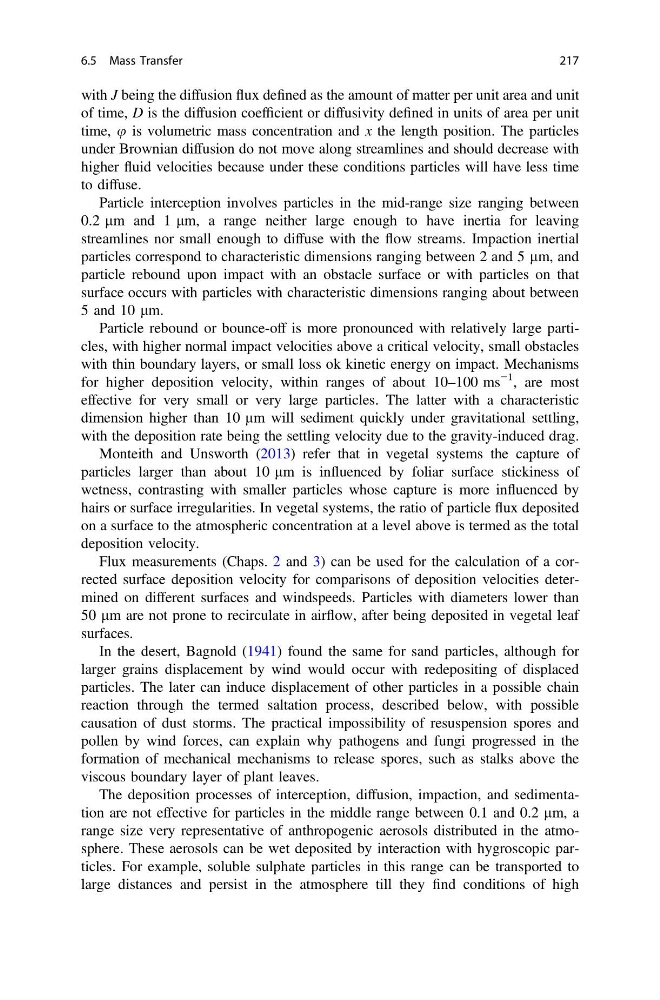
with J being the diffusion flux defined as the amount of matter per unit area and unit
of time, D is the diffusion coefficient or diffusivity defined in units of area per unit
time, u is volumetric mass concentration and x the length position. The particles
under Brownian diffusion do not move along streamlines and should decrease with
higher fluid velocities because under these conditions particles will have less time
to diffuse.
Particle interception involves particles in the mid-range size ranging between
0.2 lm and 1 lm, a range neither large enough to have inertia for leaving
streamlines nor small enough to diffuse with the flow streams. Impaction inertial
particles correspond to characteristic dimensions ranging between 2 and 5 lm, and
particle rebound upon impact with an obstacle surface or with particles on that
surface occurs with particles with characteristic dimensions ranging about between
5 and 10 lm.
Particle rebound or bounce-off is more pronounced with relatively large particles, with higher normal impact velocities above a critical velocity, small obstacles
with thin boundary layers, or small loss ok kinetic energy on impact. Mechanisms
for higher deposition velocity, within ranges of about 10–100 ms
−1 , are most
effective for very small or very large particles. The latter with a characteristic
dimension higher than 10 lm will sediment quickly under gravitational settling,
with the deposition rate being the settling velocity due to the gravity-induced drag.
Monteith and Unsworth (2013) refer that in vegetal systems the capture of
particles larger than about 10 lm is influenced by foliar surface stickiness of
wetness, contrasting with smaller particles whose capture is more influenced by
hairs or surface irregularities. In vegetal systems, the ratio of particle flux deposited
on a surface to the atmospheric concentration at a level above is termed as the total
deposition velocity.
Flux measurements (Chaps. 2 and 3) can be used for the calculation of a corrected surface deposition velocity for comparisons of deposition velocities determined on different surfaces and windspeeds. Particles with diameters lower than
50 lm are not prone to recirculate in airflow, after being deposited in vegetal leaf
surfaces.
In the desert, Bagnold (1941) found the same for sand particles, although for
larger grains displacement by wind would occur with redepositing of displaced
particles. The later can induce displacement of other particles in a possible chain
reaction through the termed saltation process, described below, with possible
causation of dust storms. The practical impossibility of resuspension spores and
pollen by wind forces, can explain why pathogens and fungi progressed in the
formation of mechanical mechanisms to release spores, such as stalks above the
viscous boundary layer of plant leaves.
The deposition processes of interception, diffusion, impaction, and sedimentation are not effective for particles in the middle range between 0.1 and 0.2 lm, a
range size very representative of anthropogenic aerosols distributed in the atmosphere. These aerosols can be wet deposited by interaction with hygroscopic particles. For example, soluble sulphate particles in this range can be transported to
large distances and persist in the atmosphere till they find conditions of high
6.5 Mass Transfer
217
of time, D is the diffusion coefficient or diffusivity defined in units of area per unit
time, u is volumetric mass concentration and x the length position. The particles
under Brownian diffusion do not move along streamlines and should decrease with
higher fluid velocities because under these conditions particles will have less time
to diffuse.
Particle interception involves particles in the mid-range size ranging between
0.2 lm and 1 lm, a range neither large enough to have inertia for leaving
streamlines nor small enough to diffuse with the flow streams. Impaction inertial
particles correspond to characteristic dimensions ranging between 2 and 5 lm, and
particle rebound upon impact with an obstacle surface or with particles on that
surface occurs with particles with characteristic dimensions ranging about between
5 and 10 lm.
Particle rebound or bounce-off is more pronounced with relatively large particles, with higher normal impact velocities above a critical velocity, small obstacles
with thin boundary layers, or small loss ok kinetic energy on impact. Mechanisms
for higher deposition velocity, within ranges of about 10–100 ms
−1 , are most
effective for very small or very large particles. The latter with a characteristic
dimension higher than 10 lm will sediment quickly under gravitational settling,
with the deposition rate being the settling velocity due to the gravity-induced drag.
Monteith and Unsworth (2013) refer that in vegetal systems the capture of
particles larger than about 10 lm is influenced by foliar surface stickiness of
wetness, contrasting with smaller particles whose capture is more influenced by
hairs or surface irregularities. In vegetal systems, the ratio of particle flux deposited
on a surface to the atmospheric concentration at a level above is termed as the total
deposition velocity.
Flux measurements (Chaps. 2 and 3) can be used for the calculation of a corrected surface deposition velocity for comparisons of deposition velocities determined on different surfaces and windspeeds. Particles with diameters lower than
50 lm are not prone to recirculate in airflow, after being deposited in vegetal leaf
surfaces.
In the desert, Bagnold (1941) found the same for sand particles, although for
larger grains displacement by wind would occur with redepositing of displaced
particles. The later can induce displacement of other particles in a possible chain
reaction through the termed saltation process, described below, with possible
causation of dust storms. The practical impossibility of resuspension spores and
pollen by wind forces, can explain why pathogens and fungi progressed in the
formation of mechanical mechanisms to release spores, such as stalks above the
viscous boundary layer of plant leaves.
The deposition processes of interception, diffusion, impaction, and sedimentation are not effective for particles in the middle range between 0.1 and 0.2 lm, a
range size very representative of anthropogenic aerosols distributed in the atmosphere. These aerosols can be wet deposited by interaction with hygroscopic particles. For example, soluble sulphate particles in this range can be transported to
large distances and persist in the atmosphere till they find conditions of high
6.5 Mass Transfer
217