

humidity where, by condensation, they can increase in size into larger drops that are
more prone to be captured by falling rain. The particle diameters D 0 at dry state and
D s at a water vapor saturation ratio, S, defined as the product between the % of
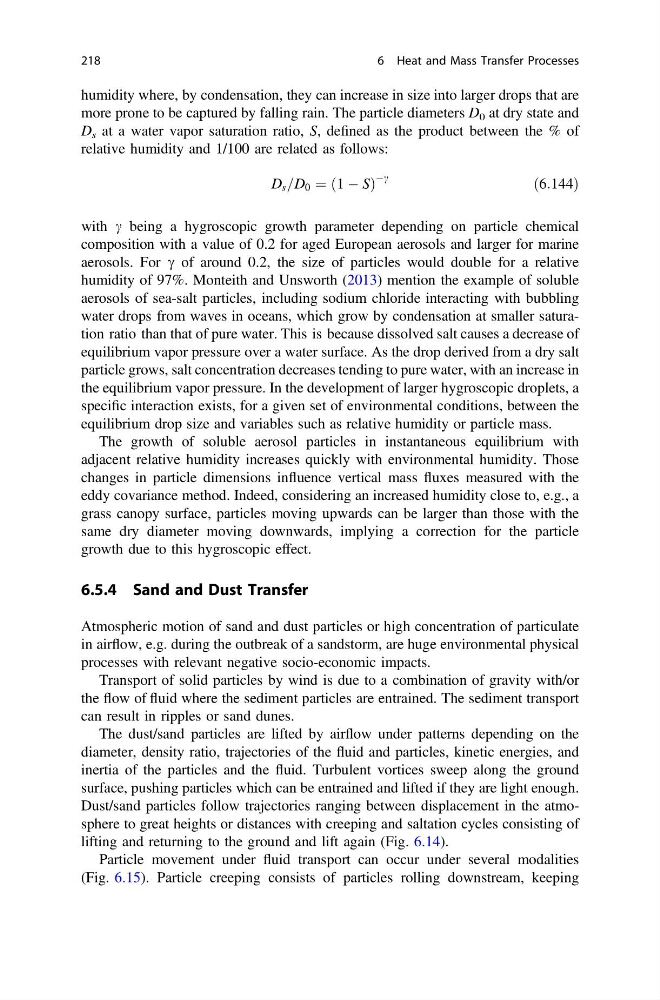
relative humidity and 1/100 are related as follows:
D s =D 0 ¼ 1 À S
ð
Þ
Àc
ð6:144Þ
with c being a hygroscopic growth parameter depending on particle chemical
composition with a value of 0.2 for aged European aerosols and larger for marine
aerosols. For c of around 0.2, the size of particles would double for a relative
humidity of 97%. Monteith and Unsworth (2013) mention the example of soluble
aerosols of sea-salt particles, including sodium chloride interacting with bubbling
water drops from waves in oceans, which grow by condensation at smaller saturation ratio than that of pure water. This is because dissolved salt causes a decrease of
equilibrium vapor pressure over a water surface. As the drop derived from a dry salt
particle grows, salt concentration decreases tending to pure water, with an increase in
the equilibrium vapor pressure. In the development of larger hygroscopic droplets, a
specific interaction exists, for a given set of environmental conditions, between the
equilibrium drop size and variables such as relative humidity or particle mass.
The growth of soluble aerosol particles in instantaneous equilibrium with
adjacent relative humidity increases quickly with environmental humidity. Those
changes in particle dimensions influence vertical mass fluxes measured with the
eddy covariance method. Indeed, considering an increased humidity close to, e.g., a
grass canopy surface, particles moving upwards can be larger than those with the
same dry diameter moving downwards, implying a correction for the particle
growth due to this hygroscopic effect.
6.5.4 Sand and Dust Transfer
Atmospheric motion of sand and dust particles or high concentration of particulate
in airflow, e.g. during the outbreak of a sandstorm, are huge environmental physical
processes with relevant negative socio-economic impacts.
Transport of solid particles by wind is due to a combination of gravity with/or
the flow of fluid where the sediment particles are entrained. The sediment transport
can result in ripples or sand dunes.
The dust/sand particles are lifted by airflow under patterns depending on the
diameter, density ratio, trajectories of the fluid and particles, kinetic energies, and
inertia of the particles and the fluid. Turbulent vortices sweep along the ground
surface, pushing particles which can be entrained and lifted if they are light enough.
Dust/sand particles follow trajectories ranging between displacement in the atmosphere to great heights or distances with creeping and saltation cycles consisting of
lifting and returning to the ground and lift again (Fig. 6.14).
Particle movement under fluid transport can occur under several modalities
(Fig. 6.15). Particle creeping consists of particles rolling downstream, keeping
218
6 Heat and Mass Transfer Processes
more prone to be captured by falling rain. The particle diameters D 0 at dry state and
D s at a water vapor saturation ratio, S, defined as the product between the % of
relative humidity and 1/100 are related as follows:
D s =D 0 ¼ 1 À S
ð
Þ
Àc
ð6:144Þ
with c being a hygroscopic growth parameter depending on particle chemical
composition with a value of 0.2 for aged European aerosols and larger for marine
aerosols. For c of around 0.2, the size of particles would double for a relative
humidity of 97%. Monteith and Unsworth (2013) mention the example of soluble
aerosols of sea-salt particles, including sodium chloride interacting with bubbling
water drops from waves in oceans, which grow by condensation at smaller saturation ratio than that of pure water. This is because dissolved salt causes a decrease of
equilibrium vapor pressure over a water surface. As the drop derived from a dry salt
particle grows, salt concentration decreases tending to pure water, with an increase in
the equilibrium vapor pressure. In the development of larger hygroscopic droplets, a
specific interaction exists, for a given set of environmental conditions, between the
equilibrium drop size and variables such as relative humidity or particle mass.
The growth of soluble aerosol particles in instantaneous equilibrium with
adjacent relative humidity increases quickly with environmental humidity. Those
changes in particle dimensions influence vertical mass fluxes measured with the
eddy covariance method. Indeed, considering an increased humidity close to, e.g., a
grass canopy surface, particles moving upwards can be larger than those with the
same dry diameter moving downwards, implying a correction for the particle
growth due to this hygroscopic effect.
6.5.4 Sand and Dust Transfer
Atmospheric motion of sand and dust particles or high concentration of particulate
in airflow, e.g. during the outbreak of a sandstorm, are huge environmental physical
processes with relevant negative socio-economic impacts.
Transport of solid particles by wind is due to a combination of gravity with/or
the flow of fluid where the sediment particles are entrained. The sediment transport
can result in ripples or sand dunes.
The dust/sand particles are lifted by airflow under patterns depending on the
diameter, density ratio, trajectories of the fluid and particles, kinetic energies, and
inertia of the particles and the fluid. Turbulent vortices sweep along the ground
surface, pushing particles which can be entrained and lifted if they are light enough.
Dust/sand particles follow trajectories ranging between displacement in the atmosphere to great heights or distances with creeping and saltation cycles consisting of
lifting and returning to the ground and lift again (Fig. 6.14).
Particle movement under fluid transport can occur under several modalities
(Fig. 6.15). Particle creeping consists of particles rolling downstream, keeping
218
6 Heat and Mass Transfer Processes