

6.5.3 Particle Deposition
The term deposition concerns the set of processes by which particles in fluid flows
are deposited in surfaces or objects. In the case of aerosol, defined as a suspension of
fine solid particles or liquid droplets with a diameter lower than 1 lm in the air or
another gas, deposition processes, which decreases the concentration of particles in
the air, are usually divided into two sub-processes which are dry and wet deposition.
Aerosols can be natural such as fog, mist, or forest exudates, or from anthropogenic
origins such as particulate air pollutants or smoke. Another classification of aerosols
is of primary aerosols containing particles introduced directly into the gas flow or
secondary aerosols borne from gas-particle conversion processes.
Dry deposition includes processes such as impaction, abovementioned, gravitational deposition due to the gravity-driven particles fall, the interception related
with the unavoidable collision of particles following streamlines strictly with very
close obstacles, the collision of particles transferred by turbulent eddies or the
electrostatic attraction by particles and obstacles with different electric charges.
Electrostatic forces are more effective when the particles are very close to obstacles.
Direct interception involves particles whose size is neither large to have inertia nor
small to diffuse within the streamlines.
Wet deposition consists of the purging of aerosol by atmospheric hydrometeors
such as raindrops or snowflakes. Wet deposition is developed through gravitational,
Brownian, or coagulation with water droplets. Types of wet deposition processes
are below-cloud scavenging and in cloud scavenging. The former occurs when rain
droplets and snow particles hit aerosol particles through Brownian diffusion,
interception, impaction, or turbulent diffusion. The latter occurs when cloud droplets or cloud crystals act as nuclei or collide with aerosol particles and capture
them. These particles can be brought to the ground surface by transportation with
falling rain or snowflakes.
As an example, Monteith and Unsworth (2013) refer that for a short vegetation
canopy with a height of around 0.1 m, the dimensional ranges of particles apt for
increases from about 0.001 lm to fold scales of dozens of micrometers in the order
from Brownian diffusion, interception, impaction, rebound to gravitational settling.
Brownian displacement of particles controls the dislocation of sub-micron sized
particles with possible coagulation up to characteristic dimensions of about 0.3 lm
which largely contribute to the atmospheric amounts of 2.5 fraction of particulate
matter. Brownian diffusion will be minimal with particle dimensions higher than
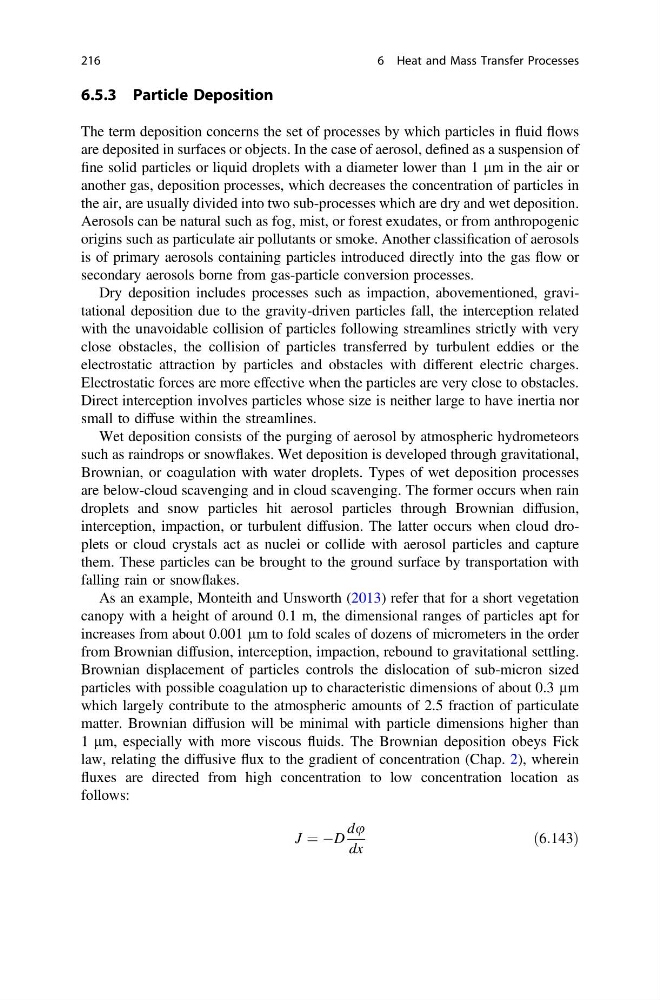
1 lm, especially with more viscous fluids. The Brownian deposition obeys Fick
law, relating the diffusive flux to the gradient of concentration (Chap. 2), wherein
fluxes are directed from high concentration to low concentration location as
follows:
J ¼ ÀD
du
dx
ð6:143Þ
216
6 Heat and Mass Transfer Processes
The term deposition concerns the set of processes by which particles in fluid flows
are deposited in surfaces or objects. In the case of aerosol, defined as a suspension of
fine solid particles or liquid droplets with a diameter lower than 1 lm in the air or
another gas, deposition processes, which decreases the concentration of particles in
the air, are usually divided into two sub-processes which are dry and wet deposition.
Aerosols can be natural such as fog, mist, or forest exudates, or from anthropogenic
origins such as particulate air pollutants or smoke. Another classification of aerosols
is of primary aerosols containing particles introduced directly into the gas flow or
secondary aerosols borne from gas-particle conversion processes.
Dry deposition includes processes such as impaction, abovementioned, gravitational deposition due to the gravity-driven particles fall, the interception related
with the unavoidable collision of particles following streamlines strictly with very
close obstacles, the collision of particles transferred by turbulent eddies or the
electrostatic attraction by particles and obstacles with different electric charges.
Electrostatic forces are more effective when the particles are very close to obstacles.
Direct interception involves particles whose size is neither large to have inertia nor
small to diffuse within the streamlines.
Wet deposition consists of the purging of aerosol by atmospheric hydrometeors
such as raindrops or snowflakes. Wet deposition is developed through gravitational,
Brownian, or coagulation with water droplets. Types of wet deposition processes
are below-cloud scavenging and in cloud scavenging. The former occurs when rain
droplets and snow particles hit aerosol particles through Brownian diffusion,
interception, impaction, or turbulent diffusion. The latter occurs when cloud droplets or cloud crystals act as nuclei or collide with aerosol particles and capture
them. These particles can be brought to the ground surface by transportation with
falling rain or snowflakes.
As an example, Monteith and Unsworth (2013) refer that for a short vegetation
canopy with a height of around 0.1 m, the dimensional ranges of particles apt for
increases from about 0.001 lm to fold scales of dozens of micrometers in the order
from Brownian diffusion, interception, impaction, rebound to gravitational settling.
Brownian displacement of particles controls the dislocation of sub-micron sized
particles with possible coagulation up to characteristic dimensions of about 0.3 lm
which largely contribute to the atmospheric amounts of 2.5 fraction of particulate
matter. Brownian diffusion will be minimal with particle dimensions higher than
1 lm, especially with more viscous fluids. The Brownian deposition obeys Fick
law, relating the diffusive flux to the gradient of concentration (Chap. 2), wherein
fluxes are directed from high concentration to low concentration location as
follows:
J ¼ ÀD
du
dx
ð6:143Þ
216
6 Heat and Mass Transfer Processes