

s ¼
q p d
2
p
18l
ð6:140Þ
with q p being the particle density, d p the particle diameter, and l the gas dynamic
viscosity.
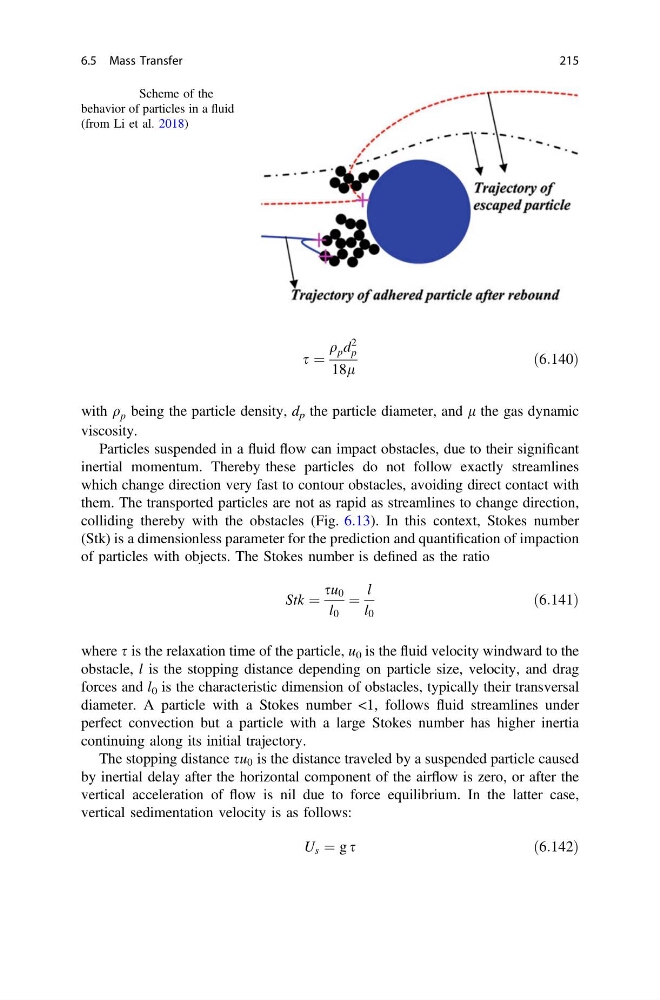
Particles suspended in a fluid flow can impact obstacles, due to their significant
inertial momentum. Thereby these particles do not follow exactly streamlines
which change direction very fast to contour obstacles, avoiding direct contact with
them. The transported particles are not as rapid as streamlines to change direction,
colliding thereby with the obstacles (Fig. 6.13). In this context, Stokes number
(Stk) is a dimensionless parameter for the prediction and quantification of impaction
of particles with objects. The Stokes number is defined as the ratio
Stk ¼
su 0
l 0
¼
l
l 0
ð6:141Þ
where s is the relaxation time of the particle, u 0 is the fluid velocity windward to the
obstacle, l is the stopping distance depending on particle size, velocity, and drag
forces and l 0 is the characteristic dimension of obstacles, typically their transversal
diameter. A particle with a Stokes number <1, follows fluid streamlines under
perfect convection but a particle with a large Stokes number has higher inertia
continuing along its initial trajectory.
The stopping distance su 0 is the distance traveled by a suspended particle caused
by inertial delay after the horizontal component of the airflow is zero, or after the
vertical acceleration of flow is nil due to force equilibrium. In the latter case,
vertical sedimentation velocity is as follows:
U s ¼ g s
ð6:142Þ
Fig. 6.13 Scheme of the
behavior of particles in a fluid
(from Li et al. 2018)
6.5 Mass Transfer
215
q p d
2
p
18l
ð6:140Þ
with q p being the particle density, d p the particle diameter, and l the gas dynamic
viscosity.
Particles suspended in a fluid flow can impact obstacles, due to their significant
inertial momentum. Thereby these particles do not follow exactly streamlines
which change direction very fast to contour obstacles, avoiding direct contact with
them. The transported particles are not as rapid as streamlines to change direction,
colliding thereby with the obstacles (Fig. 6.13). In this context, Stokes number
(Stk) is a dimensionless parameter for the prediction and quantification of impaction
of particles with objects. The Stokes number is defined as the ratio
Stk ¼
su 0
l 0
¼
l
l 0
ð6:141Þ
where s is the relaxation time of the particle, u 0 is the fluid velocity windward to the
obstacle, l is the stopping distance depending on particle size, velocity, and drag
forces and l 0 is the characteristic dimension of obstacles, typically their transversal
diameter. A particle with a Stokes number <1, follows fluid streamlines under
perfect convection but a particle with a large Stokes number has higher inertia
continuing along its initial trajectory.
The stopping distance su 0 is the distance traveled by a suspended particle caused
by inertial delay after the horizontal component of the airflow is zero, or after the
vertical acceleration of flow is nil due to force equilibrium. In the latter case,
vertical sedimentation velocity is as follows:
U s ¼ g s
ð6:142Þ
Fig. 6.13 Scheme of the
behavior of particles in a fluid
(from Li et al. 2018)
6.5 Mass Transfer
215