

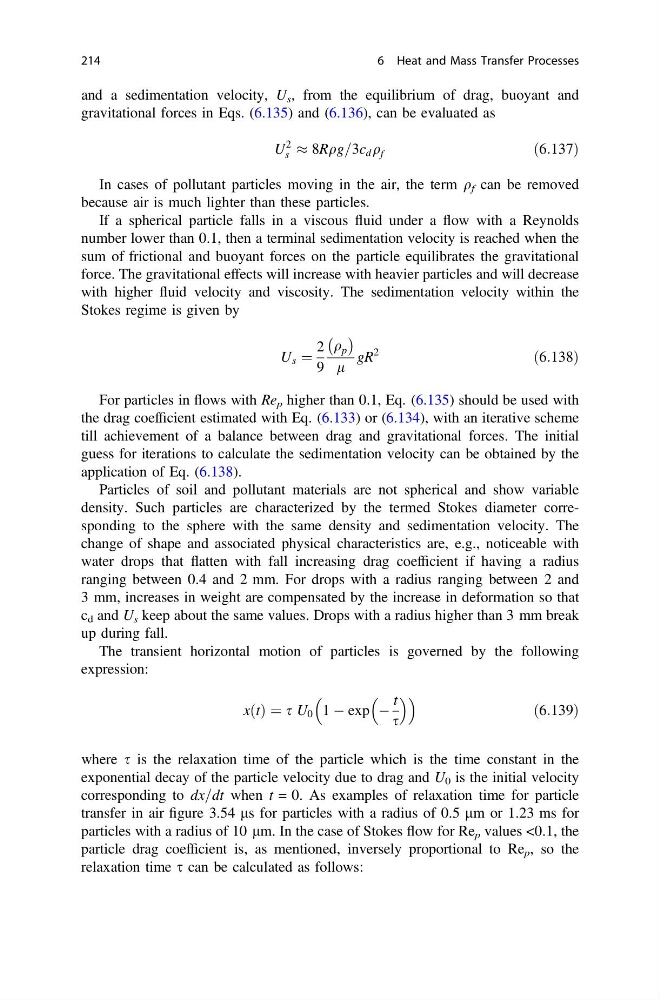
and a sedimentation velocity, U s , from the equilibrium of drag, buoyant and
gravitational forces in Eqs. (6.135) and (6.136), can be evaluated as
U
2
s % 8Rqg=3c d q f
ð6:137Þ
In cases of pollutant particles moving in the air, the term q f can be removed
because air is much lighter than these particles.
If a spherical particle falls in a viscous fluid under a flow with a Reynolds
number lower than 0.1, then a terminal sedimentation velocity is reached when the
sum of frictional and buoyant forces on the particle equilibrates the gravitational
force. The gravitational effects will increase with heavier particles and will decrease
with higher fluid velocity and viscosity. The sedimentation velocity within the
Stokes regime is given by
U s ¼
2
9
q p
À Á
l
gR
2
ð6:138Þ
For particles in flows with Re p higher than 0.1, Eq. (6.135) should be used with
the drag coefficient estimated with Eq. (6.133) or (6.134), with an iterative scheme
till achievement of a balance between drag and gravitational forces. The initial
guess for iterations to calculate the sedimentation velocity can be obtained by the
application of Eq. (6.138).
Particles of soil and pollutant materials are not spherical and show variable
density. Such particles are characterized by the termed Stokes diameter corresponding to the sphere with the same density and sedimentation velocity. The
change of shape and associated physical characteristics are, e.g., noticeable with
water drops that flatten with fall increasing drag coefficient if having a radius
ranging between 0.4 and 2 mm. For drops with a radius ranging between 2 and
3 mm, increases in weight are compensated by the increase in deformation so that
c d and U s keep about the same values. Drops with a radius higher than 3 mm break
up during fall.
The transient horizontal motion of particles is governed by the following
expression:
xðtÞ ¼ s U 0 1 À exp À
t
s
ð6:139Þ
where s is the relaxation time of the particle which is the time constant in the
exponential decay of the particle velocity due to drag and U 0 is the initial velocity
corresponding to dx=dt when t = 0. As examples of relaxation time for particle
transfer in air figure 3.54 ls for particles with a radius of 0.5 lm or 1.23 ms for
particles with a radius of 10 lm. In the case of Stokes flow for Re p values <0.1, the
particle drag coefficient is, as mentioned, inversely proportional to Re p , so the
relaxation time s can be calculated as follows:
214
6 Heat and Mass Transfer Processes
gravitational forces in Eqs. (6.135) and (6.136), can be evaluated as
U
2
s % 8Rqg=3c d q f
ð6:137Þ
In cases of pollutant particles moving in the air, the term q f can be removed
because air is much lighter than these particles.
If a spherical particle falls in a viscous fluid under a flow with a Reynolds
number lower than 0.1, then a terminal sedimentation velocity is reached when the
sum of frictional and buoyant forces on the particle equilibrates the gravitational
force. The gravitational effects will increase with heavier particles and will decrease
with higher fluid velocity and viscosity. The sedimentation velocity within the
Stokes regime is given by
U s ¼
2
9
q p
À Á
l
gR
2
ð6:138Þ
For particles in flows with Re p higher than 0.1, Eq. (6.135) should be used with
the drag coefficient estimated with Eq. (6.133) or (6.134), with an iterative scheme
till achievement of a balance between drag and gravitational forces. The initial
guess for iterations to calculate the sedimentation velocity can be obtained by the
application of Eq. (6.138).
Particles of soil and pollutant materials are not spherical and show variable
density. Such particles are characterized by the termed Stokes diameter corresponding to the sphere with the same density and sedimentation velocity. The
change of shape and associated physical characteristics are, e.g., noticeable with
water drops that flatten with fall increasing drag coefficient if having a radius
ranging between 0.4 and 2 mm. For drops with a radius ranging between 2 and
3 mm, increases in weight are compensated by the increase in deformation so that
c d and U s keep about the same values. Drops with a radius higher than 3 mm break
up during fall.
The transient horizontal motion of particles is governed by the following
expression:
xðtÞ ¼ s U 0 1 À exp À
t
s
ð6:139Þ
where s is the relaxation time of the particle which is the time constant in the
exponential decay of the particle velocity due to drag and U 0 is the initial velocity
corresponding to dx=dt when t = 0. As examples of relaxation time for particle
transfer in air figure 3.54 ls for particles with a radius of 0.5 lm or 1.23 ms for
particles with a radius of 10 lm. In the case of Stokes flow for Re p values <0.1, the
particle drag coefficient is, as mentioned, inversely proportional to Re p , so the
relaxation time s can be calculated as follows:
214
6 Heat and Mass Transfer Processes