

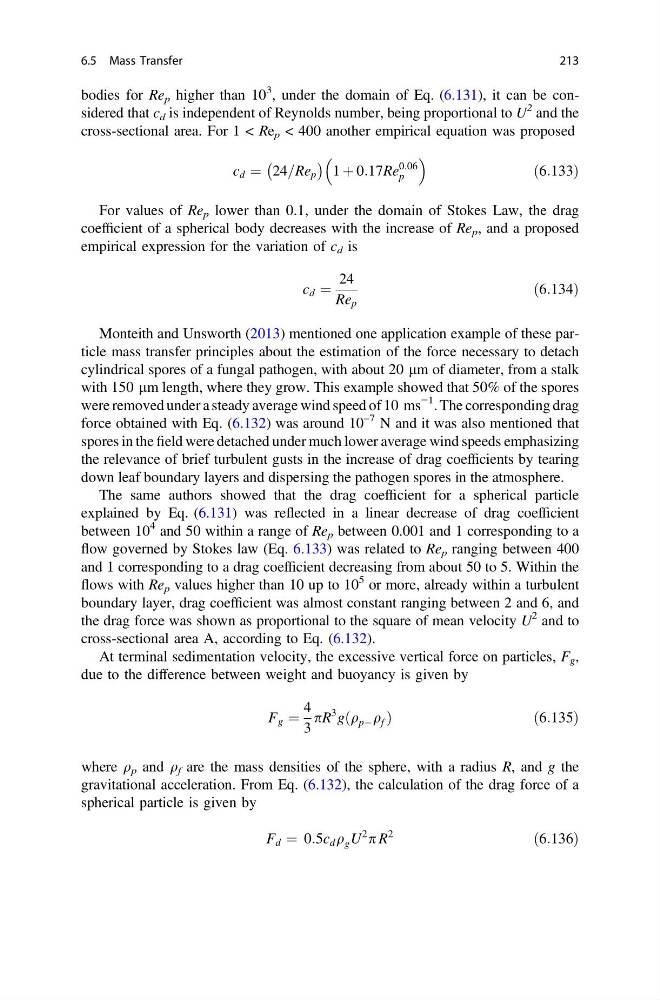
bodies for Re p higher than 10
3 , under the domain of Eq. (6.131), it can be considered that c d is independent of Reynolds number, being proportional to U
2 and the
cross-sectional area. For 1 < Re p < 400 another empirical equation was proposed
c d ¼ 24=Re p
À
Á 1 þ 0:17Re
0:06
p
ð6:133Þ
For values of Re p lower than 0.1, under the domain of Stokes Law, the drag
coefficient of a spherical body decreases with the increase of Re p , and a proposed
empirical expression for the variation of c d is
c d ¼
24
Re p
ð6:134Þ
Monteith and Unsworth (2013) mentioned one application example of these particle mass transfer principles about the estimation of the force necessary to detach
cylindrical spores of a fungal pathogen, with about 20 lm of diameter, from a stalk
with 150 lm length, where they grow. This example showed that 50% of the spores
were removed under a steady average wind speed of 10 ms
−1 . The corresponding drag
force obtained with Eq. (6.132) was around 10
–7 N and it was also mentioned that
spores in the field were detached under much lower average wind speeds emphasizing
the relevance of brief turbulent gusts in the increase of drag coefficients by tearing
down leaf boundary layers and dispersing the pathogen spores in the atmosphere.
The same authors showed that the drag coefficient for a spherical particle
explained by Eq. (6.131) was reflected in a linear decrease of drag coefficient
between 10
4 and 50 within a range of Re p between 0.001 and 1 corresponding to a
flow governed by Stokes law (Eq. 6.133) was related to Re p ranging between 400
and 1 corresponding to a drag coefficient decreasing from about 50 to 5. Within the
flows with Re p values higher than 10 up to 10
5 or more, already within a turbulent
boundary layer, drag coefficient was almost constant ranging between 2 and 6, and
the drag force was shown as proportional to the square of mean velocity U
2 and to
cross-sectional area A, according to Eq. (6.132).
At terminal sedimentation velocity, the excessive vertical force on particles, F g ,
due to the difference between weight and buoyancy is given by
F g ¼
4
3
pR
3 gðq pÀ q f Þ
ð 6:135Þ
where q p and q f are the mass densities of the sphere, with a radius R, and g the
gravitational acceleration. From Eq. (6.132), the calculation of the drag force of a
spherical particle is given by
F d ¼ 0:5c d q g U
2 p R
2
ð6:136Þ
6.5 Mass Transfer
213
3 , under the domain of Eq. (6.131), it can be considered that c d is independent of Reynolds number, being proportional to U
2 and the
cross-sectional area. For 1 < Re p < 400 another empirical equation was proposed
c d ¼ 24=Re p
À
Á 1 þ 0:17Re
0:06
p
ð6:133Þ
For values of Re p lower than 0.1, under the domain of Stokes Law, the drag
coefficient of a spherical body decreases with the increase of Re p , and a proposed
empirical expression for the variation of c d is
c d ¼
24
Re p
ð6:134Þ
Monteith and Unsworth (2013) mentioned one application example of these particle mass transfer principles about the estimation of the force necessary to detach
cylindrical spores of a fungal pathogen, with about 20 lm of diameter, from a stalk
with 150 lm length, where they grow. This example showed that 50% of the spores
were removed under a steady average wind speed of 10 ms
−1 . The corresponding drag
force obtained with Eq. (6.132) was around 10
–7 N and it was also mentioned that
spores in the field were detached under much lower average wind speeds emphasizing
the relevance of brief turbulent gusts in the increase of drag coefficients by tearing
down leaf boundary layers and dispersing the pathogen spores in the atmosphere.
The same authors showed that the drag coefficient for a spherical particle
explained by Eq. (6.131) was reflected in a linear decrease of drag coefficient
between 10
4 and 50 within a range of Re p between 0.001 and 1 corresponding to a
flow governed by Stokes law (Eq. 6.133) was related to Re p ranging between 400
and 1 corresponding to a drag coefficient decreasing from about 50 to 5. Within the
flows with Re p values higher than 10 up to 10
5 or more, already within a turbulent
boundary layer, drag coefficient was almost constant ranging between 2 and 6, and
the drag force was shown as proportional to the square of mean velocity U
2 and to
cross-sectional area A, according to Eq. (6.132).
At terminal sedimentation velocity, the excessive vertical force on particles, F g ,
due to the difference between weight and buoyancy is given by
F g ¼
4
3
pR
3 gðq pÀ q f Þ
ð 6:135Þ
where q p and q f are the mass densities of the sphere, with a radius R, and g the
gravitational acceleration. From Eq. (6.132), the calculation of the drag force of a
spherical particle is given by
F d ¼ 0:5c d q g U
2 p R
2
ð6:136Þ
6.5 Mass Transfer
213