

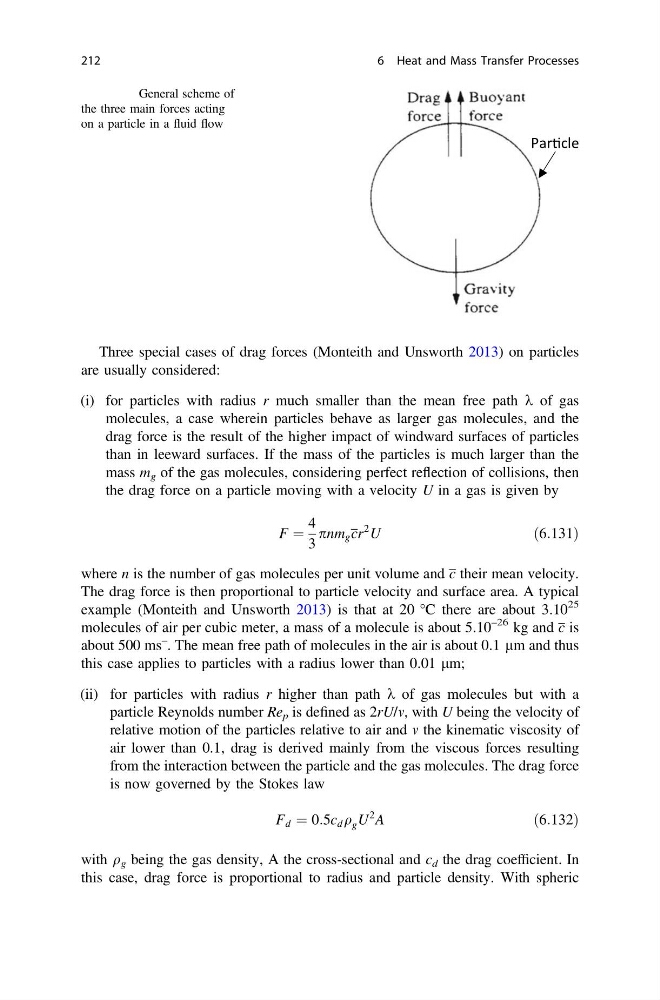
Three special cases of drag forces (Monteith and Unsworth 2013) on particles
are usually considered:
(i) for particles with radius r much smaller than the mean free path k of gas
molecules, a case wherein particles behave as larger gas molecules, and the
drag force is the result of the higher impact of windward surfaces of particles
than in leeward surfaces. If the mass of the particles is much larger than the
mass m g of the gas molecules, considering perfect reflection of collisions, then
the drag force on a particle moving with a velocity U in a gas is given by
F ¼
4
3
pnm g cr
2 U
ð6:131Þ
where n is the number of gas molecules per unit volume and c their mean velocity.
The drag force is then proportional to particle velocity and surface area. A typical
example (Monteith and Unsworth 2013) is that at 20 °C there are about 3.10
25
molecules of air per cubic meter, a mass of a molecule is about 5.10
–26 kg and c is
about 500 ms
– . The mean free path of molecules in the air is about 0.1 lm and thus
this case applies to particles with a radius lower than 0.01 lm;
(ii) for particles with radius r higher than path k of gas molecules but with a
particle Reynolds number Re p is defined as 2rU/m, with U being the velocity of
relative motion of the particles relative to air and m the kinematic viscosity of
air lower than 0.1, drag is derived mainly from the viscous forces resulting
from the interaction between the particle and the gas molecules. The drag force
is now governed by the Stokes law
F d ¼ 0:5c d q g U
2 A
ð6:132Þ
with q g being the gas density, A the cross-sectional and c d the drag coefficient. In
this case, drag force is proportional to radius and particle density. With spheric
ParƟcle
Fig. 6.12 General scheme of
the three main forces acting
on a particle in a fluid flow
212
6 Heat and Mass Transfer Processes
are usually considered:
(i) for particles with radius r much smaller than the mean free path k of gas
molecules, a case wherein particles behave as larger gas molecules, and the
drag force is the result of the higher impact of windward surfaces of particles
than in leeward surfaces. If the mass of the particles is much larger than the
mass m g of the gas molecules, considering perfect reflection of collisions, then
the drag force on a particle moving with a velocity U in a gas is given by
F ¼
4
3
pnm g cr
2 U
ð6:131Þ
where n is the number of gas molecules per unit volume and c their mean velocity.
The drag force is then proportional to particle velocity and surface area. A typical
example (Monteith and Unsworth 2013) is that at 20 °C there are about 3.10
25
molecules of air per cubic meter, a mass of a molecule is about 5.10
–26 kg and c is
about 500 ms
– . The mean free path of molecules in the air is about 0.1 lm and thus
this case applies to particles with a radius lower than 0.01 lm;
(ii) for particles with radius r higher than path k of gas molecules but with a
particle Reynolds number Re p is defined as 2rU/m, with U being the velocity of
relative motion of the particles relative to air and m the kinematic viscosity of
air lower than 0.1, drag is derived mainly from the viscous forces resulting
from the interaction between the particle and the gas molecules. The drag force
is now governed by the Stokes law
F d ¼ 0:5c d q g U
2 A
ð6:132Þ
with q g being the gas density, A the cross-sectional and c d the drag coefficient. In
this case, drag force is proportional to radius and particle density. With spheric
ParƟcle
Fig. 6.12 General scheme of
the three main forces acting
on a particle in a fluid flow
212
6 Heat and Mass Transfer Processes