

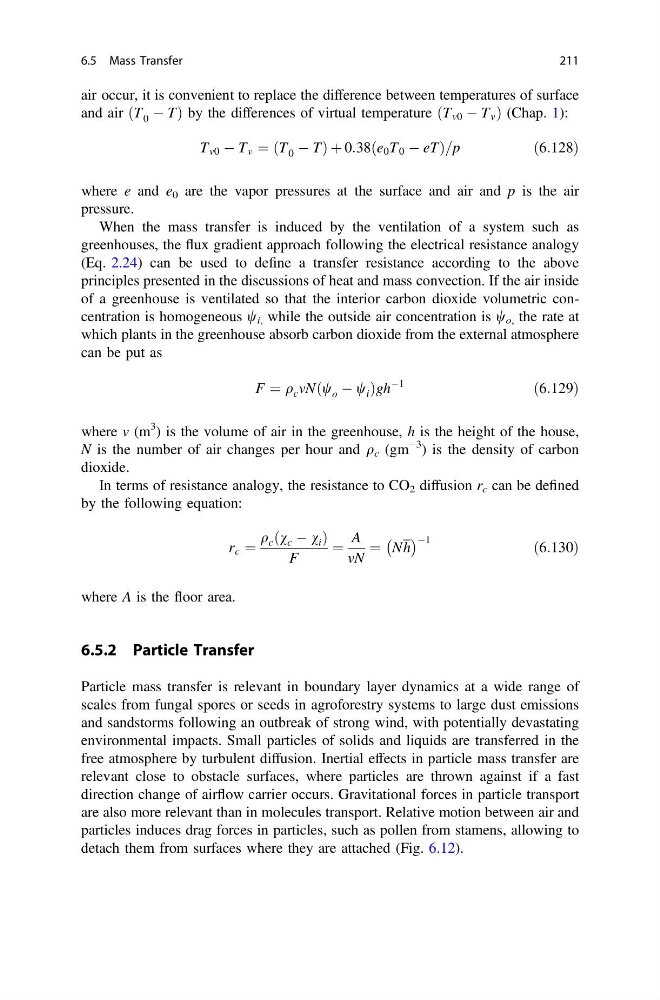
air occur, it is convenient to replace the difference between temperatures of surface
and air ðT 0 À TÞ by the differences of virtual temperature ðT v0 À T v Þ (Chap. 1):
T v0 À T v ¼ ðT 0 À TÞ þ 0:38ðe 0 T 0 À eTÞ=p
ð6:128Þ
where e and e 0 are the vapor pressures at the surface and air and p is the air
pressure.
When the mass transfer is induced by the ventilation of a system such as
greenhouses, the flux gradient approach following the electrical resistance analogy
(Eq. 2.24) can be used to define a transfer resistance according to the above
principles presented in the discussions of heat and mass convection. If the air inside
of a greenhouse is ventilated so that the interior carbon dioxide volumetric concentration is homogeneous w i, while the outside air concentration is w o, the rate at
which plants in the greenhouse absorb carbon dioxide from the external atmosphere
can be put as
F ¼ q c vNðw o À w i Þgh
À1
ð6:129Þ
where v (m
3 ) is the volume of air in the greenhouse, h is the height of the house,
N is the number of air changes per hour and q c (gm
−3 ) is the density of carbon
dioxide.
In terms of resistance analogy, the resistance to CO 2 diffusion r c can be defined
by the following equation:
r c ¼
q c v c À v i
ð
Þ
F
¼
A
vN
¼ Nh
À Á À1
ð6:130Þ
where A is the floor area.
6.5.2 Particle Transfer
Particle mass transfer is relevant in boundary layer dynamics at a wide range of
scales from fungal spores or seeds in agroforestry systems to large dust emissions
and sandstorms following an outbreak of strong wind, with potentially devastating
environmental impacts. Small particles of solids and liquids are transferred in the
free atmosphere by turbulent diffusion. Inertial effects in particle mass transfer are
relevant close to obstacle surfaces, where particles are thrown against if a fast
direction change of airflow carrier occurs. Gravitational forces in particle transport
are also more relevant than in molecules transport. Relative motion between air and
particles induces drag forces in particles, such as pollen from stamens, allowing to
detach them from surfaces where they are attached (Fig. 6.12).
6.5 Mass Transfer
211
and air ðT 0 À TÞ by the differences of virtual temperature ðT v0 À T v Þ (Chap. 1):
T v0 À T v ¼ ðT 0 À TÞ þ 0:38ðe 0 T 0 À eTÞ=p
ð6:128Þ
where e and e 0 are the vapor pressures at the surface and air and p is the air
pressure.
When the mass transfer is induced by the ventilation of a system such as
greenhouses, the flux gradient approach following the electrical resistance analogy
(Eq. 2.24) can be used to define a transfer resistance according to the above
principles presented in the discussions of heat and mass convection. If the air inside
of a greenhouse is ventilated so that the interior carbon dioxide volumetric concentration is homogeneous w i, while the outside air concentration is w o, the rate at
which plants in the greenhouse absorb carbon dioxide from the external atmosphere
can be put as
F ¼ q c vNðw o À w i Þgh
À1
ð6:129Þ
where v (m
3 ) is the volume of air in the greenhouse, h is the height of the house,
N is the number of air changes per hour and q c (gm
−3 ) is the density of carbon
dioxide.
In terms of resistance analogy, the resistance to CO 2 diffusion r c can be defined
by the following equation:
r c ¼
q c v c À v i
ð
Þ
F
¼
A
vN
¼ Nh
À Á À1
ð6:130Þ
where A is the floor area.
6.5.2 Particle Transfer
Particle mass transfer is relevant in boundary layer dynamics at a wide range of
scales from fungal spores or seeds in agroforestry systems to large dust emissions
and sandstorms following an outbreak of strong wind, with potentially devastating
environmental impacts. Small particles of solids and liquids are transferred in the
free atmosphere by turbulent diffusion. Inertial effects in particle mass transfer are
relevant close to obstacle surfaces, where particles are thrown against if a fast
direction change of airflow carrier occurs. Gravitational forces in particle transport
are also more relevant than in molecules transport. Relative motion between air and
particles induces drag forces in particles, such as pollen from stamens, allowing to
detach them from surfaces where they are attached (Fig. 6.12).
6.5 Mass Transfer
211