

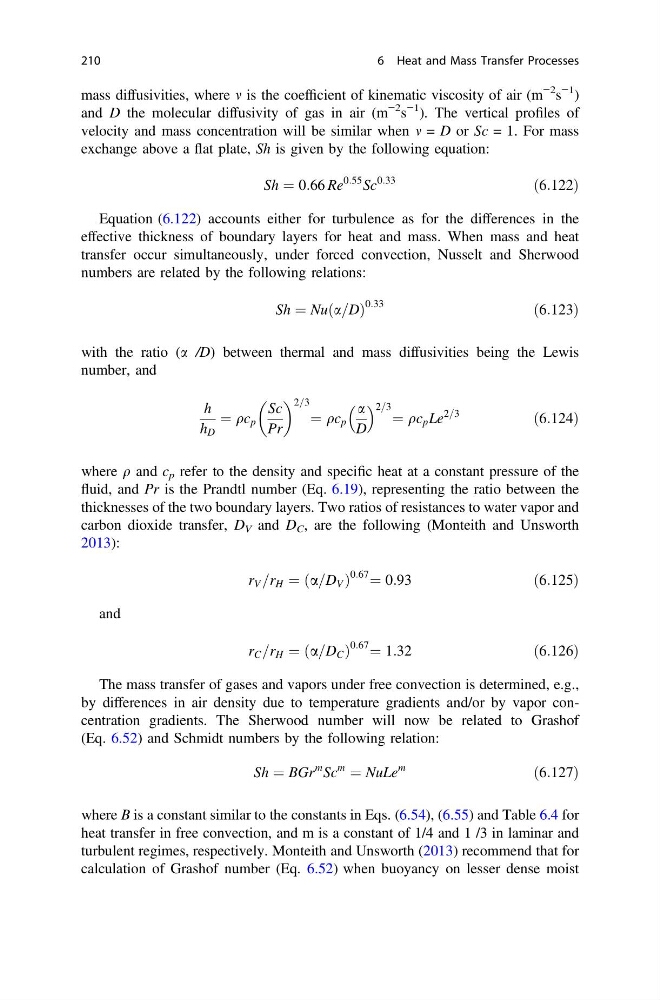
mass diffusivities, where m is the coefficient of kinematic viscosity of air (m
−2 s
−1 )
and D the molecular diffusivity of gas in air (m
−2 s
−1 ). The vertical profiles of
velocity and mass concentration will be similar when m = D or Sc = 1. For mass
exchange above a flat plate, Sh is given by the following equation:
Sh ¼ 0:66 Re
0:55 Sc
0:33
ð6:122Þ
Equation (6.122) accounts either for turbulence as for the differences in the
effective thickness of boundary layers for heat and mass. When mass and heat
transfer occur simultaneously, under forced convection, Nusselt and Sherwood
numbers are related by the following relations:
Sh ¼ Nuða=DÞ
0:33
ð6:123Þ
with the ratio (a /D) between thermal and mass diffusivities being the Lewis
number, and
h
h D
¼ qc p
Sc
Pr
2=3
¼ qc p
a
D
2=3 ¼ qc p Le
2=3
ð6:124Þ
where q and c p refer to the density and specific heat at a constant pressure of the
fluid, and Pr is the Prandtl number (Eq. 6.19), representing the ratio between the
thicknesses of the two boundary layers. Two ratios of resistances to water vapor and
carbon dioxide transfer, D V and D C , are the following (Monteith and Unsworth
2013):
r V =r H ¼ a=D V
ð
Þ
0:67 ¼ 0:93
ð6:125Þ
and
r C =r H ¼ a=D C
ð
Þ
0:67 ¼ 1:32
ð6:126Þ
The mass transfer of gases and vapors under free convection is determined, e.g.,
by differences in air density due to temperature gradients and/or by vapor concentration gradients. The Sherwood number will now be related to Grashof
(Eq. 6.52) and Schmidt numbers by the following relation:
Sh ¼ BGr
m Sc
m
¼ NuLe
m
ð6:127Þ
where B is a constant similar to the constants in Eqs. (6.54), (6.55) and Table 6.4 for
heat transfer in free convection, and m is a constant of 1/4 and 1 /3 in laminar and
turbulent regimes, respectively. Monteith and Unsworth (2013) recommend that for
calculation of Grashof number (Eq. 6.52) when buoyancy on lesser dense moist
210
6 Heat and Mass Transfer Processes
−2 s
−1 )
and D the molecular diffusivity of gas in air (m
−2 s
−1 ). The vertical profiles of
velocity and mass concentration will be similar when m = D or Sc = 1. For mass
exchange above a flat plate, Sh is given by the following equation:
Sh ¼ 0:66 Re
0:55 Sc
0:33
ð6:122Þ
Equation (6.122) accounts either for turbulence as for the differences in the
effective thickness of boundary layers for heat and mass. When mass and heat
transfer occur simultaneously, under forced convection, Nusselt and Sherwood
numbers are related by the following relations:
Sh ¼ Nuða=DÞ
0:33
ð6:123Þ
with the ratio (a /D) between thermal and mass diffusivities being the Lewis
number, and
h
h D
¼ qc p
Sc
Pr
2=3
¼ qc p
a
D
2=3 ¼ qc p Le
2=3
ð6:124Þ
where q and c p refer to the density and specific heat at a constant pressure of the
fluid, and Pr is the Prandtl number (Eq. 6.19), representing the ratio between the
thicknesses of the two boundary layers. Two ratios of resistances to water vapor and
carbon dioxide transfer, D V and D C , are the following (Monteith and Unsworth
2013):
r V =r H ¼ a=D V
ð
Þ
0:67 ¼ 0:93
ð6:125Þ
and
r C =r H ¼ a=D C
ð
Þ
0:67 ¼ 1:32
ð6:126Þ
The mass transfer of gases and vapors under free convection is determined, e.g.,
by differences in air density due to temperature gradients and/or by vapor concentration gradients. The Sherwood number will now be related to Grashof
(Eq. 6.52) and Schmidt numbers by the following relation:
Sh ¼ BGr
m Sc
m
¼ NuLe
m
ð6:127Þ
where B is a constant similar to the constants in Eqs. (6.54), (6.55) and Table 6.4 for
heat transfer in free convection, and m is a constant of 1/4 and 1 /3 in laminar and
turbulent regimes, respectively. Monteith and Unsworth (2013) recommend that for
calculation of Grashof number (Eq. 6.52) when buoyancy on lesser dense moist
210
6 Heat and Mass Transfer Processes