

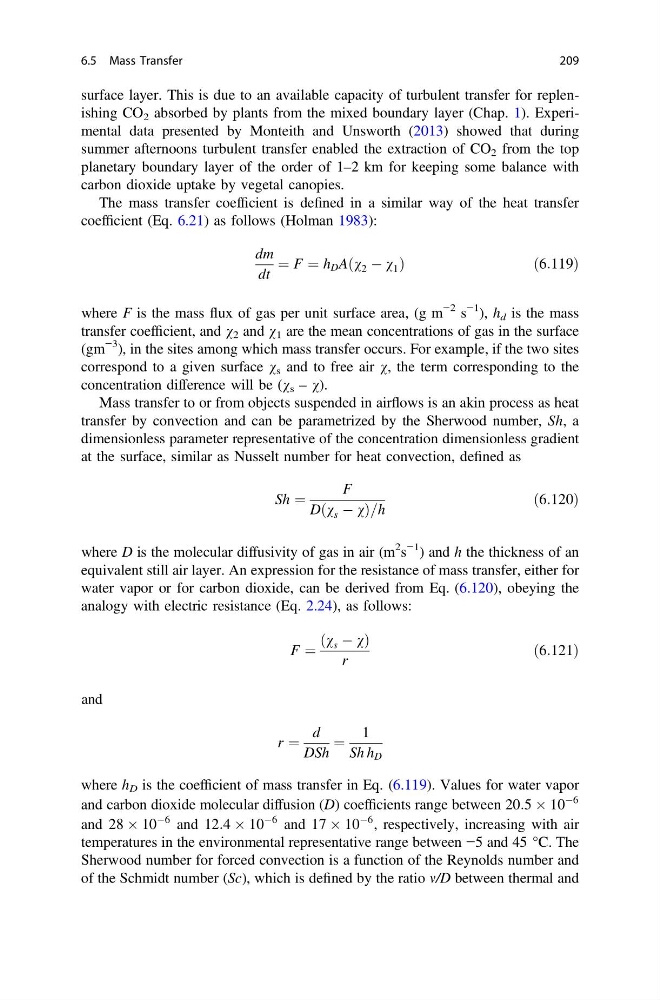
surface layer. This is due to an available capacity of turbulent transfer for replenishing CO 2 absorbed by plants from the mixed boundary layer (Chap. 1). Experimental data presented by Monteith and Unsworth (2013) showed that during
summer afternoons turbulent transfer enabled the extraction of CO 2 from the top
planetary boundary layer of the order of 1–2 km for keeping some balance with
carbon dioxide uptake by vegetal canopies.
The mass transfer coefficient is defined in a similar way of the heat transfer
coefficient (Eq. 6.21) as follows (Holman 1983):
dm
dt
¼ F ¼ h D Aðv 2 À v 1 Þ
ð 6:119Þ
where F is the mass flux of gas per unit surface area, (g m
−2 s
−1 ), h d is the mass
transfer coefficient, and v 2 and v 1 are the mean concentrations of gas in the surface
(gm
−3 ), in the sites among which mass transfer occurs. For example, if the two sites
correspond to a given surface v s and to free air v, the term corresponding to the
concentration difference will be (v s – v).
Mass transfer to or from objects suspended in airflows is an akin process as heat
transfer by convection and can be parametrized by the Sherwood number, Sh, a
dimensionless parameter representative of the concentration dimensionless gradient
at the surface, similar as Nusselt number for heat convection, defined as
Sh ¼
F
D v s À v
ð
Þ=h
ð6:120Þ
where D is the molecular diffusivity of gas in air (m
2 s
−1 ) and h the thickness of an
equivalent still air layer. An expression for the resistance of mass transfer, either for
water vapor or for carbon dioxide, can be derived from Eq. (6.120), obeying the
analogy with electric resistance (Eq. 2.24), as follows:
F ¼
v s À v
ð
Þ
r
ð6:121Þ
and
r ¼
d
DSh
¼
1
Sh h D
where h D is the coefficient of mass transfer in Eq. (6.119). Values for water vapor
and carbon dioxide molecular diffusion (D) coefficients range between 20:5 Â 10
À6
and 28 Â 10
À6 and 12:4 Â 10
À6 and 17 Â 10
À6 , respectively, increasing with air
temperatures in the environmental representative range between −5 and 45 °C. The
Sherwood number for forced convection is a function of the Reynolds number and
of the Schmidt number (Sc), which is defined by the ratio m/D between thermal and
6.5 Mass Transfer
209
summer afternoons turbulent transfer enabled the extraction of CO 2 from the top
planetary boundary layer of the order of 1–2 km for keeping some balance with
carbon dioxide uptake by vegetal canopies.
The mass transfer coefficient is defined in a similar way of the heat transfer
coefficient (Eq. 6.21) as follows (Holman 1983):
dm
dt
¼ F ¼ h D Aðv 2 À v 1 Þ
ð 6:119Þ
where F is the mass flux of gas per unit surface area, (g m
−2 s
−1 ), h d is the mass
transfer coefficient, and v 2 and v 1 are the mean concentrations of gas in the surface
(gm
−3 ), in the sites among which mass transfer occurs. For example, if the two sites
correspond to a given surface v s and to free air v, the term corresponding to the
concentration difference will be (v s – v).
Mass transfer to or from objects suspended in airflows is an akin process as heat
transfer by convection and can be parametrized by the Sherwood number, Sh, a
dimensionless parameter representative of the concentration dimensionless gradient
at the surface, similar as Nusselt number for heat convection, defined as
Sh ¼
F
D v s À v
ð
Þ=h
ð6:120Þ
where D is the molecular diffusivity of gas in air (m
2 s
−1 ) and h the thickness of an
equivalent still air layer. An expression for the resistance of mass transfer, either for
water vapor or for carbon dioxide, can be derived from Eq. (6.120), obeying the
analogy with electric resistance (Eq. 2.24), as follows:
F ¼
v s À v
ð
Þ
r
ð6:121Þ
and
r ¼
d
DSh
¼
1
Sh h D
where h D is the coefficient of mass transfer in Eq. (6.119). Values for water vapor
and carbon dioxide molecular diffusion (D) coefficients range between 20:5 Â 10
À6
and 28 Â 10
À6 and 12:4 Â 10
À6 and 17 Â 10
À6 , respectively, increasing with air
temperatures in the environmental representative range between −5 and 45 °C. The
Sherwood number for forced convection is a function of the Reynolds number and
of the Schmidt number (Sc), which is defined by the ratio m/D between thermal and
6.5 Mass Transfer
209