

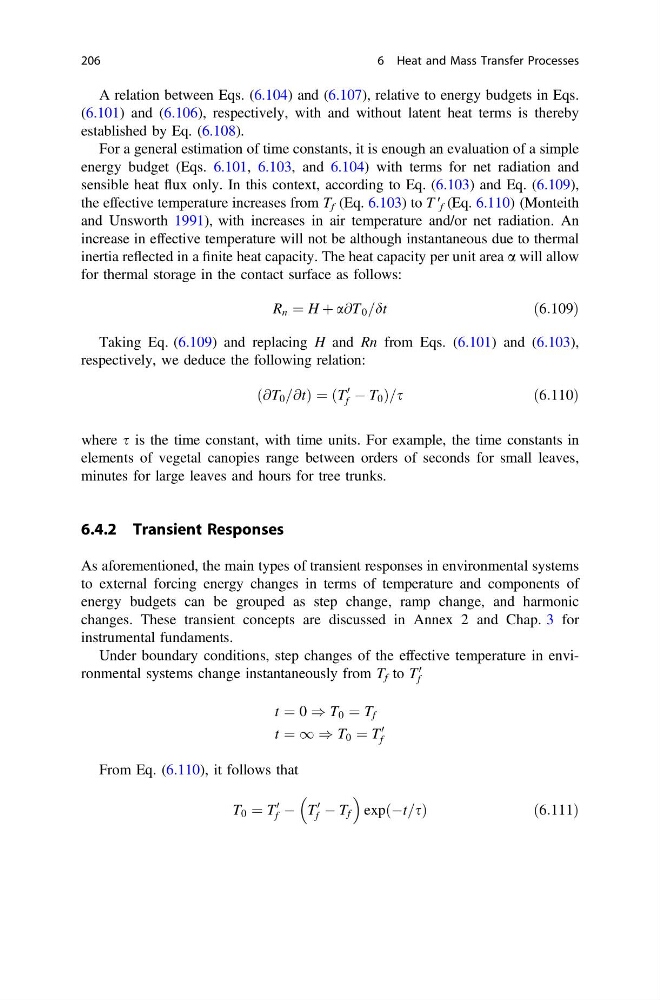
A relation between Eqs. (6.104) and (6.107), relative to energy budgets in Eqs.
(6.101) and (6.106), respectively, with and without latent heat terms is thereby
established by Eq. (6.108).
For a general estimation of time constants, it is enough an evaluation of a simple
energy budget (Eqs. 6.101, 6.103, and 6.104) with terms for net radiation and
sensible heat flux only. In this context, according to Eq. (6.103) and Eq. (6.109),
the effective temperature increases from T f (Eq. 6.103) to T ′ f (Eq. 6.110) (Monteith
and Unsworth 1991), with increases in air temperature and/or net radiation. An
increase in effective temperature will not be although instantaneous due to thermal
inertia reflected in a finite heat capacity. The heat capacity per unit area a will allow
for thermal storage in the contact surface as follows:
R n ¼ H þ a@T 0 =dt
ð6:109Þ
Taking Eq. (6.109) and replacing H and Rn from Eqs. (6.101) and (6.103),
respectively, we deduce the following relation:
@T 0 =@t
ð
Þ¼ðT
0
f À T 0 Þ=s
ð6:110Þ
where s is the time constant, with time units. For example, the time constants in
elements of vegetal canopies range between orders of seconds for small leaves,
minutes for large leaves and hours for tree trunks.
6.4.2 Transient Responses
As aforementioned, the main types of transient responses in environmental systems
to external forcing energy changes in terms of temperature and components of
energy budgets can be grouped as step change, ramp change, and harmonic
changes. These transient concepts are discussed in Annex 2 and Chap. 3 for
instrumental fundaments.
Under boundary conditions, step changes of the effective temperature in environmental systems change instantaneously from T f to T
0
f
t ¼ 0 ) T 0 ¼ T f
t ¼ 1 ) T 0 ¼ T
0
f
From Eq. (6.110), it follows that
T 0 ¼ T
0
f À T
0
f À T f
expðÀt=sÞ
ð 6:111Þ
206
6 Heat and Mass Transfer Processes
(6.101) and (6.106), respectively, with and without latent heat terms is thereby
established by Eq. (6.108).
For a general estimation of time constants, it is enough an evaluation of a simple
energy budget (Eqs. 6.101, 6.103, and 6.104) with terms for net radiation and
sensible heat flux only. In this context, according to Eq. (6.103) and Eq. (6.109),
the effective temperature increases from T f (Eq. 6.103) to T ′ f (Eq. 6.110) (Monteith
and Unsworth 1991), with increases in air temperature and/or net radiation. An
increase in effective temperature will not be although instantaneous due to thermal
inertia reflected in a finite heat capacity. The heat capacity per unit area a will allow
for thermal storage in the contact surface as follows:
R n ¼ H þ a@T 0 =dt
ð6:109Þ
Taking Eq. (6.109) and replacing H and Rn from Eqs. (6.101) and (6.103),
respectively, we deduce the following relation:
@T 0 =@t
ð
Þ¼ðT
0
f À T 0 Þ=s
ð6:110Þ
where s is the time constant, with time units. For example, the time constants in
elements of vegetal canopies range between orders of seconds for small leaves,
minutes for large leaves and hours for tree trunks.
6.4.2 Transient Responses
As aforementioned, the main types of transient responses in environmental systems
to external forcing energy changes in terms of temperature and components of
energy budgets can be grouped as step change, ramp change, and harmonic
changes. These transient concepts are discussed in Annex 2 and Chap. 3 for
instrumental fundaments.
Under boundary conditions, step changes of the effective temperature in environmental systems change instantaneously from T f to T
0
f
t ¼ 0 ) T 0 ¼ T f
t ¼ 1 ) T 0 ¼ T
0
f
From Eq. (6.110), it follows that
T 0 ¼ T
0
f À T
0
f À T f
expðÀt=sÞ
ð 6:111Þ
206
6 Heat and Mass Transfer Processes