

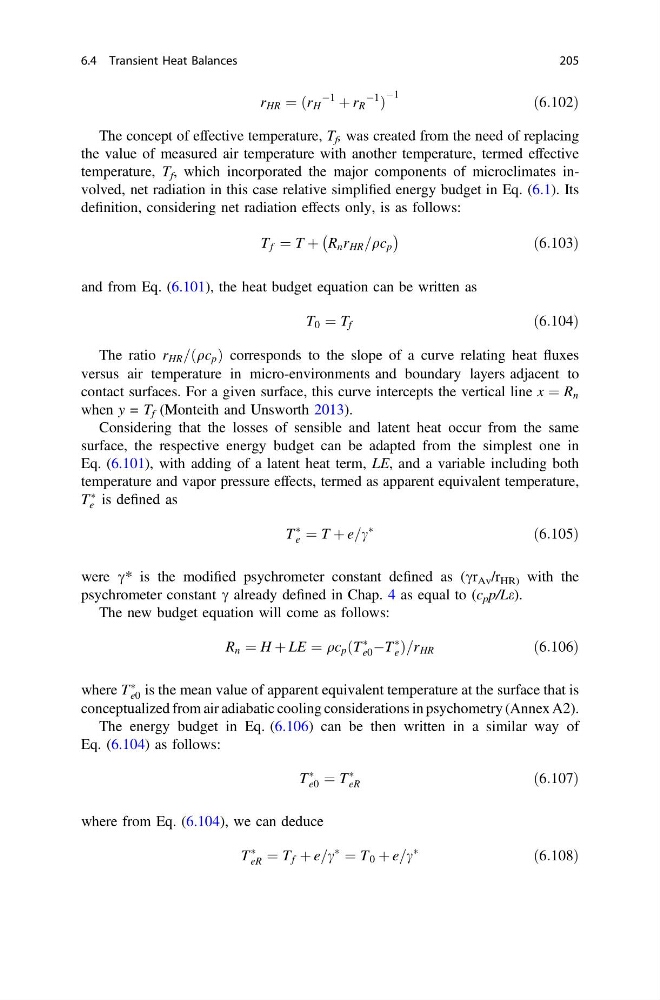
r HR ¼ ðr H
À1
þ r R
À1
Þ
À1
ð6:102Þ
The concept of effective temperature, T f , was created from the need of replacing
the value of measured air temperature with another temperature, termed effective
temperature, T f , which incorporated the major components of microclimates involved, net radiation in this case relative simplified energy budget in Eq. (6.1). Its
definition, considering net radiation effects only, is as follows:
T f ¼ T þ R n r HR =qc p
À
Á
ð6:103Þ
and from Eq. (6.101), the heat budget equation can be written as
T 0 ¼ T f
ð6:104Þ
The ratio r HR =ðqc p Þ corresponds to the slope of a curve relating heat fluxes
versus air temperature in micro-environments and boundary layers adjacent to
contact surfaces. For a given surface, this curve intercepts the vertical line x ¼ R n
when y = T f (Monteith and Unsworth 2013).
Considering that the losses of sensible and latent heat occur from the same
surface, the respective energy budget can be adapted from the simplest one in
Eq. (6.101), with adding of a latent heat term, LE, and a variable including both
temperature and vapor pressure effects, termed as apparent equivalent temperature,
T
Ã
e is defined as
T
Ã
e ¼ T þ e=c
Ã
ð6:105Þ
were c* is the modified psychrometer constant defined as (cr Av /r HR) with the
psychrometer constant c already defined in Chap. 4 as equal to (c p p/Le).
The new budget equation will come as follows:
R n ¼ H þ LE ¼ qc p ðT
Ã
e0 ÀT
Ã
e Þ=r HR
ð6:106Þ
where T
Ã
e0 is the mean value of apparent equivalent temperature at the surface that is
conceptualized from air adiabatic cooling considerations in psychometry (Annex A2).
The energy budget in Eq. (6.106) can be then written in a similar way of
Eq. (6.104) as follows:
T
Ã
e0 ¼ T
Ã
eR
ð6:107Þ
where from Eq. (6.104), we can deduce
T
Ã
eR ¼ T f þ e=c
Ã
¼ T 0 þ e=c
Ã
ð6:108Þ
6.4 Transient Heat Balances
205
À1
þ r R
À1
Þ
À1
ð6:102Þ
The concept of effective temperature, T f , was created from the need of replacing
the value of measured air temperature with another temperature, termed effective
temperature, T f , which incorporated the major components of microclimates involved, net radiation in this case relative simplified energy budget in Eq. (6.1). Its
definition, considering net radiation effects only, is as follows:
T f ¼ T þ R n r HR =qc p
À
Á
ð6:103Þ
and from Eq. (6.101), the heat budget equation can be written as
T 0 ¼ T f
ð6:104Þ
The ratio r HR =ðqc p Þ corresponds to the slope of a curve relating heat fluxes
versus air temperature in micro-environments and boundary layers adjacent to
contact surfaces. For a given surface, this curve intercepts the vertical line x ¼ R n
when y = T f (Monteith and Unsworth 2013).
Considering that the losses of sensible and latent heat occur from the same
surface, the respective energy budget can be adapted from the simplest one in
Eq. (6.101), with adding of a latent heat term, LE, and a variable including both
temperature and vapor pressure effects, termed as apparent equivalent temperature,
T
Ã
e is defined as
T
Ã
e ¼ T þ e=c
Ã
ð6:105Þ
were c* is the modified psychrometer constant defined as (cr Av /r HR) with the
psychrometer constant c already defined in Chap. 4 as equal to (c p p/Le).
The new budget equation will come as follows:
R n ¼ H þ LE ¼ qc p ðT
Ã
e0 ÀT
Ã
e Þ=r HR
ð6:106Þ
where T
Ã
e0 is the mean value of apparent equivalent temperature at the surface that is
conceptualized from air adiabatic cooling considerations in psychometry (Annex A2).
The energy budget in Eq. (6.106) can be then written in a similar way of
Eq. (6.104) as follows:
T
Ã
e0 ¼ T
Ã
eR
ð6:107Þ
where from Eq. (6.104), we can deduce
T
Ã
eR ¼ T f þ e=c
Ã
¼ T 0 þ e=c
Ã
ð6:108Þ
6.4 Transient Heat Balances
205