

walls to prevent frost deposition in the valleys. Frost-resistant fruit trees should be
cultivated in the lowest areas of slopes more prone to cold and frost formation (Foken 2017).
6.4 Transient Heat Balances
6.4.1 The Concept of Time Constant
Heat transmission mechanisms involving conduction, convection, and radiation are
key physical processes for heat exchange between constitutive elements in environmental systems. These mechanisms are closely interconnected with the components of the energy balance, and especially with the most relevant, such as latent
and sensible heat fluxes, net radiation and heat fluxes, and energy storage in soils or
animals or heat production by metabolism in animals.
Heat transfer in natural and modified environments is also a non-equilibrium
transient process wherein thermal inertia imposes a time lag, usually termed as the
time constant, between energy outputs and inputs and temperature changes of
bodies at different energy levels.
The transient energy transfer processes can be simplistically grouped and described as step changes, ramp change, and harmonic oscillations. The latter was discussed
above within the process of heat transfer in soil through thermal conduction
(Sect. 6.1.3) and thus only step and ramp changes will be shortly evaluated below.
As examples of environmental lagged responses, figure diurnal and seasonal
changes of ambient temperatures, following the pattern of solar radiation superimposed with shorter-term fluctuations associated with cloudiness and turbulence.
Oscillations in energy budget components occur also in the biosphere, with sinusoidal
variations of heat sinking during heating periods (daytime, summer) alternating with
similar variations of heat sourcing during the colder periods (night, winter). Surface
organic and inorganic materials can thus act as transient thermal reservoirs which
attenuate the atmosphere’s physical variations near the ground. Also, in the biosphere,
while plants and cold-blooded animals with internal energy production can work as
passive conductors, warm-blooded animals generate large amounts of internal energy
and can, in principle, provide thermal energy to the environment (Lee 1978).
For evaluation of time constant meaning in environmental systems, a simple case
of energy budget composed only by net radiation and sensible heat fluxes can be
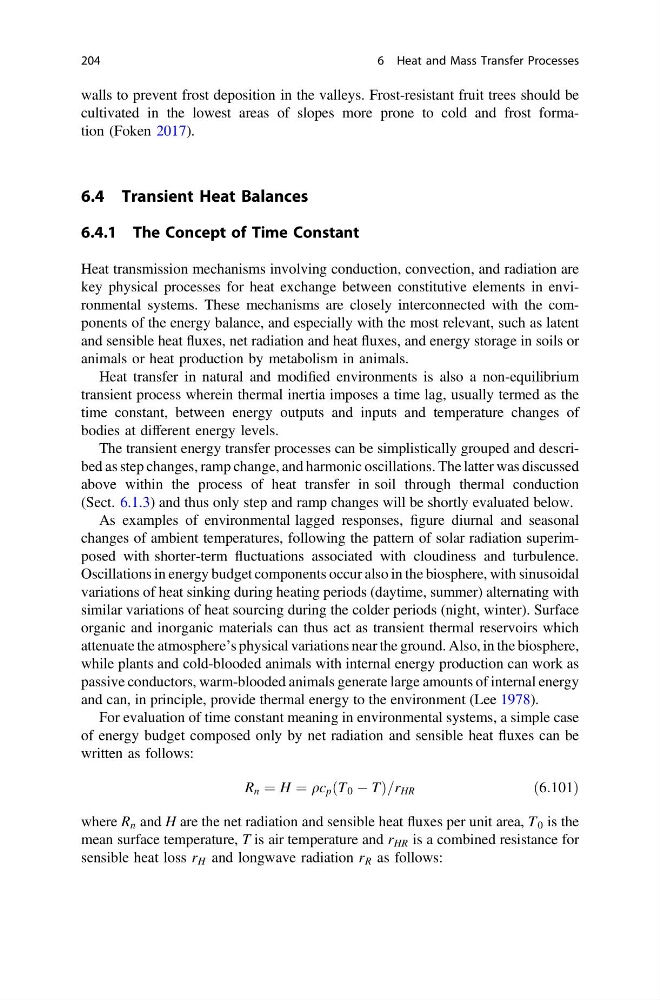
written as follows:
R n ¼ H ¼ qc p ðT 0 À TÞ=r HR
ð6:101Þ
where R n and H are the net radiation and sensible heat fluxes per unit area, T 0 is the
mean surface temperature, T is air temperature and r HR is a combined resistance for
sensible heat loss r H and longwave radiation r R as follows:
204
6 Heat and Mass Transfer Processes
cultivated in the lowest areas of slopes more prone to cold and frost formation (Foken 2017).
6.4 Transient Heat Balances
6.4.1 The Concept of Time Constant
Heat transmission mechanisms involving conduction, convection, and radiation are
key physical processes for heat exchange between constitutive elements in environmental systems. These mechanisms are closely interconnected with the components of the energy balance, and especially with the most relevant, such as latent
and sensible heat fluxes, net radiation and heat fluxes, and energy storage in soils or
animals or heat production by metabolism in animals.
Heat transfer in natural and modified environments is also a non-equilibrium
transient process wherein thermal inertia imposes a time lag, usually termed as the
time constant, between energy outputs and inputs and temperature changes of
bodies at different energy levels.
The transient energy transfer processes can be simplistically grouped and described as step changes, ramp change, and harmonic oscillations. The latter was discussed
above within the process of heat transfer in soil through thermal conduction
(Sect. 6.1.3) and thus only step and ramp changes will be shortly evaluated below.
As examples of environmental lagged responses, figure diurnal and seasonal
changes of ambient temperatures, following the pattern of solar radiation superimposed with shorter-term fluctuations associated with cloudiness and turbulence.
Oscillations in energy budget components occur also in the biosphere, with sinusoidal
variations of heat sinking during heating periods (daytime, summer) alternating with
similar variations of heat sourcing during the colder periods (night, winter). Surface
organic and inorganic materials can thus act as transient thermal reservoirs which
attenuate the atmosphere’s physical variations near the ground. Also, in the biosphere,
while plants and cold-blooded animals with internal energy production can work as
passive conductors, warm-blooded animals generate large amounts of internal energy
and can, in principle, provide thermal energy to the environment (Lee 1978).
For evaluation of time constant meaning in environmental systems, a simple case
of energy budget composed only by net radiation and sensible heat fluxes can be
written as follows:
R n ¼ H ¼ qc p ðT 0 À TÞ=r HR
ð6:101Þ
where R n and H are the net radiation and sensible heat fluxes per unit area, T 0 is the
mean surface temperature, T is air temperature and r HR is a combined resistance for
sensible heat loss r H and longwave radiation r R as follows:
204
6 Heat and Mass Transfer Processes