

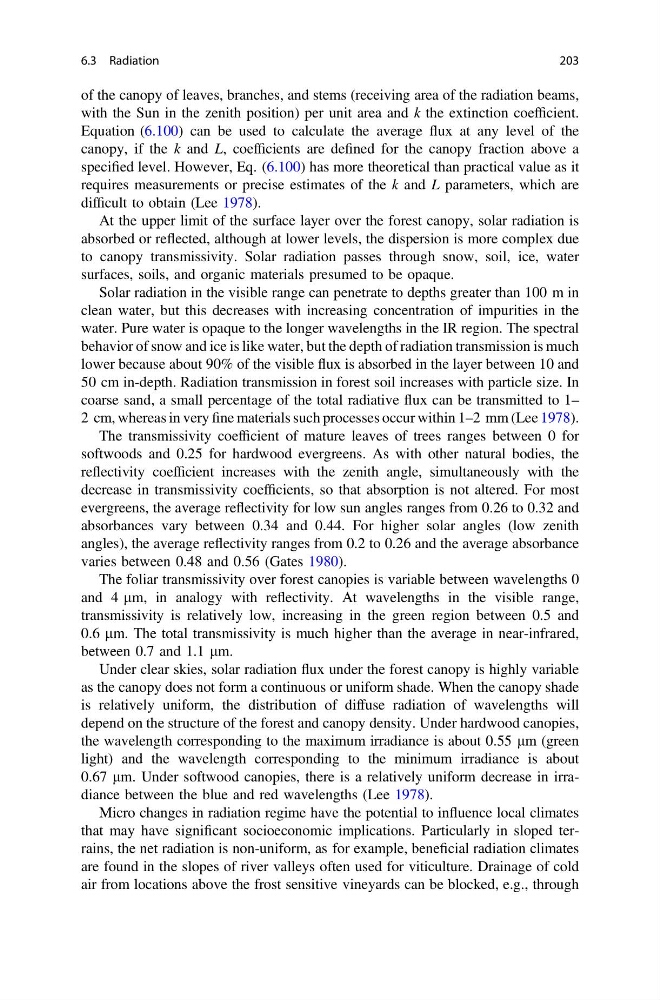
of the canopy of leaves, branches, and stems (receiving area of the radiation beams,
with the Sun in the zenith position) per unit area and k the extinction coefficient.
Equation (6.100) can be used to calculate the average flux at any level of the
canopy, if the k and L, coefficients are defined for the canopy fraction above a
specified level. However, Eq. (6.100) has more theoretical than practical value as it
requires measurements or precise estimates of the k and L parameters, which are
difficult to obtain (Lee 1978).
At the upper limit of the surface layer over the forest canopy, solar radiation is
absorbed or reflected, although at lower levels, the dispersion is more complex due
to canopy transmissivity. Solar radiation passes through snow, soil, ice, water
surfaces, soils, and organic materials presumed to be opaque.
Solar radiation in the visible range can penetrate to depths greater than 100 m in
clean water, but this decreases with increasing concentration of impurities in the
water. Pure water is opaque to the longer wavelengths in the IR region. The spectral
behavior of snow and ice is like water, but the depth of radiation transmission is much
lower because about 90% of the visible flux is absorbed in the layer between 10 and
50 cm in-depth. Radiation transmission in forest soil increases with particle size. In
coarse sand, a small percentage of the total radiative flux can be transmitted to 1–
2 cm, whereas in very fine materials such processes occur within 1–2 mm (Lee 1978).
The transmissivity coefficient of mature leaves of trees ranges between 0 for
softwoods and 0.25 for hardwood evergreens. As with other natural bodies, the
reflectivity coefficient increases with the zenith angle, simultaneously with the
decrease in transmissivity coefficients, so that absorption is not altered. For most
evergreens, the average reflectivity for low sun angles ranges from 0.26 to 0.32 and
absorbances vary between 0.34 and 0.44. For higher solar angles (low zenith
angles), the average reflectivity ranges from 0.2 to 0.26 and the average absorbance
varies between 0.48 and 0.56 (Gates 1980).
The foliar transmissivity over forest canopies is variable between wavelengths 0
and 4 lm, in analogy with reflectivity. At wavelengths in the visible range,
transmissivity is relatively low, increasing in the green region between 0.5 and
0.6 lm. The total transmissivity is much higher than the average in near-infrared,
between 0.7 and 1.1 lm.
Under clear skies, solar radiation flux under the forest canopy is highly variable
as the canopy does not form a continuous or uniform shade. When the canopy shade
is relatively uniform, the distribution of diffuse radiation of wavelengths will
depend on the structure of the forest and canopy density. Under hardwood canopies,
the wavelength corresponding to the maximum irradiance is about 0.55 lm (green
light) and the wavelength corresponding to the minimum irradiance is about
0.67 lm. Under softwood canopies, there is a relatively uniform decrease in irradiance between the blue and red wavelengths (Lee 1978).
Micro changes in radiation regime have the potential to influence local climates
that may have significant socioeconomic implications. Particularly in sloped terrains, the net radiation is non-uniform, as for example, beneficial radiation climates
are found in the slopes of river valleys often used for viticulture. Drainage of cold
air from locations above the frost sensitive vineyards can be blocked, e.g., through
6.3 Radiation
203
with the Sun in the zenith position) per unit area and k the extinction coefficient.
Equation (6.100) can be used to calculate the average flux at any level of the
canopy, if the k and L, coefficients are defined for the canopy fraction above a
specified level. However, Eq. (6.100) has more theoretical than practical value as it
requires measurements or precise estimates of the k and L parameters, which are
difficult to obtain (Lee 1978).
At the upper limit of the surface layer over the forest canopy, solar radiation is
absorbed or reflected, although at lower levels, the dispersion is more complex due
to canopy transmissivity. Solar radiation passes through snow, soil, ice, water
surfaces, soils, and organic materials presumed to be opaque.
Solar radiation in the visible range can penetrate to depths greater than 100 m in
clean water, but this decreases with increasing concentration of impurities in the
water. Pure water is opaque to the longer wavelengths in the IR region. The spectral
behavior of snow and ice is like water, but the depth of radiation transmission is much
lower because about 90% of the visible flux is absorbed in the layer between 10 and
50 cm in-depth. Radiation transmission in forest soil increases with particle size. In
coarse sand, a small percentage of the total radiative flux can be transmitted to 1–
2 cm, whereas in very fine materials such processes occur within 1–2 mm (Lee 1978).
The transmissivity coefficient of mature leaves of trees ranges between 0 for
softwoods and 0.25 for hardwood evergreens. As with other natural bodies, the
reflectivity coefficient increases with the zenith angle, simultaneously with the
decrease in transmissivity coefficients, so that absorption is not altered. For most
evergreens, the average reflectivity for low sun angles ranges from 0.26 to 0.32 and
absorbances vary between 0.34 and 0.44. For higher solar angles (low zenith
angles), the average reflectivity ranges from 0.2 to 0.26 and the average absorbance
varies between 0.48 and 0.56 (Gates 1980).
The foliar transmissivity over forest canopies is variable between wavelengths 0
and 4 lm, in analogy with reflectivity. At wavelengths in the visible range,
transmissivity is relatively low, increasing in the green region between 0.5 and
0.6 lm. The total transmissivity is much higher than the average in near-infrared,
between 0.7 and 1.1 lm.
Under clear skies, solar radiation flux under the forest canopy is highly variable
as the canopy does not form a continuous or uniform shade. When the canopy shade
is relatively uniform, the distribution of diffuse radiation of wavelengths will
depend on the structure of the forest and canopy density. Under hardwood canopies,
the wavelength corresponding to the maximum irradiance is about 0.55 lm (green
light) and the wavelength corresponding to the minimum irradiance is about
0.67 lm. Under softwood canopies, there is a relatively uniform decrease in irradiance between the blue and red wavelengths (Lee 1978).
Micro changes in radiation regime have the potential to influence local climates
that may have significant socioeconomic implications. Particularly in sloped terrains, the net radiation is non-uniform, as for example, beneficial radiation climates
are found in the slopes of river valleys often used for viticulture. Drainage of cold
air from locations above the frost sensitive vineyards can be blocked, e.g., through
6.3 Radiation
203