

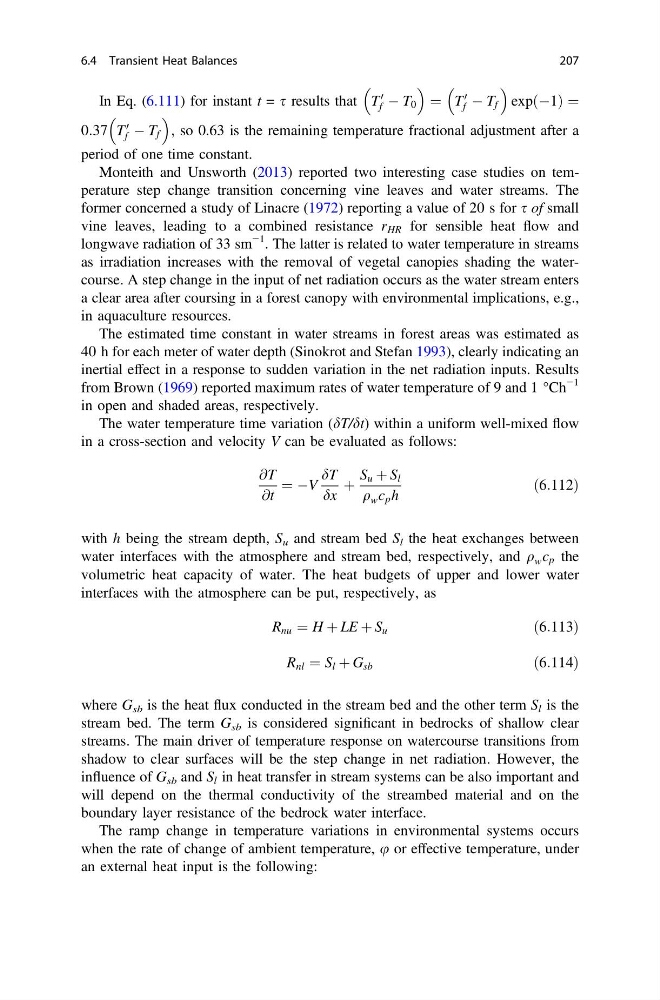
In Eq. (6.111) for instant t = s results that T
0
f À T 0
¼ T
0
f À T f
expðÀ1Þ ¼
0:37 T
0
f À T f
; so 0.63 is the remaining temperature fractional adjustment after a
period of one time constant.
Monteith and Unsworth (2013) reported two interesting case studies on temperature step change transition concerning vine leaves and water streams. The
former concerned a study of Linacre (1972) reporting a value of 20 s for s of small
vine leaves, leading to a combined resistance r HR for sensible heat flow and
longwave radiation of 33 sm
−1 . The latter is related to water temperature in streams
as irradiation increases with the removal of vegetal canopies shading the watercourse. A step change in the input of net radiation occurs as the water stream enters
a clear area after coursing in a forest canopy with environmental implications, e.g.,
in aquaculture resources.
The estimated time constant in water streams in forest areas was estimated as
40 h for each meter of water depth (Sinokrot and Stefan 1993), clearly indicating an
inertial effect in a response to sudden variation in the net radiation inputs. Results
from Brown (1969) reported maximum rates of water temperature of 9 and 1 °Ch
−1
in open and shaded areas, respectively.
The water temperature time variation (dT/dt) within a uniform well-mixed flow
in a cross-section and velocity V can be evaluated as follows:
@T
@t
¼ ÀV
dT
dx
þ
S u þ S l
q w c p h
ð6:112Þ
with h being the stream depth, S u and stream bed S l the heat exchanges between
water interfaces with the atmosphere and stream bed, respectively, and q w c p the
volumetric heat capacity of water. The heat budgets of upper and lower water
interfaces with the atmosphere can be put, respectively, as
R nu ¼ H þ LE þ S u
ð6:113Þ
R nl ¼ S l þ G sb
ð6:114Þ
where G sb is the heat flux conducted in the stream bed and the other term S l is the
stream bed. The term G sb is considered significant in bedrocks of shallow clear
streams. The main driver of temperature response on watercourse transitions from
shadow to clear surfaces will be the step change in net radiation. However, the
influence of G sb and S l in heat transfer in stream systems can be also important and
will depend on the thermal conductivity of the streambed material and on the
boundary layer resistance of the bedrock water interface.
The ramp change in temperature variations in environmental systems occurs
when the rate of change of ambient temperature, u or effective temperature, under
an external heat input is the following:
6.4 Transient Heat Balances
207
0
f À T 0
¼ T
0
f À T f
expðÀ1Þ ¼
0:37 T
0
f À T f
; so 0.63 is the remaining temperature fractional adjustment after a
period of one time constant.
Monteith and Unsworth (2013) reported two interesting case studies on temperature step change transition concerning vine leaves and water streams. The
former concerned a study of Linacre (1972) reporting a value of 20 s for s of small
vine leaves, leading to a combined resistance r HR for sensible heat flow and
longwave radiation of 33 sm
−1 . The latter is related to water temperature in streams
as irradiation increases with the removal of vegetal canopies shading the watercourse. A step change in the input of net radiation occurs as the water stream enters
a clear area after coursing in a forest canopy with environmental implications, e.g.,
in aquaculture resources.
The estimated time constant in water streams in forest areas was estimated as
40 h for each meter of water depth (Sinokrot and Stefan 1993), clearly indicating an
inertial effect in a response to sudden variation in the net radiation inputs. Results
from Brown (1969) reported maximum rates of water temperature of 9 and 1 °Ch
−1
in open and shaded areas, respectively.
The water temperature time variation (dT/dt) within a uniform well-mixed flow
in a cross-section and velocity V can be evaluated as follows:
@T
@t
¼ ÀV
dT
dx
þ
S u þ S l
q w c p h
ð6:112Þ
with h being the stream depth, S u and stream bed S l the heat exchanges between
water interfaces with the atmosphere and stream bed, respectively, and q w c p the
volumetric heat capacity of water. The heat budgets of upper and lower water
interfaces with the atmosphere can be put, respectively, as
R nu ¼ H þ LE þ S u
ð6:113Þ
R nl ¼ S l þ G sb
ð6:114Þ
where G sb is the heat flux conducted in the stream bed and the other term S l is the
stream bed. The term G sb is considered significant in bedrocks of shallow clear
streams. The main driver of temperature response on watercourse transitions from
shadow to clear surfaces will be the step change in net radiation. However, the
influence of G sb and S l in heat transfer in stream systems can be also important and
will depend on the thermal conductivity of the streambed material and on the
boundary layer resistance of the bedrock water interface.
The ramp change in temperature variations in environmental systems occurs
when the rate of change of ambient temperature, u or effective temperature, under
an external heat input is the following:
6.4 Transient Heat Balances
207