

sun elevation angle. This is due to the longer path on the horizon of emitted gases
such as CO 2 and H 2 O. In general, about half of the radiative flux from the atmosphere comes from gases within 100 m height and more than 90% is from emissions within 1 km. The temperature gradient near the ground contributes largely to
determining this energy flux (Monteith and Unsworth 1991).
In temperate zones, the night-time radiative balance is generally negative, with
long-wavelength energy losses from the ground to the atmosphere (about 100–140
Wm
−2 ) relating to the heat exchange processes (night-time temperature decreasing
with height above ground). The long-wavelength radiation ascending L u and
descending L d fluxes can be measured or determined based on knowledge of the
temperature and emissivity of the bodies. In temperate zones, long-wavelength
radiant density flux, L u , range between 270–430 Wm
−2 and L d between 150 and
320 Wm
−2 (Monteith and Unsworth 1991).
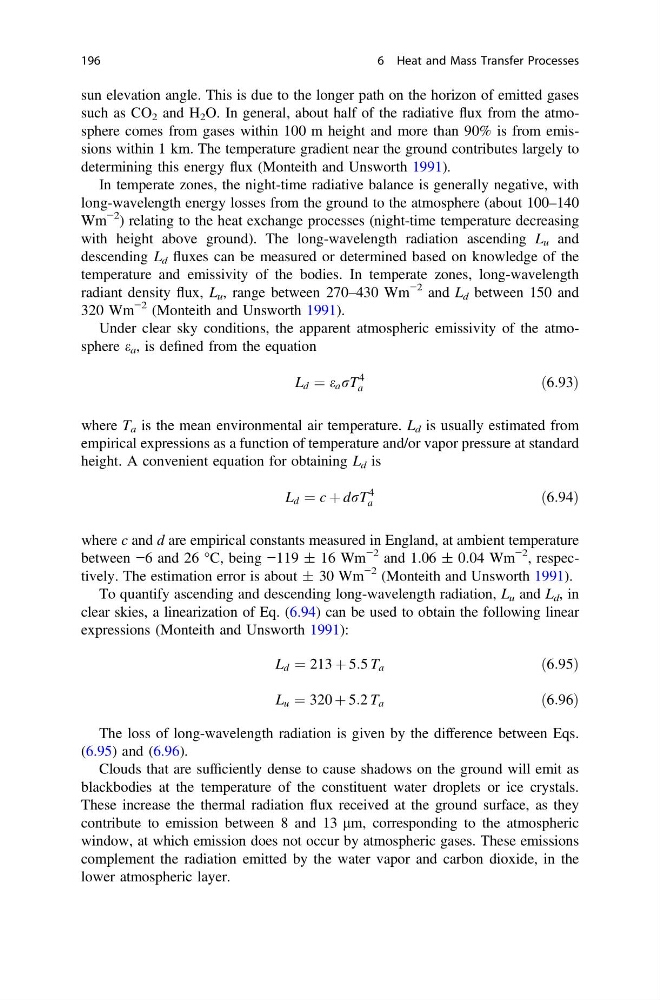
Under clear sky conditions, the apparent atmospheric emissivity of the atmosphere e a , is defined from the equation
L d ¼ e a rT
4
a
ð6:93Þ
where T a is the mean environmental air temperature. L d is usually estimated from
empirical expressions as a function of temperature and/or vapor pressure at standard
height. A convenient equation for obtaining L d is
L d ¼ c þ drT
4
a
ð6:94Þ
where c and d are empirical constants measured in England, at ambient temperature
between −6 and 26 °C, being −119 ± 16 Wm
−2 and 1.06 ± 0.04 Wm
−2 , respectively. The estimation error is about ± 30 Wm
−2 (Monteith and Unsworth 1991).
To quantify ascending and descending long-wavelength radiation, L u and L d , in
clear skies, a linearization of Eq. (6.94) can be used to obtain the following linear
expressions (Monteith and Unsworth 1991):
L d ¼ 213 þ 5:5 T a
ð6:95Þ
L u ¼ 320 þ 5:2 T a
ð6:96Þ
The loss of long-wavelength radiation is given by the difference between Eqs.
(6.95) and (6.96).
Clouds that are sufficiently dense to cause shadows on the ground will emit as
blackbodies at the temperature of the constituent water droplets or ice crystals.
These increase the thermal radiation flux received at the ground surface, as they
contribute to emission between 8 and 13 lm, corresponding to the atmospheric
window, at which emission does not occur by atmospheric gases. These emissions
complement the radiation emitted by the water vapor and carbon dioxide, in the
lower atmospheric layer.
196
6 Heat and Mass Transfer Processes
such as CO 2 and H 2 O. In general, about half of the radiative flux from the atmosphere comes from gases within 100 m height and more than 90% is from emissions within 1 km. The temperature gradient near the ground contributes largely to
determining this energy flux (Monteith and Unsworth 1991).
In temperate zones, the night-time radiative balance is generally negative, with
long-wavelength energy losses from the ground to the atmosphere (about 100–140
Wm
−2 ) relating to the heat exchange processes (night-time temperature decreasing
with height above ground). The long-wavelength radiation ascending L u and
descending L d fluxes can be measured or determined based on knowledge of the
temperature and emissivity of the bodies. In temperate zones, long-wavelength
radiant density flux, L u , range between 270–430 Wm
−2 and L d between 150 and
320 Wm
−2 (Monteith and Unsworth 1991).
Under clear sky conditions, the apparent atmospheric emissivity of the atmosphere e a , is defined from the equation
L d ¼ e a rT
4
a
ð6:93Þ
where T a is the mean environmental air temperature. L d is usually estimated from
empirical expressions as a function of temperature and/or vapor pressure at standard
height. A convenient equation for obtaining L d is
L d ¼ c þ drT
4
a
ð6:94Þ
where c and d are empirical constants measured in England, at ambient temperature
between −6 and 26 °C, being −119 ± 16 Wm
−2 and 1.06 ± 0.04 Wm
−2 , respectively. The estimation error is about ± 30 Wm
−2 (Monteith and Unsworth 1991).
To quantify ascending and descending long-wavelength radiation, L u and L d , in
clear skies, a linearization of Eq. (6.94) can be used to obtain the following linear
expressions (Monteith and Unsworth 1991):
L d ¼ 213 þ 5:5 T a
ð6:95Þ
L u ¼ 320 þ 5:2 T a
ð6:96Þ
The loss of long-wavelength radiation is given by the difference between Eqs.
(6.95) and (6.96).
Clouds that are sufficiently dense to cause shadows on the ground will emit as
blackbodies at the temperature of the constituent water droplets or ice crystals.
These increase the thermal radiation flux received at the ground surface, as they
contribute to emission between 8 and 13 lm, corresponding to the atmospheric
window, at which emission does not occur by atmospheric gases. These emissions
complement the radiation emitted by the water vapor and carbon dioxide, in the
lower atmospheric layer.
196
6 Heat and Mass Transfer Processes