

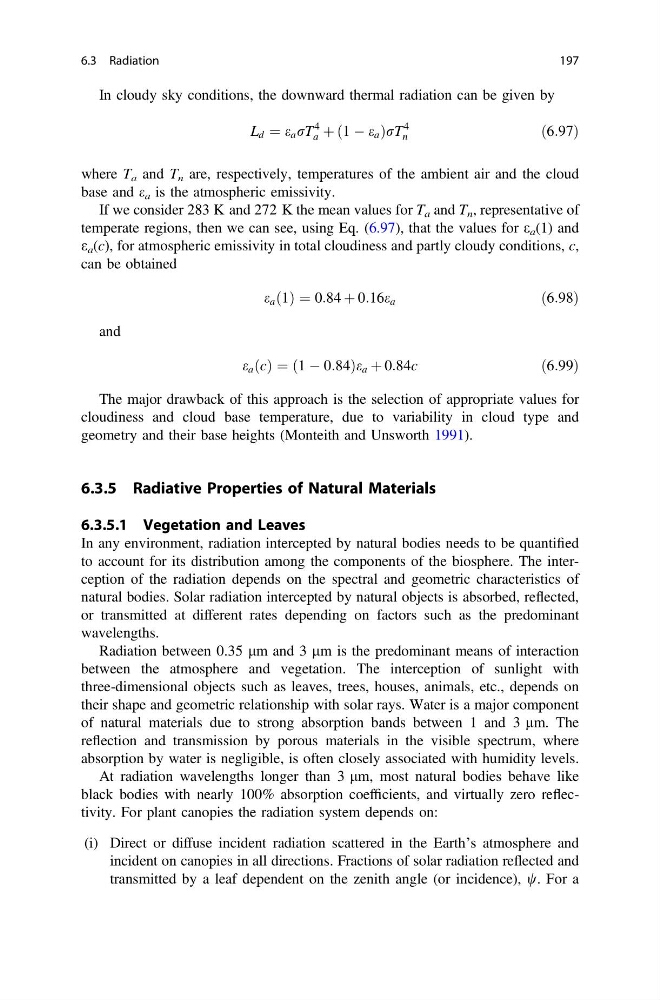
In cloudy sky conditions, the downward thermal radiation can be given by
L d ¼ e a rT
4
a þ 1 À e a
ð
ÞrT
4
n
ð6:97Þ
where T a and T n are, respectively, temperatures of the ambient air and the cloud
base and e a is the atmospheric emissivity.
If we consider 283 K and 272 K the mean values for T a and T n , representative of
temperate regions, then we can see, using Eq. (6.97), that the values for e a (1) and
e a (c), for atmospheric emissivity in total cloudiness and partly cloudy conditions, c,
can be obtained
e a ð1Þ ¼ 0:84 þ 0:16e a
ð6:98Þ
and
e a ðcÞ ¼ ð1 À 0:84Þe a þ 0:84c
ð6:99Þ
The major drawback of this approach is the selection of appropriate values for
cloudiness and cloud base temperature, due to variability in cloud type and
geometry and their base heights (Monteith and Unsworth 1991).
6.3.5 Radiative Properties of Natural Materials
6.3.5.1 Vegetation and Leaves
In any environment, radiation intercepted by natural bodies needs to be quantified
to account for its distribution among the components of the biosphere. The interception of the radiation depends on the spectral and geometric characteristics of
natural bodies. Solar radiation intercepted by natural objects is absorbed, reflected,
or transmitted at different rates depending on factors such as the predominant
wavelengths.
Radiation between 0.35 lm and 3 lm is the predominant means of interaction
between the atmosphere and vegetation. The interception of sunlight with
three-dimensional objects such as leaves, trees, houses, animals, etc., depends on
their shape and geometric relationship with solar rays. Water is a major component
of natural materials due to strong absorption bands between 1 and 3 lm. The
reflection and transmission by porous materials in the visible spectrum, where
absorption by water is negligible, is often closely associated with humidity levels.
At radiation wavelengths longer than 3 lm, most natural bodies behave like
black bodies with nearly 100% absorption coefficients, and virtually zero reflectivity. For plant canopies the radiation system depends on:
(i) Direct or diffuse incident radiation scattered in the Earth’s atmosphere and
incident on canopies in all directions. Fractions of solar radiation reflected and
transmitted by a leaf dependent on the zenith angle (or incidence), w. For a
6.3 Radiation
197
L d ¼ e a rT
4
a þ 1 À e a
ð
ÞrT
4
n
ð6:97Þ
where T a and T n are, respectively, temperatures of the ambient air and the cloud
base and e a is the atmospheric emissivity.
If we consider 283 K and 272 K the mean values for T a and T n , representative of
temperate regions, then we can see, using Eq. (6.97), that the values for e a (1) and
e a (c), for atmospheric emissivity in total cloudiness and partly cloudy conditions, c,
can be obtained
e a ð1Þ ¼ 0:84 þ 0:16e a
ð6:98Þ
and
e a ðcÞ ¼ ð1 À 0:84Þe a þ 0:84c
ð6:99Þ
The major drawback of this approach is the selection of appropriate values for
cloudiness and cloud base temperature, due to variability in cloud type and
geometry and their base heights (Monteith and Unsworth 1991).
6.3.5 Radiative Properties of Natural Materials
6.3.5.1 Vegetation and Leaves
In any environment, radiation intercepted by natural bodies needs to be quantified
to account for its distribution among the components of the biosphere. The interception of the radiation depends on the spectral and geometric characteristics of
natural bodies. Solar radiation intercepted by natural objects is absorbed, reflected,
or transmitted at different rates depending on factors such as the predominant
wavelengths.
Radiation between 0.35 lm and 3 lm is the predominant means of interaction
between the atmosphere and vegetation. The interception of sunlight with
three-dimensional objects such as leaves, trees, houses, animals, etc., depends on
their shape and geometric relationship with solar rays. Water is a major component
of natural materials due to strong absorption bands between 1 and 3 lm. The
reflection and transmission by porous materials in the visible spectrum, where
absorption by water is negligible, is often closely associated with humidity levels.
At radiation wavelengths longer than 3 lm, most natural bodies behave like
black bodies with nearly 100% absorption coefficients, and virtually zero reflectivity. For plant canopies the radiation system depends on:
(i) Direct or diffuse incident radiation scattered in the Earth’s atmosphere and
incident on canopies in all directions. Fractions of solar radiation reflected and
transmitted by a leaf dependent on the zenith angle (or incidence), w. For a
6.3 Radiation
197