

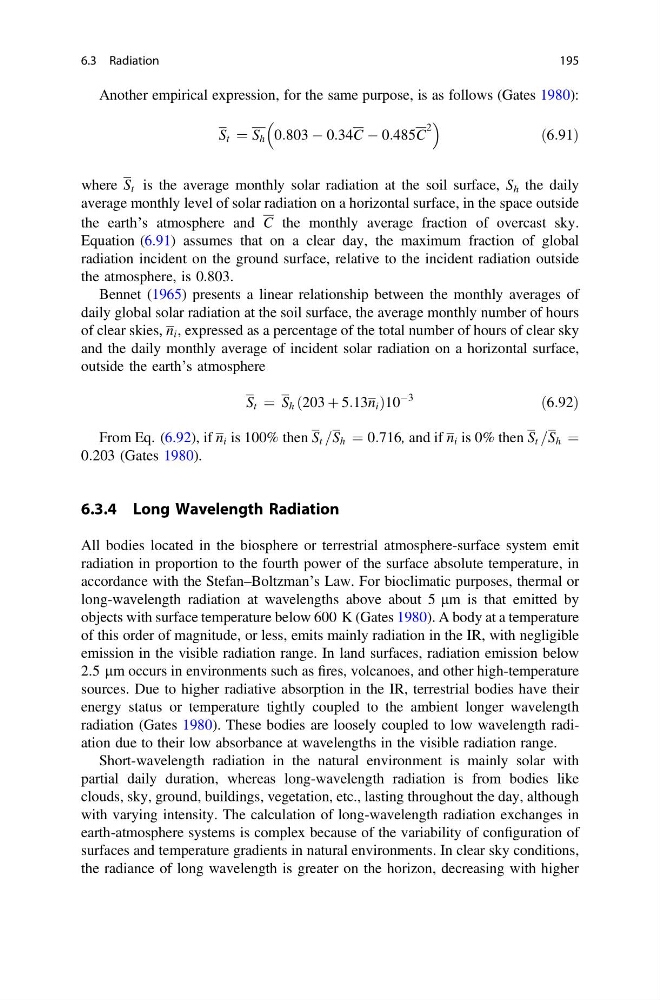
Another empirical expression, for the same purpose, is as follows (Gates 1980):
S t ¼ S h 0:803 À 0:34C À 0:485C
2
ð6:91Þ
where S t is the average monthly solar radiation at the soil surface, S h the daily
average monthly level of solar radiation on a horizontal surface, in the space outside
the earth’s atmosphere and C the monthly average fraction of overcast sky.
Equation (6.91) assumes that on a clear day, the maximum fraction of global
radiation incident on the ground surface, relative to the incident radiation outside
the atmosphere, is 0.803.
Bennet (1965) presents a linear relationship between the monthly averages of
daily global solar radiation at the soil surface, the average monthly number of hours
of clear skies, n i , expressed as a percentage of the total number of hours of clear sky
and the daily monthly average of incident solar radiation on a horizontal surface,
outside the earth’s atmosphere
S t ¼ S h 203 þ 5:13n i
ð
Þ 10
À3
ð6:92Þ
From Eq. (6.92), if n i is 100% then S t =S h ¼ 0:716, and if n i is 0% then S t =S h ¼
0:203 (Gates 1980).
6.3.4 Long Wavelength Radiation
All bodies located in the biosphere or terrestrial atmosphere-surface system emit
radiation in proportion to the fourth power of the surface absolute temperature, in
accordance with the Stefan–Boltzman’s Law. For bioclimatic purposes, thermal or
long-wavelength radiation at wavelengths above about 5 lm is that emitted by
objects with surface temperature below 600 K (Gates 1980). A body at a temperature
of this order of magnitude, or less, emits mainly radiation in the IR, with negligible
emission in the visible radiation range. In land surfaces, radiation emission below
2.5 lm occurs in environments such as fires, volcanoes, and other high-temperature
sources. Due to higher radiative absorption in the IR, terrestrial bodies have their
energy status or temperature tightly coupled to the ambient longer wavelength
radiation (Gates 1980). These bodies are loosely coupled to low wavelength radiation due to their low absorbance at wavelengths in the visible radiation range.
Short-wavelength radiation in the natural environment is mainly solar with
partial daily duration, whereas long-wavelength radiation is from bodies like
clouds, sky, ground, buildings, vegetation, etc., lasting throughout the day, although
with varying intensity. The calculation of long-wavelength radiation exchanges in
earth-atmosphere systems is complex because of the variability of configuration of
surfaces and temperature gradients in natural environments. In clear sky conditions,
the radiance of long wavelength is greater on the horizon, decreasing with higher
6.3 Radiation
195
S t ¼ S h 0:803 À 0:34C À 0:485C
2
ð6:91Þ
where S t is the average monthly solar radiation at the soil surface, S h the daily
average monthly level of solar radiation on a horizontal surface, in the space outside
the earth’s atmosphere and C the monthly average fraction of overcast sky.
Equation (6.91) assumes that on a clear day, the maximum fraction of global
radiation incident on the ground surface, relative to the incident radiation outside
the atmosphere, is 0.803.
Bennet (1965) presents a linear relationship between the monthly averages of
daily global solar radiation at the soil surface, the average monthly number of hours
of clear skies, n i , expressed as a percentage of the total number of hours of clear sky
and the daily monthly average of incident solar radiation on a horizontal surface,
outside the earth’s atmosphere
S t ¼ S h 203 þ 5:13n i
ð
Þ 10
À3
ð6:92Þ
From Eq. (6.92), if n i is 100% then S t =S h ¼ 0:716, and if n i is 0% then S t =S h ¼
0:203 (Gates 1980).
6.3.4 Long Wavelength Radiation
All bodies located in the biosphere or terrestrial atmosphere-surface system emit
radiation in proportion to the fourth power of the surface absolute temperature, in
accordance with the Stefan–Boltzman’s Law. For bioclimatic purposes, thermal or
long-wavelength radiation at wavelengths above about 5 lm is that emitted by
objects with surface temperature below 600 K (Gates 1980). A body at a temperature
of this order of magnitude, or less, emits mainly radiation in the IR, with negligible
emission in the visible radiation range. In land surfaces, radiation emission below
2.5 lm occurs in environments such as fires, volcanoes, and other high-temperature
sources. Due to higher radiative absorption in the IR, terrestrial bodies have their
energy status or temperature tightly coupled to the ambient longer wavelength
radiation (Gates 1980). These bodies are loosely coupled to low wavelength radiation due to their low absorbance at wavelengths in the visible radiation range.
Short-wavelength radiation in the natural environment is mainly solar with
partial daily duration, whereas long-wavelength radiation is from bodies like
clouds, sky, ground, buildings, vegetation, etc., lasting throughout the day, although
with varying intensity. The calculation of long-wavelength radiation exchanges in
earth-atmosphere systems is complex because of the variability of configuration of
surfaces and temperature gradients in natural environments. In clear sky conditions,
the radiance of long wavelength is greater on the horizon, decreasing with higher
6.3 Radiation
195