

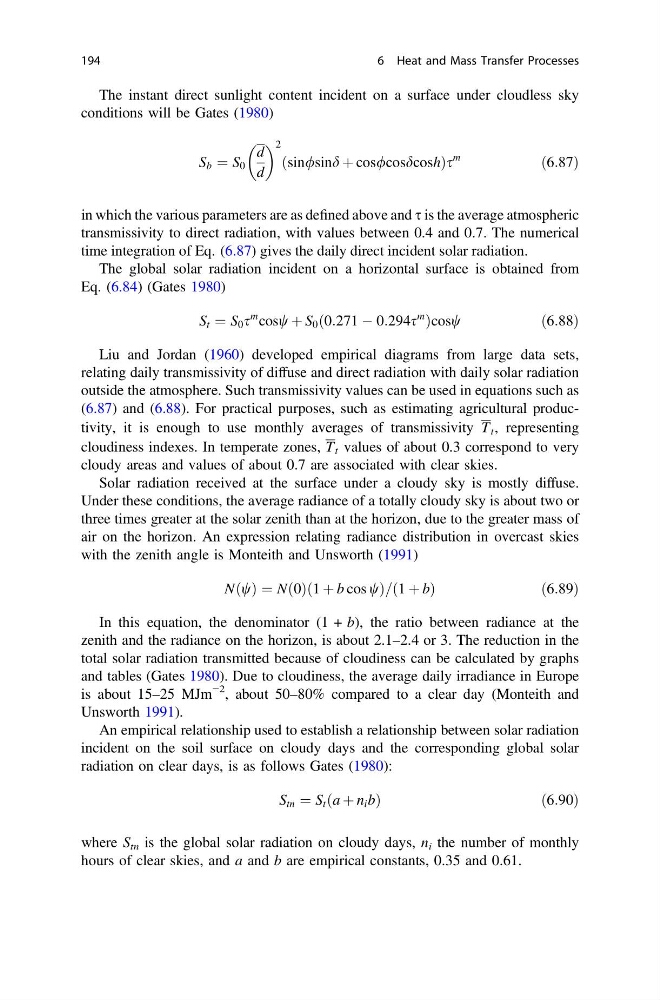
The instant direct sunlight content incident on a surface under cloudless sky
conditions will be Gates (1980)
S b ¼ S 0
d
d
2
sin/sind þ cos/cosdcosh
ð
Þ s
m
ð6:87Þ
in which the various parameters are as defined above and s is the average atmospheric
transmissivity to direct radiation, with values between 0.4 and 0.7. The numerical
time integration of Eq. (6.87) gives the daily direct incident solar radiation.
The global solar radiation incident on a horizontal surface is obtained from
Eq. (6.84) (Gates 1980)
S t ¼ S 0 s
m cosw þ S 0 0:271 À 0:294s
m
ð
Þ cosw
ð6:88Þ
Liu and Jordan (1960) developed empirical diagrams from large data sets,
relating daily transmissivity of diffuse and direct radiation with daily solar radiation
outside the atmosphere. Such transmissivity values can be used in equations such as
(6.87) and (6.88). For practical purposes, such as estimating agricultural productivity, it is enough to use monthly averages of transmissivity T t , representing
cloudiness indexes. In temperate zones, T t values of about 0.3 correspond to very
cloudy areas and values of about 0.7 are associated with clear skies.
Solar radiation received at the surface under a cloudy sky is mostly diffuse.
Under these conditions, the average radiance of a totally cloudy sky is about two or
three times greater at the solar zenith than at the horizon, due to the greater mass of
air on the horizon. An expression relating radiance distribution in overcast skies
with the zenith angle is Monteith and Unsworth (1991)
NðwÞ ¼ Nð0Þð1 þ b cos wÞ=ð1 þ bÞ
ð 6:89Þ
In this equation, the denominator (1 + b), the ratio between radiance at the
zenith and the radiance on the horizon, is about 2.1–2.4 or 3. The reduction in the
total solar radiation transmitted because of cloudiness can be calculated by graphs
and tables (Gates 1980). Due to cloudiness, the average daily irradiance in Europe
is about 15–25 MJm
−2 , about 50–80% compared to a clear day (Monteith and
Unsworth 1991).
An empirical relationship used to establish a relationship between solar radiation
incident on the soil surface on cloudy days and the corresponding global solar
radiation on clear days, is as follows Gates (1980):
S tn ¼ S t a þ n i b
ð
Þ
ð6:90Þ
where S tn is the global solar radiation on cloudy days, n i the number of monthly
hours of clear skies, and a and b are empirical constants, 0.35 and 0.61.
194
6 Heat and Mass Transfer Processes
conditions will be Gates (1980)
S b ¼ S 0
d
d
2
sin/sind þ cos/cosdcosh
ð
Þ s
m
ð6:87Þ
in which the various parameters are as defined above and s is the average atmospheric
transmissivity to direct radiation, with values between 0.4 and 0.7. The numerical
time integration of Eq. (6.87) gives the daily direct incident solar radiation.
The global solar radiation incident on a horizontal surface is obtained from
Eq. (6.84) (Gates 1980)
S t ¼ S 0 s
m cosw þ S 0 0:271 À 0:294s
m
ð
Þ cosw
ð6:88Þ
Liu and Jordan (1960) developed empirical diagrams from large data sets,
relating daily transmissivity of diffuse and direct radiation with daily solar radiation
outside the atmosphere. Such transmissivity values can be used in equations such as
(6.87) and (6.88). For practical purposes, such as estimating agricultural productivity, it is enough to use monthly averages of transmissivity T t , representing
cloudiness indexes. In temperate zones, T t values of about 0.3 correspond to very
cloudy areas and values of about 0.7 are associated with clear skies.
Solar radiation received at the surface under a cloudy sky is mostly diffuse.
Under these conditions, the average radiance of a totally cloudy sky is about two or
three times greater at the solar zenith than at the horizon, due to the greater mass of
air on the horizon. An expression relating radiance distribution in overcast skies
with the zenith angle is Monteith and Unsworth (1991)
NðwÞ ¼ Nð0Þð1 þ b cos wÞ=ð1 þ bÞ
ð 6:89Þ
In this equation, the denominator (1 + b), the ratio between radiance at the
zenith and the radiance on the horizon, is about 2.1–2.4 or 3. The reduction in the
total solar radiation transmitted because of cloudiness can be calculated by graphs
and tables (Gates 1980). Due to cloudiness, the average daily irradiance in Europe
is about 15–25 MJm
−2 , about 50–80% compared to a clear day (Monteith and
Unsworth 1991).
An empirical relationship used to establish a relationship between solar radiation
incident on the soil surface on cloudy days and the corresponding global solar
radiation on clear days, is as follows Gates (1980):
S tn ¼ S t a þ n i b
ð
Þ
ð6:90Þ
where S tn is the global solar radiation on cloudy days, n i the number of monthly
hours of clear skies, and a and b are empirical constants, 0.35 and 0.61.
194
6 Heat and Mass Transfer Processes