

It follows that the total or global radiative flux, S t , incident on soil horizontal
surface is given by the following equation (Monteith and Unsworth 1991):
S t ¼ S p cos w þ S d ¼ S b þ S d
ð6:84Þ
where S b and S d are the terms for direct and diffuse solar radiation fluxes,
respectively, on a surface perpendicular to the solar rays. The S p term corresponds
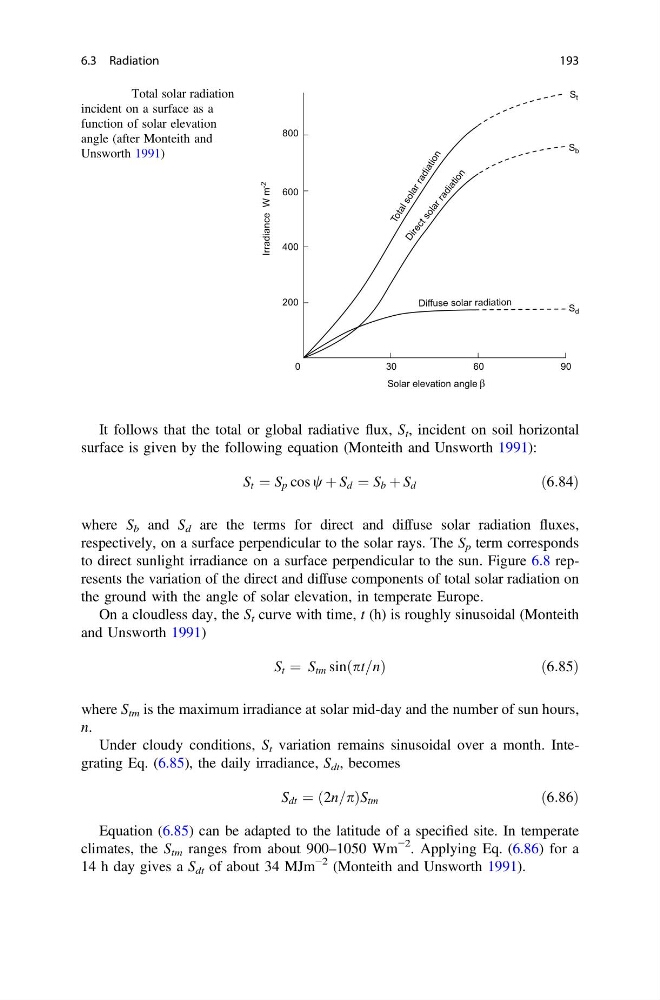
to direct sunlight irradiance on a surface perpendicular to the sun. Figure 6.8 represents the variation of the direct and diffuse components of total solar radiation on
the ground with the angle of solar elevation, in temperate Europe.
On a cloudless day, the S t curve with time, t (h) is roughly sinusoidal (Monteith
and Unsworth 1991)
S t ¼ S tm sin pt=n
ð
Þ
ð6:85Þ
where S tm is the maximum irradiance at solar mid-day and the number of sun hours,
n.
Under cloudy conditions, S t variation remains sinusoidal over a month. Integrating Eq. (6.85), the daily irradiance, S dt , becomes
S dt ¼ 2n=p
ð
ÞS tm
ð6:86Þ
Equation (6.85) can be adapted to the latitude of a specified site. In temperate
climates, the S tm ranges from about 900–1050 Wm
−2 . Applying Eq. (6.86) for a
14 h day gives a S dt of about 34 MJm
−2 (Monteith and Unsworth 1991).
Solar elevation angle β
Irradiance W m -2
0
3 0
200
400
600
800
60
90
Diffuse solar radiation
S b
S d
S t
D ir e c t s o la r r a d ia t io n
T o ta l s o la r r a d ia ti o n
Fig. 6.8 Total solar radiation
incident on a surface as a
function of solar elevation
angle (after Monteith and
Unsworth 1991)
6.3 Radiation
193
surface is given by the following equation (Monteith and Unsworth 1991):
S t ¼ S p cos w þ S d ¼ S b þ S d
ð6:84Þ
where S b and S d are the terms for direct and diffuse solar radiation fluxes,
respectively, on a surface perpendicular to the solar rays. The S p term corresponds
to direct sunlight irradiance on a surface perpendicular to the sun. Figure 6.8 represents the variation of the direct and diffuse components of total solar radiation on
the ground with the angle of solar elevation, in temperate Europe.
On a cloudless day, the S t curve with time, t (h) is roughly sinusoidal (Monteith
and Unsworth 1991)
S t ¼ S tm sin pt=n
ð
Þ
ð6:85Þ
where S tm is the maximum irradiance at solar mid-day and the number of sun hours,
n.
Under cloudy conditions, S t variation remains sinusoidal over a month. Integrating Eq. (6.85), the daily irradiance, S dt , becomes
S dt ¼ 2n=p
ð
ÞS tm
ð6:86Þ
Equation (6.85) can be adapted to the latitude of a specified site. In temperate
climates, the S tm ranges from about 900–1050 Wm
−2 . Applying Eq. (6.86) for a
14 h day gives a S dt of about 34 MJm
−2 (Monteith and Unsworth 1991).
Solar elevation angle β
Irradiance W m -2
0
3 0
200
400
600
800
60
90
Diffuse solar radiation
S b
S d
S t
D ir e c t s o la r r a d ia t io n
T o ta l s o la r r a d ia ti o n
Fig. 6.8 Total solar radiation
incident on a surface as a
function of solar elevation
angle (after Monteith and
Unsworth 1991)
6.3 Radiation
193