

horizon, the attenuation via scattering increases, and the wavelength at maximum
irradiance is in the IR spectrum.
Under clear sky conditions, when the zenith angle is <50°, the ratio of diffuse to
total radiation is <0.2. The ratio of diffuse irradiance and total irradiance increases
with the increase in cloudiness and maybe one when the sun is fully covered.
However, the maximum amount of diffuse light occurs at cloudiness of about 50%.
The spectral composition of the scattered radiation is also affected by cloudiness.
Under a clear sky, the radiant energy spectrum concentrates in the visible range, and
with increasing cloudiness, visible radiation corresponds to about 50% of the total
radiation (Monteith and Unsworth 1991).
Rayleigh scattering is not valid for particles such as aerosols (dust, smoke,
pollen, water droplets, etc.) where the characteristic dimension d, and the wavelength k, are the same order of magnitude. In this case prevails the so-called Mie
scattering wherein radiative scattering for the various wavelengths is a function of
ratio (d/k). Indeed, for similar (d/k) ratios, the longer-wavelength radiation is
scattered more intensely than the lower-wavelength radiation, unlike what happens
with Rayleigh scattering. Radiative dispersion caused by larger particles or aerosols, is more significant in the direction of the incident radiation, without changing
direction. Spitters et al. (1986), mention that under a clear sky and total sun height
of 45°, about 15% of the diffusive flux consist of radiation without any additional
modification.
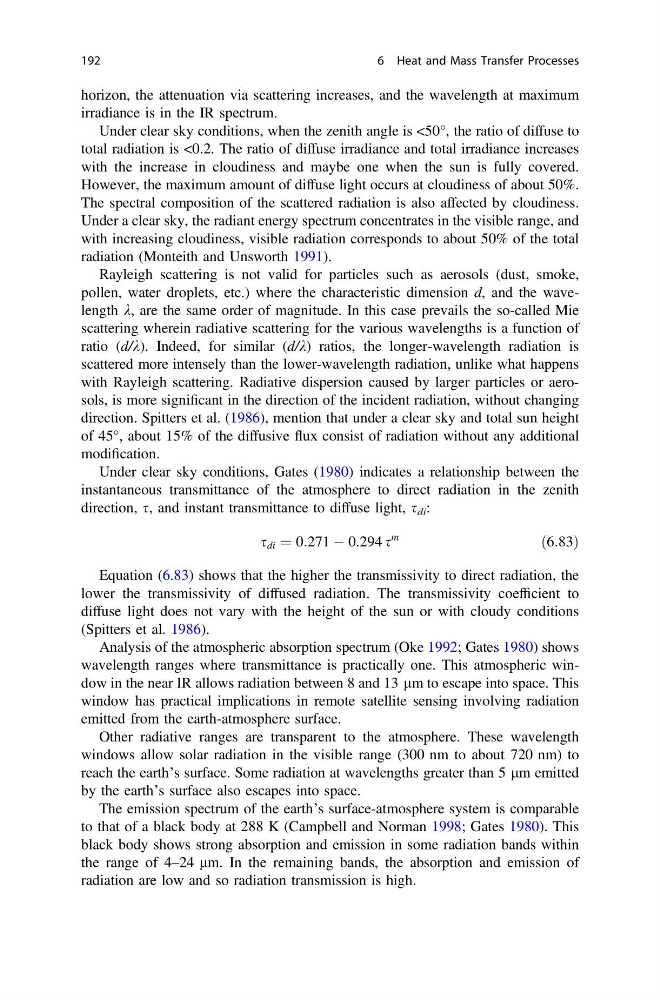
Under clear sky conditions, Gates (1980) indicates a relationship between the
instantaneous transmittance of the atmosphere to direct radiation in the zenith
direction, s, and instant transmittance to diffuse light, s di :
s di ¼ 0:271 À 0:294 s
m
ð6:83Þ
Equation (6.83) shows that the higher the transmissivity to direct radiation, the
lower the transmissivity of diffused radiation. The transmissivity coefficient to
diffuse light does not vary with the height of the sun or with cloudy conditions
(Spitters et al. 1986).
Analysis of the atmospheric absorption spectrum (Oke 1992; Gates 1980) shows
wavelength ranges where transmittance is practically one. This atmospheric window in the near IR allows radiation between 8 and 13 lm to escape into space. This
window has practical implications in remote satellite sensing involving radiation
emitted from the earth-atmosphere surface.
Other radiative ranges are transparent to the atmosphere. These wavelength
windows allow solar radiation in the visible range (300 nm to about 720 nm) to
reach the earth’s surface. Some radiation at wavelengths greater than 5 lm emitted
by the earth’s surface also escapes into space.
The emission spectrum of the earth’s surface-atmosphere system is comparable
to that of a black body at 288 K (Campbell and Norman 1998; Gates 1980). This
black body shows strong absorption and emission in some radiation bands within
the range of 4–24 lm. In the remaining bands, the absorption and emission of
radiation are low and so radiation transmission is high.
192
6 Heat and Mass Transfer Processes
irradiance is in the IR spectrum.
Under clear sky conditions, when the zenith angle is <50°, the ratio of diffuse to
total radiation is <0.2. The ratio of diffuse irradiance and total irradiance increases
with the increase in cloudiness and maybe one when the sun is fully covered.
However, the maximum amount of diffuse light occurs at cloudiness of about 50%.
The spectral composition of the scattered radiation is also affected by cloudiness.
Under a clear sky, the radiant energy spectrum concentrates in the visible range, and
with increasing cloudiness, visible radiation corresponds to about 50% of the total
radiation (Monteith and Unsworth 1991).
Rayleigh scattering is not valid for particles such as aerosols (dust, smoke,
pollen, water droplets, etc.) where the characteristic dimension d, and the wavelength k, are the same order of magnitude. In this case prevails the so-called Mie
scattering wherein radiative scattering for the various wavelengths is a function of
ratio (d/k). Indeed, for similar (d/k) ratios, the longer-wavelength radiation is
scattered more intensely than the lower-wavelength radiation, unlike what happens
with Rayleigh scattering. Radiative dispersion caused by larger particles or aerosols, is more significant in the direction of the incident radiation, without changing
direction. Spitters et al. (1986), mention that under a clear sky and total sun height
of 45°, about 15% of the diffusive flux consist of radiation without any additional
modification.
Under clear sky conditions, Gates (1980) indicates a relationship between the
instantaneous transmittance of the atmosphere to direct radiation in the zenith
direction, s, and instant transmittance to diffuse light, s di :
s di ¼ 0:271 À 0:294 s
m
ð6:83Þ
Equation (6.83) shows that the higher the transmissivity to direct radiation, the
lower the transmissivity of diffused radiation. The transmissivity coefficient to
diffuse light does not vary with the height of the sun or with cloudy conditions
(Spitters et al. 1986).
Analysis of the atmospheric absorption spectrum (Oke 1992; Gates 1980) shows
wavelength ranges where transmittance is practically one. This atmospheric window in the near IR allows radiation between 8 and 13 lm to escape into space. This
window has practical implications in remote satellite sensing involving radiation
emitted from the earth-atmosphere surface.
Other radiative ranges are transparent to the atmosphere. These wavelength
windows allow solar radiation in the visible range (300 nm to about 720 nm) to
reach the earth’s surface. Some radiation at wavelengths greater than 5 lm emitted
by the earth’s surface also escapes into space.
The emission spectrum of the earth’s surface-atmosphere system is comparable
to that of a black body at 288 K (Campbell and Norman 1998; Gates 1980). This
black body shows strong absorption and emission in some radiation bands within
the range of 4–24 lm. In the remaining bands, the absorption and emission of
radiation are low and so radiation transmission is high.
192
6 Heat and Mass Transfer Processes