

6.3.3.2 Solar Radiation Outside the Atmosphere
The incident radiation throughout the day and year, above the Earth’s atmosphere,
varies with the season, time, and latitude due to the earth’s rotation and translation.
Three-dimensional geometrical sun–earth relationships can be used to establish the
expressions for solar declination, zenith angle, duration of the solar day as a
function of time and latitude.
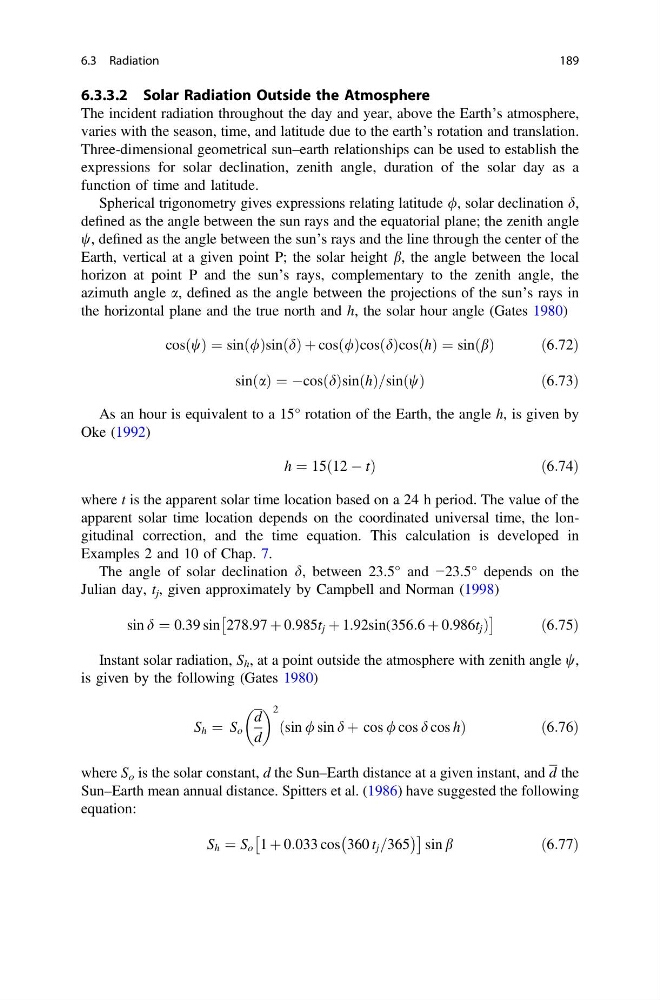
Spherical trigonometry gives expressions relating latitude /, solar declination d,
defined as the angle between the sun rays and the equatorial plane; the zenith angle
w, defined as the angle between the sun’s rays and the line through the center of the
Earth, vertical at a given point P; the solar height b, the angle between the local
horizon at point P and the sun’s rays, complementary to the zenith angle, the
azimuth angle a, defined as the angle between the projections of the sun’s rays in
the horizontal plane and the true north and h, the solar hour angle (Gates 1980)
cos w
ð Þ ¼ sin /
ð Þsin d
ð Þ þ cos /
ð Þcos d
ð Þcos h
ð Þ ¼ sin b
ð Þ
ð6:72Þ
sin a
ð Þ ¼ Àcos d
ð Þsin h
ð Þ=sin w
ð Þ
ð6:73Þ
As an hour is equivalent to a 15° rotation of the Earth, the angle h, is given by
Oke (1992)
h ¼ 15ð12 À tÞ
ð 6:74Þ
where t is the apparent solar time location based on a 24 h period. The value of the
apparent solar time location depends on the coordinated universal time, the longitudinal correction, and the time equation. This calculation is developed in
Examples 2 and 10 of Chap. 7.
The angle of solar declination d, between 23.5° and −23.5° depends on the
Julian day, t j , given approximately by Campbell and Norman (1998)
sin d ¼ 0.39 sin 278.97 þ 0.985t j þ 1.92sin(356:6 þ 0.986t j Þ
Â
Ã
ð6:75Þ
Instant solar radiation, S h , at a point outside the atmosphere with zenith angle w,
is given by the following (Gates 1980)
S h ¼ S o
d
d
2
ðsin / sin d þ cos / cos d cos hÞ
ð 6:76Þ
where S o is the solar constant, d the Sun–Earth distance at a given instant, and d the
Sun–Earth mean annual distance. Spitters et al. (1986) have suggested the following
equation:
S h ¼ S o 1 þ 0:033 cos 360 t j =365
À
Á
Â
Ã
sin b
ð6:77Þ
6.3 Radiation
189
The incident radiation throughout the day and year, above the Earth’s atmosphere,
varies with the season, time, and latitude due to the earth’s rotation and translation.
Three-dimensional geometrical sun–earth relationships can be used to establish the
expressions for solar declination, zenith angle, duration of the solar day as a
function of time and latitude.
Spherical trigonometry gives expressions relating latitude /, solar declination d,
defined as the angle between the sun rays and the equatorial plane; the zenith angle
w, defined as the angle between the sun’s rays and the line through the center of the
Earth, vertical at a given point P; the solar height b, the angle between the local
horizon at point P and the sun’s rays, complementary to the zenith angle, the
azimuth angle a, defined as the angle between the projections of the sun’s rays in
the horizontal plane and the true north and h, the solar hour angle (Gates 1980)
cos w
ð Þ ¼ sin /
ð Þsin d
ð Þ þ cos /
ð Þcos d
ð Þcos h
ð Þ ¼ sin b
ð Þ
ð6:72Þ
sin a
ð Þ ¼ Àcos d
ð Þsin h
ð Þ=sin w
ð Þ
ð6:73Þ
As an hour is equivalent to a 15° rotation of the Earth, the angle h, is given by
Oke (1992)
h ¼ 15ð12 À tÞ
ð 6:74Þ
where t is the apparent solar time location based on a 24 h period. The value of the
apparent solar time location depends on the coordinated universal time, the longitudinal correction, and the time equation. This calculation is developed in
Examples 2 and 10 of Chap. 7.
The angle of solar declination d, between 23.5° and −23.5° depends on the
Julian day, t j , given approximately by Campbell and Norman (1998)
sin d ¼ 0.39 sin 278.97 þ 0.985t j þ 1.92sin(356:6 þ 0.986t j Þ
Â
Ã
ð6:75Þ
Instant solar radiation, S h , at a point outside the atmosphere with zenith angle w,
is given by the following (Gates 1980)
S h ¼ S o
d
d
2
ðsin / sin d þ cos / cos d cos hÞ
ð 6:76Þ
where S o is the solar constant, d the Sun–Earth distance at a given instant, and d the
Sun–Earth mean annual distance. Spitters et al. (1986) have suggested the following
equation:
S h ¼ S o 1 þ 0:033 cos 360 t j =365
À
Á
Â
Ã
sin b
ð6:77Þ
6.3 Radiation
189