

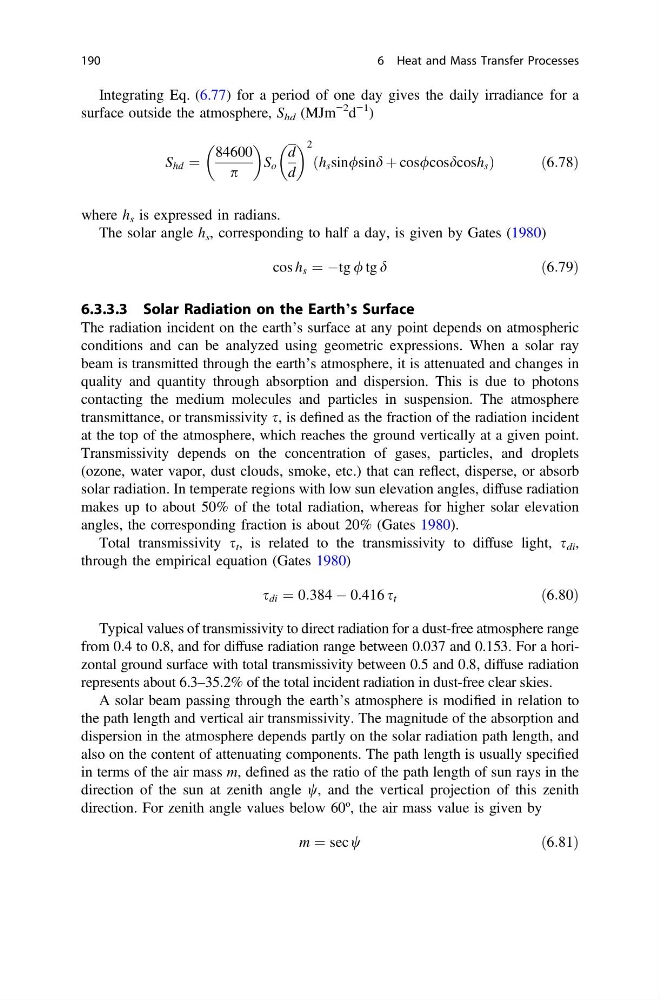
Integrating Eq. (6.77) for a period of one day gives the daily irradiance for a
surface outside the atmosphere, S hd (MJm
−2 d
−1 )
S hd ¼
84600
p
S o
d
d
2
h s sin/sind þ cos/cosdcosh s
ð
Þ
ð 6:78Þ
where h s is expressed in radians.
The solar angle h s , corresponding to half a day, is given by Gates (1980)
cos h s ¼ Àtg / tg d
ð6:79Þ
6.3.3.3 Solar Radiation on the Earth’s Surface
The radiation incident on the earth’s surface at any point depends on atmospheric
conditions and can be analyzed using geometric expressions. When a solar ray
beam is transmitted through the earth’s atmosphere, it is attenuated and changes in
quality and quantity through absorption and dispersion. This is due to photons
contacting the medium molecules and particles in suspension. The atmosphere
transmittance, or transmissivity s, is defined as the fraction of the radiation incident
at the top of the atmosphere, which reaches the ground vertically at a given point.
Transmissivity depends on the concentration of gases, particles, and droplets
(ozone, water vapor, dust clouds, smoke, etc.) that can reflect, disperse, or absorb
solar radiation. In temperate regions with low sun elevation angles, diffuse radiation
makes up to about 50% of the total radiation, whereas for higher solar elevation
angles, the corresponding fraction is about 20% (Gates 1980).
Total transmissivity s t , is related to the transmissivity to diffuse light, s di ,
through the empirical equation (Gates 1980)
s di ¼ 0:384 À 0:416 s t
ð6:80Þ
Typical values of transmissivity to direct radiation for a dust-free atmosphere range
from 0.4 to 0.8, and for diffuse radiation range between 0.037 and 0.153. For a horizontal ground surface with total transmissivity between 0.5 and 0.8, diffuse radiation
represents about 6.3–35.2% of the total incident radiation in dust-free clear skies.
A solar beam passing through the earth’s atmosphere is modified in relation to
the path length and vertical air transmissivity. The magnitude of the absorption and
dispersion in the atmosphere depends partly on the solar radiation path length, and
also on the content of attenuating components. The path length is usually specified
in terms of the air mass m, defined as the ratio of the path length of sun rays in the
direction of the sun at zenith angle w, and the vertical projection of this zenith
direction. For zenith angle values below 60º, the air mass value is given by
m ¼ sec w
ð6:81Þ
190
6 Heat and Mass Transfer Processes
surface outside the atmosphere, S hd (MJm
−2 d
−1 )
S hd ¼
84600
p
S o
d
d
2
h s sin/sind þ cos/cosdcosh s
ð
Þ
ð 6:78Þ
where h s is expressed in radians.
The solar angle h s , corresponding to half a day, is given by Gates (1980)
cos h s ¼ Àtg / tg d
ð6:79Þ
6.3.3.3 Solar Radiation on the Earth’s Surface
The radiation incident on the earth’s surface at any point depends on atmospheric
conditions and can be analyzed using geometric expressions. When a solar ray
beam is transmitted through the earth’s atmosphere, it is attenuated and changes in
quality and quantity through absorption and dispersion. This is due to photons
contacting the medium molecules and particles in suspension. The atmosphere
transmittance, or transmissivity s, is defined as the fraction of the radiation incident
at the top of the atmosphere, which reaches the ground vertically at a given point.
Transmissivity depends on the concentration of gases, particles, and droplets
(ozone, water vapor, dust clouds, smoke, etc.) that can reflect, disperse, or absorb
solar radiation. In temperate regions with low sun elevation angles, diffuse radiation
makes up to about 50% of the total radiation, whereas for higher solar elevation
angles, the corresponding fraction is about 20% (Gates 1980).
Total transmissivity s t , is related to the transmissivity to diffuse light, s di ,
through the empirical equation (Gates 1980)
s di ¼ 0:384 À 0:416 s t
ð6:80Þ
Typical values of transmissivity to direct radiation for a dust-free atmosphere range
from 0.4 to 0.8, and for diffuse radiation range between 0.037 and 0.153. For a horizontal ground surface with total transmissivity between 0.5 and 0.8, diffuse radiation
represents about 6.3–35.2% of the total incident radiation in dust-free clear skies.
A solar beam passing through the earth’s atmosphere is modified in relation to
the path length and vertical air transmissivity. The magnitude of the absorption and
dispersion in the atmosphere depends partly on the solar radiation path length, and
also on the content of attenuating components. The path length is usually specified
in terms of the air mass m, defined as the ratio of the path length of sun rays in the
direction of the sun at zenith angle w, and the vertical projection of this zenith
direction. For zenith angle values below 60º, the air mass value is given by
m ¼ sec w
ð6:81Þ
190
6 Heat and Mass Transfer Processes