

radiation below 2.5 lm, as well as long-wavelength radiation. Solar radiation
emission per unit area peaks at mid-spectrum, about 0.48 lm. Radiation referred to
as thermal or high wavelength is emitted from bodies with surface temperatures
below 600 K. At lower temperatures, these bodies emit negligible amounts of
short-wavelength energy.
Much of the radiation emitted by the earth’s surface is absorbed into specific
ranges of wavelengths by atmospheric gases, particularly water vapor and carbon
dioxide. According to Kirchhoff’s Law, these gases have equivalent emission and
absorption spectra. A small fraction of large wavelength radiation emitted by the
earth-atmosphere system is lost to outer space, so this energy loss must be compensated by incident solar radiation (Monteith and Unsworth 1991).
The solar radiation spectrum can be divided into several ranges, relating to percentages of the solar constant: 1.2% of 0–300 nm, 7.8% of 300–400 nm (UV), 39.8%
of 400–700 nm (vis./PAR), 38.8% of 700–1500 nm (near IR), and 12.2% of 1500 nm
to ∞. The visible radiation ranges between 400 and 700 nm, corresponding to blue
and red, respectively. Photosynthesis is stimulated by the radiation in the photosynthetically active radiation (PAR) range, corresponding to 21–46% of the total
energy of the extraterrestrial solar spectrum. More than 70% of the solar radiation
absorbed by the plant canopy is used in transpiration and convective exchanges with
the surrounding air, which regulates the temperature of the various plant organs.
About 28% of the total solar energy used in photosynthesis is stored chemically in
the form of organic compounds. The remaining, from UV to IR of about 750 nm is
used in the regulation and control of growth and development of photomorphogenic
processes (Ross 1975). Due to atmospheric attenuation, global or total solar radiation
reaching the ground has two components: direct and diffuse radiation. The sun
provides direct radiation, including a small fraction of scattered radiation that has not
undergone any directional change. The direct radiation incident on the earth’s surface is up to about 75% of the solar constant. The remaining 25% is diffuse radiation,
including emissions from the sky and clouds via transmission and reflection of
attenuated solar radiation. This attenuation is due to absorption and scattering, in
similar proportions, by molecules and aerosol (Monteith and Unsworth 1991).
The radiative attenuation decreases direct solar radiation content and changes the
spectral composition also. The radiative absorption and dispersion processes vary
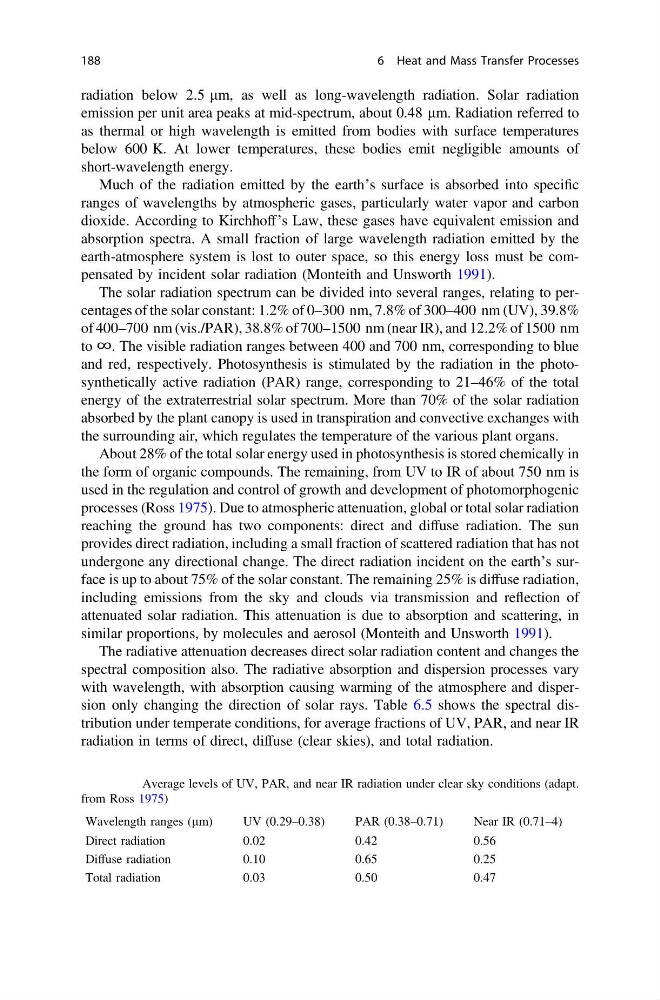
with wavelength, with absorption causing warming of the atmosphere and dispersion only changing the direction of solar rays. Table 6.5 shows the spectral distribution under temperate conditions, for average fractions of UV, PAR, and near IR
radiation in terms of direct, diffuse (clear skies), and total radiation.
Table 6.5 Average levels of UV, PAR, and near IR radiation under clear sky conditions (adapt.
from Ross 1975)
Wavelength ranges (lm)
UV (0.29–0.38)
PAR (0.38–0.71)
Near IR (0.71–4)
Direct radiation
0.02
0.42
0.56
Diffuse radiation
0.10
0.65
0.25
Total radiation
0.03
0.50
0.47
188
6 Heat and Mass Transfer Processes
emission per unit area peaks at mid-spectrum, about 0.48 lm. Radiation referred to
as thermal or high wavelength is emitted from bodies with surface temperatures
below 600 K. At lower temperatures, these bodies emit negligible amounts of
short-wavelength energy.
Much of the radiation emitted by the earth’s surface is absorbed into specific
ranges of wavelengths by atmospheric gases, particularly water vapor and carbon
dioxide. According to Kirchhoff’s Law, these gases have equivalent emission and
absorption spectra. A small fraction of large wavelength radiation emitted by the
earth-atmosphere system is lost to outer space, so this energy loss must be compensated by incident solar radiation (Monteith and Unsworth 1991).
The solar radiation spectrum can be divided into several ranges, relating to percentages of the solar constant: 1.2% of 0–300 nm, 7.8% of 300–400 nm (UV), 39.8%
of 400–700 nm (vis./PAR), 38.8% of 700–1500 nm (near IR), and 12.2% of 1500 nm
to ∞. The visible radiation ranges between 400 and 700 nm, corresponding to blue
and red, respectively. Photosynthesis is stimulated by the radiation in the photosynthetically active radiation (PAR) range, corresponding to 21–46% of the total
energy of the extraterrestrial solar spectrum. More than 70% of the solar radiation
absorbed by the plant canopy is used in transpiration and convective exchanges with
the surrounding air, which regulates the temperature of the various plant organs.
About 28% of the total solar energy used in photosynthesis is stored chemically in
the form of organic compounds. The remaining, from UV to IR of about 750 nm is
used in the regulation and control of growth and development of photomorphogenic
processes (Ross 1975). Due to atmospheric attenuation, global or total solar radiation
reaching the ground has two components: direct and diffuse radiation. The sun
provides direct radiation, including a small fraction of scattered radiation that has not
undergone any directional change. The direct radiation incident on the earth’s surface is up to about 75% of the solar constant. The remaining 25% is diffuse radiation,
including emissions from the sky and clouds via transmission and reflection of
attenuated solar radiation. This attenuation is due to absorption and scattering, in
similar proportions, by molecules and aerosol (Monteith and Unsworth 1991).
The radiative attenuation decreases direct solar radiation content and changes the
spectral composition also. The radiative absorption and dispersion processes vary
with wavelength, with absorption causing warming of the atmosphere and dispersion only changing the direction of solar rays. Table 6.5 shows the spectral distribution under temperate conditions, for average fractions of UV, PAR, and near IR
radiation in terms of direct, diffuse (clear skies), and total radiation.
Table 6.5 Average levels of UV, PAR, and near IR radiation under clear sky conditions (adapt.
from Ross 1975)
Wavelength ranges (lm)
UV (0.29–0.38)
PAR (0.38–0.71)
Near IR (0.71–4)
Direct radiation
0.02
0.42
0.56
Diffuse radiation
0.10
0.65
0.25
Total radiation
0.03
0.50
0.47
188
6 Heat and Mass Transfer Processes