

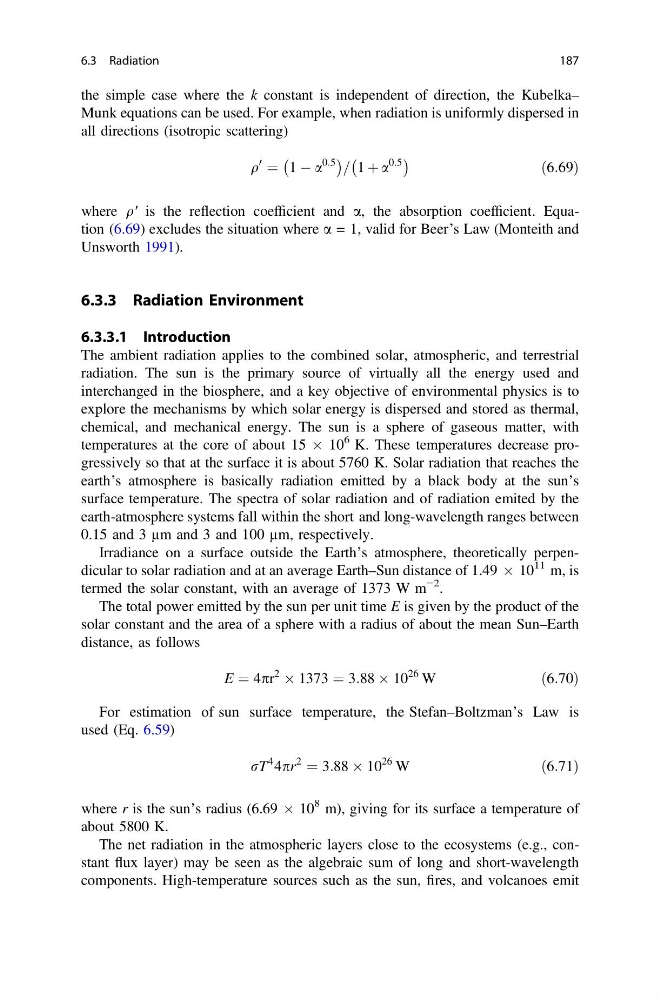
the simple case where the k constant is independent of direction, the Kubelka–
Munk equations can be used. For example, when radiation is uniformly dispersed in
all directions (isotropic scattering)
q
0
¼ 1 À a
0:5
À
Á = 1 þ a
0:5
À
Á
ð6:69Þ
where q′ is the reflection coefficient and a, the absorption coefficient. Equation (6.69) excludes the situation where a = 1, valid for Beer’s Law (Monteith and
Unsworth 1991).
6.3.3 Radiation Environment
6.3.3.1 Introduction
The ambient radiation applies to the combined solar, atmospheric, and terrestrial
radiation. The sun is the primary source of virtually all the energy used and
interchanged in the biosphere, and a key objective of environmental physics is to
explore the mechanisms by which solar energy is dispersed and stored as thermal,
chemical, and mechanical energy. The sun is a sphere of gaseous matter, with
temperatures at the core of about 15 Â 10
6 K. These temperatures decrease progressively so that at the surface it is about 5760 K. Solar radiation that reaches the
earth’s atmosphere is basically radiation emitted by a black body at the sun’s
surface temperature. The spectra of solar radiation and of radiation emited by the
earth-atmosphere systems fall within the short and long-wavelength ranges between
0.15 and 3 µm and 3 and 100 µm, respectively.
Irradiance on a surface outside the Earth’s atmosphere, theoretically perpendicular to solar radiation and at an average Earth–Sun distance of 1.49 Â 10
11 m, is
termed the solar constant, with an average of 1373 W m
−2 .
The total power emitted by the sun per unit time E is given by the product of the
solar constant and the area of a sphere with a radius of about the mean Sun–Earth
distance, as follows
E ¼ 4pr
2
 1373 ¼ 3:88  10
26
W
ð6:70Þ
For estimation of sun surface temperature, the Stefan–Boltzman’s Law is
used (Eq. 6.59)
rT
4
4pr
2
¼ 3:88 Â 10
26
W
ð6:71Þ
where r is the sun’s radius (6.69 Â 10
8 m), giving for its surface a temperature of
about 5800 K.
The net radiation in the atmospheric layers close to the ecosystems (e.g., constant flux layer) may be seen as the algebraic sum of long and short-wavelength
components. High-temperature sources such as the sun, fires, and volcanoes emit
6.3 Radiation
187
Munk equations can be used. For example, when radiation is uniformly dispersed in
all directions (isotropic scattering)
q
0
¼ 1 À a
0:5
À
Á = 1 þ a
0:5
À
Á
ð6:69Þ
where q′ is the reflection coefficient and a, the absorption coefficient. Equation (6.69) excludes the situation where a = 1, valid for Beer’s Law (Monteith and
Unsworth 1991).
6.3.3 Radiation Environment
6.3.3.1 Introduction
The ambient radiation applies to the combined solar, atmospheric, and terrestrial
radiation. The sun is the primary source of virtually all the energy used and
interchanged in the biosphere, and a key objective of environmental physics is to
explore the mechanisms by which solar energy is dispersed and stored as thermal,
chemical, and mechanical energy. The sun is a sphere of gaseous matter, with
temperatures at the core of about 15 Â 10
6 K. These temperatures decrease progressively so that at the surface it is about 5760 K. Solar radiation that reaches the
earth’s atmosphere is basically radiation emitted by a black body at the sun’s
surface temperature. The spectra of solar radiation and of radiation emited by the
earth-atmosphere systems fall within the short and long-wavelength ranges between
0.15 and 3 µm and 3 and 100 µm, respectively.
Irradiance on a surface outside the Earth’s atmosphere, theoretically perpendicular to solar radiation and at an average Earth–Sun distance of 1.49 Â 10
11 m, is
termed the solar constant, with an average of 1373 W m
−2 .
The total power emitted by the sun per unit time E is given by the product of the
solar constant and the area of a sphere with a radius of about the mean Sun–Earth
distance, as follows
E ¼ 4pr
2
 1373 ¼ 3:88  10
26
W
ð6:70Þ
For estimation of sun surface temperature, the Stefan–Boltzman’s Law is
used (Eq. 6.59)
rT
4
4pr
2
¼ 3:88 Â 10
26
W
ð6:71Þ
where r is the sun’s radius (6.69 Â 10
8 m), giving for its surface a temperature of
about 5800 K.
The net radiation in the atmospheric layers close to the ecosystems (e.g., constant flux layer) may be seen as the algebraic sum of long and short-wavelength
components. High-temperature sources such as the sun, fires, and volcanoes emit
6.3 Radiation
187