

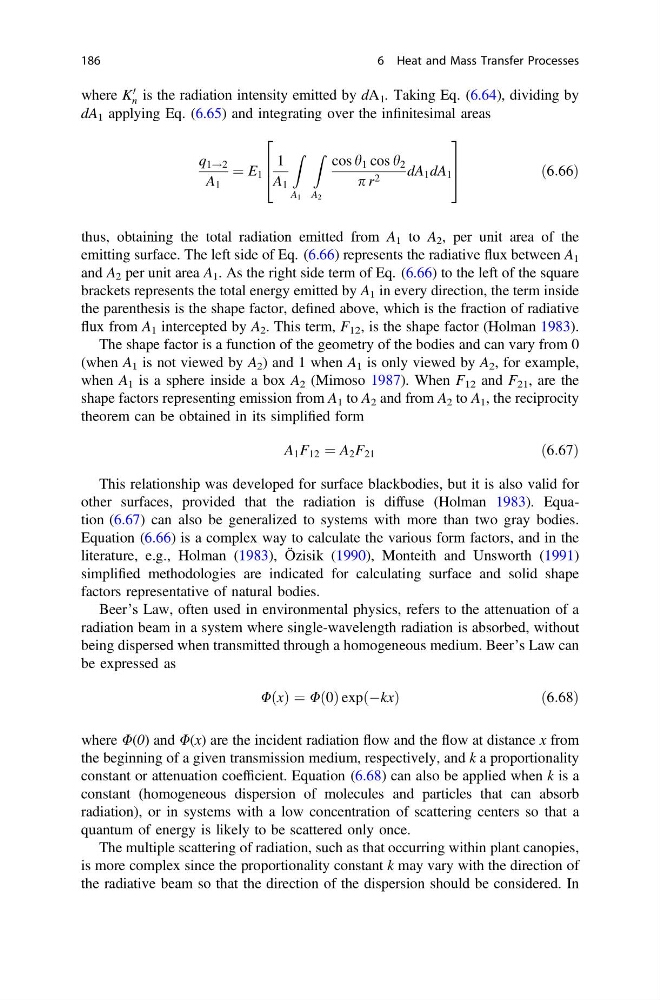
where K
0
n is the radiation intensity emitted by dA 1 . Taking Eq. (6.64), dividing by
dA 1 applying Eq. (6.65) and integrating over the infinitesimal areas
q 1!2
A 1
¼ E 1
1
A 1
Z
A 1
Z
A 2
cos h 1 cos h 2
p r 2
dA 1 dA 1
2
6
4
3
7
5
ð6:66Þ
thus, obtaining the total radiation emitted from A 1 to A 2 , per unit area of the
emitting surface. The left side of Eq. (6.66) represents the radiative flux between A 1
and A 2 per unit area A 1 . As the right side term of Eq. (6.66) to the left of the square
brackets represents the total energy emitted by A 1 in every direction, the term inside
the parenthesis is the shape factor, defined above, which is the fraction of radiative
flux from A 1 intercepted by A 2 . This term, F 12 , is the shape factor (Holman 1983).
The shape factor is a function of the geometry of the bodies and can vary from 0
(when A 1 is not viewed by A 2 ) and 1 when A 1 is only viewed by A 2 , for example,
when A 1 is a sphere inside a box A 2 (Mimoso 1987). When F 12 and F 21 , are the
shape factors representing emission from A 1 to A 2 and from A 2 to A 1 , the reciprocity
theorem can be obtained in its simplified form
A 1 F 12 ¼ A 2 F 21
ð6:67Þ
This relationship was developed for surface blackbodies, but it is also valid for
other surfaces, provided that the radiation is diffuse (Holman 1983). Equation (6.67) can also be generalized to systems with more than two gray bodies.
Equation (6.66) is a complex way to calculate the various form factors, and in the
literature, e.g., Holman (1983), Özisik (1990), Monteith and Unsworth (1991)
simplified methodologies are indicated for calculating surface and solid shape
factors representative of natural bodies.
Beer’s Law, often used in environmental physics, refers to the attenuation of a
radiation beam in a system where single-wavelength radiation is absorbed, without
being dispersed when transmitted through a homogeneous medium. Beer’s Law can
be expressed as
UðxÞ ¼ Uð0Þ expðÀkxÞ
ð 6:68Þ
where U(0) and U(x) are the incident radiation flow and the flow at distance x from
the beginning of a given transmission medium, respectively, and k a proportionality
constant or attenuation coefficient. Equation (6.68) can also be applied when k is a
constant (homogeneous dispersion of molecules and particles that can absorb
radiation), or in systems with a low concentration of scattering centers so that a
quantum of energy is likely to be scattered only once.
The multiple scattering of radiation, such as that occurring within plant canopies,
is more complex since the proportionality constant k may vary with the direction of
the radiative beam so that the direction of the dispersion should be considered. In
186
6 Heat and Mass Transfer Processes
0
n is the radiation intensity emitted by dA 1 . Taking Eq. (6.64), dividing by
dA 1 applying Eq. (6.65) and integrating over the infinitesimal areas
q 1!2
A 1
¼ E 1
1
A 1
Z
A 1
Z
A 2
cos h 1 cos h 2
p r 2
dA 1 dA 1
2
6
4
3
7
5
ð6:66Þ
thus, obtaining the total radiation emitted from A 1 to A 2 , per unit area of the
emitting surface. The left side of Eq. (6.66) represents the radiative flux between A 1
and A 2 per unit area A 1 . As the right side term of Eq. (6.66) to the left of the square
brackets represents the total energy emitted by A 1 in every direction, the term inside
the parenthesis is the shape factor, defined above, which is the fraction of radiative
flux from A 1 intercepted by A 2 . This term, F 12 , is the shape factor (Holman 1983).
The shape factor is a function of the geometry of the bodies and can vary from 0
(when A 1 is not viewed by A 2 ) and 1 when A 1 is only viewed by A 2 , for example,
when A 1 is a sphere inside a box A 2 (Mimoso 1987). When F 12 and F 21 , are the
shape factors representing emission from A 1 to A 2 and from A 2 to A 1 , the reciprocity
theorem can be obtained in its simplified form
A 1 F 12 ¼ A 2 F 21
ð6:67Þ
This relationship was developed for surface blackbodies, but it is also valid for
other surfaces, provided that the radiation is diffuse (Holman 1983). Equation (6.67) can also be generalized to systems with more than two gray bodies.
Equation (6.66) is a complex way to calculate the various form factors, and in the
literature, e.g., Holman (1983), Özisik (1990), Monteith and Unsworth (1991)
simplified methodologies are indicated for calculating surface and solid shape
factors representative of natural bodies.
Beer’s Law, often used in environmental physics, refers to the attenuation of a
radiation beam in a system where single-wavelength radiation is absorbed, without
being dispersed when transmitted through a homogeneous medium. Beer’s Law can
be expressed as
UðxÞ ¼ Uð0Þ expðÀkxÞ
ð 6:68Þ
where U(0) and U(x) are the incident radiation flow and the flow at distance x from
the beginning of a given transmission medium, respectively, and k a proportionality
constant or attenuation coefficient. Equation (6.68) can also be applied when k is a
constant (homogeneous dispersion of molecules and particles that can absorb
radiation), or in systems with a low concentration of scattering centers so that a
quantum of energy is likely to be scattered only once.
The multiple scattering of radiation, such as that occurring within plant canopies,
is more complex since the proportionality constant k may vary with the direction of
the radiative beam so that the direction of the dispersion should be considered. In
186
6 Heat and Mass Transfer Processes