

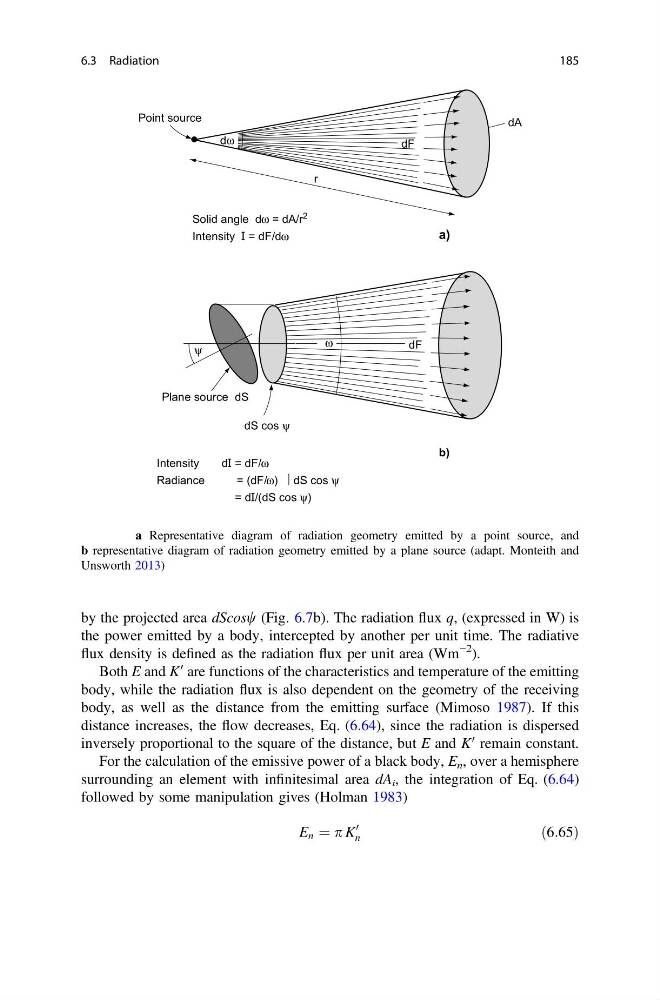
by the projected area dScosw (Fig. 6.7b). The radiation flux q, (expressed in W) is
the power emitted by a body, intercepted by another per unit time. The radiative
flux density is defined as the radiation flux per unit area (Wm
−2 ).
Both E and K
0 are functions of the characteristics and temperature of the emitting
body, while the radiation flux is also dependent on the geometry of the receiving
body, as well as the distance from the emitting surface (Mimoso 1987). If this
distance increases, the flow decreases, Eq. (6.64), since the radiation is dispersed
inversely proportional to the square of the distance, but E and K
0 remain constant.
For the calculation of the emissive power of a black body, E n , over a hemisphere
surrounding an element with infinitesimal area dA i , the integration of Eq. (6.64)
followed by some manipulation gives (Holman 1983)
E n ¼ p K
0
n
ð6:65Þ
Point source
Plane source dS
dS cos ψ
dA
dF
r
dF
Solid angle dω = dA/r
2
Intensity I = dF/dω
dω
Intensity
dI = dF/ω
Radiance
= (dF/ω) ⎟ dS cos ψ
= dI/(dS cos ψ)
a)
b)
ω
ψ
Fig. 6.7 a Representative diagram of radiation geometry emitted by a point source, and
b representative diagram of radiation geometry emitted by a plane source (adapt. Monteith and
Unsworth 2013)
6.3 Radiation
185
the power emitted by a body, intercepted by another per unit time. The radiative
flux density is defined as the radiation flux per unit area (Wm
−2 ).
Both E and K
0 are functions of the characteristics and temperature of the emitting
body, while the radiation flux is also dependent on the geometry of the receiving
body, as well as the distance from the emitting surface (Mimoso 1987). If this
distance increases, the flow decreases, Eq. (6.64), since the radiation is dispersed
inversely proportional to the square of the distance, but E and K
0 remain constant.
For the calculation of the emissive power of a black body, E n , over a hemisphere
surrounding an element with infinitesimal area dA i , the integration of Eq. (6.64)
followed by some manipulation gives (Holman 1983)
E n ¼ p K
0
n
ð6:65Þ
Point source
Plane source dS
dS cos ψ
dA
dF
r
dF
Solid angle dω = dA/r
2
Intensity I = dF/dω
dω
Intensity
dI = dF/ω
Radiance
= (dF/ω) ⎟ dS cos ψ
= dI/(dS cos ψ)
a)
b)
ω
ψ
Fig. 6.7 a Representative diagram of radiation geometry emitted by a point source, and
b representative diagram of radiation geometry emitted by a plane source (adapt. Monteith and
Unsworth 2013)
6.3 Radiation
185