

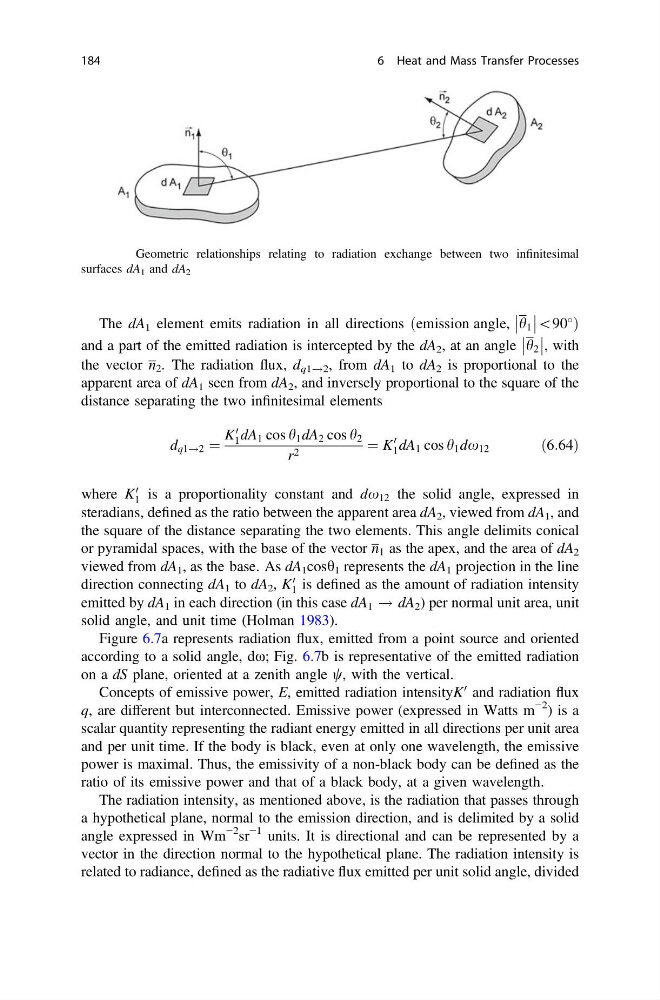
The dA 1 element emits radiation in all directions ðemission angle, h 1
\90
Þ
and a part of the emitted radiation is intercepted by the dA 2 , at an angle h 2
, with
the vector n 2 . The radiation flux, d q1!2 , from dA 1 to dA 2 is proportional to the
apparent area of dA 1 seen from dA 2 , and inversely proportional to the square of the
distance separating the two infinitesimal elements
d q1!2 ¼
K
0
1 dA 1 cos h 1 dA 2 cos h 2
r 2
¼ K
0
1 dA 1 cos h 1 dx 12
ð6:64Þ
where K
0
1 is a proportionality constant and dx 12 the solid angle, expressed in
steradians, defined as the ratio between the apparent area dA 2 , viewed from dA 1 , and
the square of the distance separating the two elements. This angle delimits conical
or pyramidal spaces, with the base of the vector n 1 as the apex, and the area of dA 2
viewed from dA 1 , as the base. As dA 1 cosh 1 represents the dA 1 projection in the line
direction connecting dA 1 to dA 2 , K
0
1 is defined as the amount of radiation intensity
emitted by dA 1 in each direction (in this case dA 1 ! dA 2 ) per normal unit area, unit
solid angle, and unit time (Holman 1983).
Figure 6.7a represents radiation flux, emitted from a point source and oriented
according to a solid angle, dx; Fig. 6.7b is representative of the emitted radiation
on a dS plane, oriented at a zenith angle w, with the vertical.
Concepts of emissive power, E, emitted radiation intensityK
0 and radiation flux
q, are different but interconnected. Emissive power (expressed in Watts m
−2 ) is a
scalar quantity representing the radiant energy emitted in all directions per unit area
and per unit time. If the body is black, even at only one wavelength, the emissive
power is maximal. Thus, the emissivity of a non-black body can be defined as the
ratio of its emissive power and that of a black body, at a given wavelength.
The radiation intensity, as mentioned above, is the radiation that passes through
a hypothetical plane, normal to the emission direction, and is delimited by a solid
angle expressed in Wm
−2 sr
−1 units. It is directional and can be represented by a
vector in the direction normal to the hypothetical plane. The radiation intensity is
related to radiance, defined as the radiative flux emitted per unit solid angle, divided
Fig. 6.6 Geometric relationships relating to radiation exchange between two infinitesimal
surfaces dA 1 and dA 2
184
6 Heat and Mass Transfer Processes
\90
Þ
and a part of the emitted radiation is intercepted by the dA 2 , at an angle h 2
, with
the vector n 2 . The radiation flux, d q1!2 , from dA 1 to dA 2 is proportional to the
apparent area of dA 1 seen from dA 2 , and inversely proportional to the square of the
distance separating the two infinitesimal elements
d q1!2 ¼
K
0
1 dA 1 cos h 1 dA 2 cos h 2
r 2
¼ K
0
1 dA 1 cos h 1 dx 12
ð6:64Þ
where K
0
1 is a proportionality constant and dx 12 the solid angle, expressed in
steradians, defined as the ratio between the apparent area dA 2 , viewed from dA 1 , and
the square of the distance separating the two elements. This angle delimits conical
or pyramidal spaces, with the base of the vector n 1 as the apex, and the area of dA 2
viewed from dA 1 , as the base. As dA 1 cosh 1 represents the dA 1 projection in the line
direction connecting dA 1 to dA 2 , K
0
1 is defined as the amount of radiation intensity
emitted by dA 1 in each direction (in this case dA 1 ! dA 2 ) per normal unit area, unit
solid angle, and unit time (Holman 1983).
Figure 6.7a represents radiation flux, emitted from a point source and oriented
according to a solid angle, dx; Fig. 6.7b is representative of the emitted radiation
on a dS plane, oriented at a zenith angle w, with the vertical.
Concepts of emissive power, E, emitted radiation intensityK
0 and radiation flux
q, are different but interconnected. Emissive power (expressed in Watts m
−2 ) is a
scalar quantity representing the radiant energy emitted in all directions per unit area
and per unit time. If the body is black, even at only one wavelength, the emissive
power is maximal. Thus, the emissivity of a non-black body can be defined as the
ratio of its emissive power and that of a black body, at a given wavelength.
The radiation intensity, as mentioned above, is the radiation that passes through
a hypothetical plane, normal to the emission direction, and is delimited by a solid
angle expressed in Wm
−2 sr
−1 units. It is directional and can be represented by a
vector in the direction normal to the hypothetical plane. The radiation intensity is
related to radiance, defined as the radiative flux emitted per unit solid angle, divided
Fig. 6.6 Geometric relationships relating to radiation exchange between two infinitesimal
surfaces dA 1 and dA 2
184
6 Heat and Mass Transfer Processes