

6.3.2 Spatial Relationships
Radiant energy rays emitted from a point source (Wm
−2 ) passing through a
homogeneous medium are parallel over a circular section if the linear characteristic
dimension of this section is small relative to the distance to the emitting source.
This principle applies to the sun rays relative to the earth–sun length. Irradiance and
emittance can be used to evaluate the radiative balance of surfaces. The irradiance J,
of a surface, is the total power incident on the surface per unit area. The emittance
of a surface is the radiant energy emitted per unit of time and per unit area. The
reflectivity of a surface of q (k) is defined as the ratio between the incident and
reflected flux at the same wavelength. If reflectivity q, has a unit value, the body is a
perfect reflector.
The reflected radiation depends on the surface properties of the bodies, which
can be specular or diffuse. For specular reflective surfaces a radiative beam with an
incidence angle w, relative to the reference, is reflected at the same angle (−w).
Often natural surfaces act as diffuse reflectors, scattering fractions of the incident
radiation in all directions. According to the Lambert cosine law, the scattered
energy is independent of the angle of incidence, but the radiant flux reflected from a
given surface is proportional to cos w.
The reflection at the surface of a natural body depends on the surface structure
and its electrical properties (Monteith and Unsworth 1991). In general, natural
surfaces (e.g., water, leaves, or smooth surfaces) are diffuse reflectors, when the
zenith angle (defined between the direction of the solar rays and the normal to the
location) is <60º to 70º. Specular reflection predominates when the angles are
higher, as specular reflectors absorb less radiation than diffuse reflective surfaces.
The interception of direct sunlight causes great seasonal, daily, and spatial
variability in radiation regimes. An opaque body in the sun’s path casts a shadow,
changing the radiative climate over this area. The local topography, canopy density,
as well as other natural bodies, introduce light and shade patterns which are surface
energy sources and sinks, influencing biological processes (Lee 1978). The shadow
area on a horizontal surface, A h , multiplied by the horizontal flux density of direct
radiation, S b , equals the total flux intercepted by the body, and
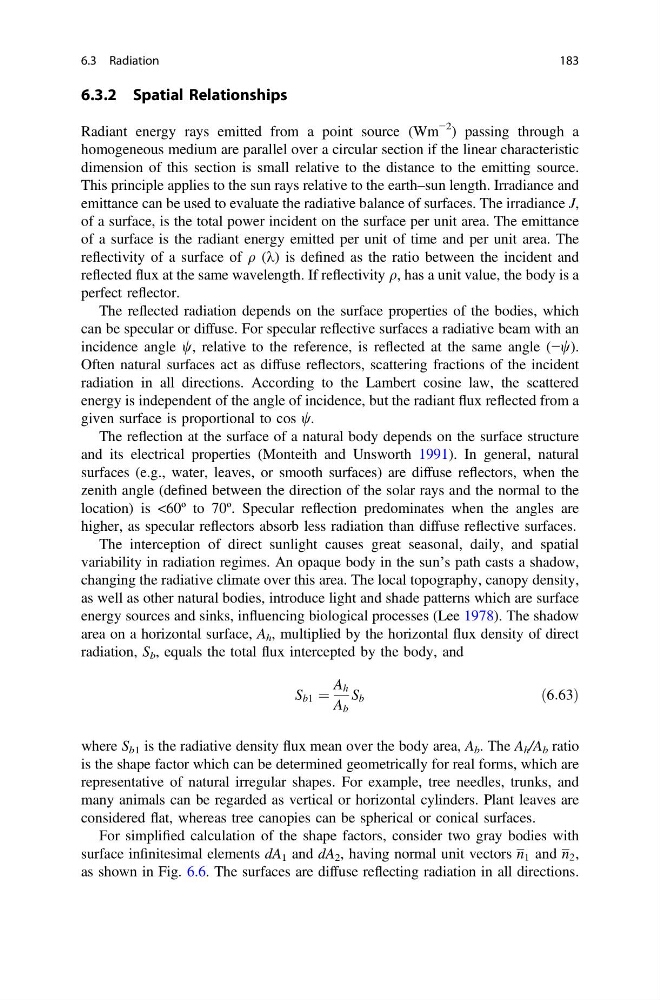
S b1 ¼
A h
A b
S b
ð6:63Þ
where S b1 is the radiative density flux mean over the body area, A b . The A h /A b ratio
is the shape factor which can be determined geometrically for real forms, which are
representative of natural irregular shapes. For example, tree needles, trunks, and
many animals can be regarded as vertical or horizontal cylinders. Plant leaves are
considered flat, whereas tree canopies can be spherical or conical surfaces.
For simplified calculation of the shape factors, consider two gray bodies with
surface infinitesimal elements dA 1 and dA 2 , having normal unit vectors n 1 and n 2 ,
as shown in Fig. 6.6. The surfaces are diffuse reflecting radiation in all directions.
6.3 Radiation
183
Radiant energy rays emitted from a point source (Wm
−2 ) passing through a
homogeneous medium are parallel over a circular section if the linear characteristic
dimension of this section is small relative to the distance to the emitting source.
This principle applies to the sun rays relative to the earth–sun length. Irradiance and
emittance can be used to evaluate the radiative balance of surfaces. The irradiance J,
of a surface, is the total power incident on the surface per unit area. The emittance
of a surface is the radiant energy emitted per unit of time and per unit area. The
reflectivity of a surface of q (k) is defined as the ratio between the incident and
reflected flux at the same wavelength. If reflectivity q, has a unit value, the body is a
perfect reflector.
The reflected radiation depends on the surface properties of the bodies, which
can be specular or diffuse. For specular reflective surfaces a radiative beam with an
incidence angle w, relative to the reference, is reflected at the same angle (−w).
Often natural surfaces act as diffuse reflectors, scattering fractions of the incident
radiation in all directions. According to the Lambert cosine law, the scattered
energy is independent of the angle of incidence, but the radiant flux reflected from a
given surface is proportional to cos w.
The reflection at the surface of a natural body depends on the surface structure
and its electrical properties (Monteith and Unsworth 1991). In general, natural
surfaces (e.g., water, leaves, or smooth surfaces) are diffuse reflectors, when the
zenith angle (defined between the direction of the solar rays and the normal to the
location) is <60º to 70º. Specular reflection predominates when the angles are
higher, as specular reflectors absorb less radiation than diffuse reflective surfaces.
The interception of direct sunlight causes great seasonal, daily, and spatial
variability in radiation regimes. An opaque body in the sun’s path casts a shadow,
changing the radiative climate over this area. The local topography, canopy density,
as well as other natural bodies, introduce light and shade patterns which are surface
energy sources and sinks, influencing biological processes (Lee 1978). The shadow
area on a horizontal surface, A h , multiplied by the horizontal flux density of direct
radiation, S b , equals the total flux intercepted by the body, and
S b1 ¼
A h
A b
S b
ð6:63Þ
where S b1 is the radiative density flux mean over the body area, A b . The A h /A b ratio
is the shape factor which can be determined geometrically for real forms, which are
representative of natural irregular shapes. For example, tree needles, trunks, and
many animals can be regarded as vertical or horizontal cylinders. Plant leaves are
considered flat, whereas tree canopies can be spherical or conical surfaces.
For simplified calculation of the shape factors, consider two gray bodies with
surface infinitesimal elements dA 1 and dA 2 , having normal unit vectors n 1 and n 2 ,
as shown in Fig. 6.6. The surfaces are diffuse reflecting radiation in all directions.
6.3 Radiation
183