

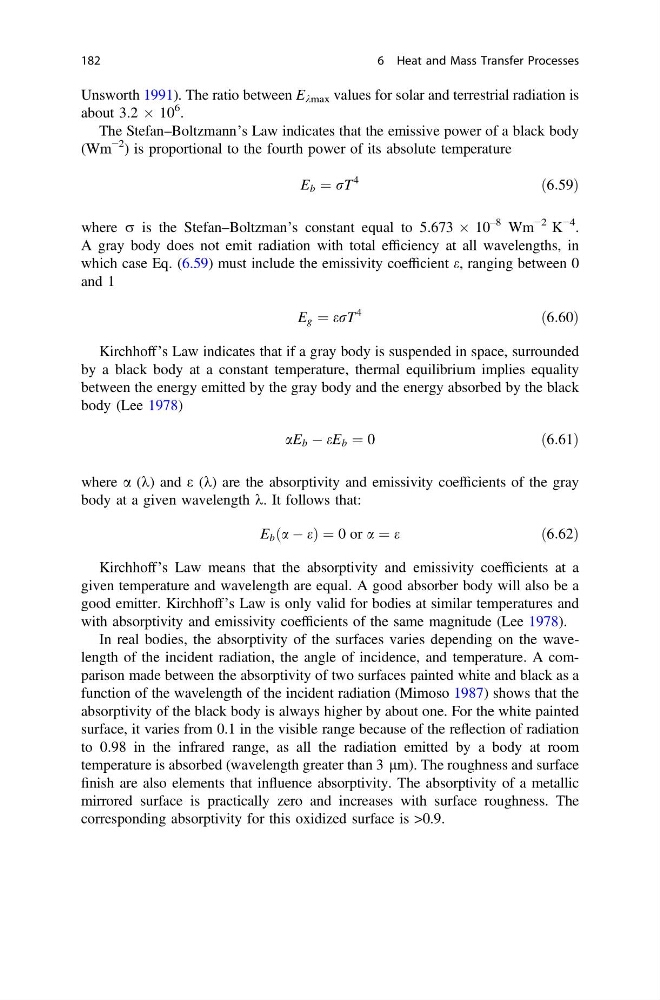
Unsworth 1991). The ratio between E kmax values for solar and terrestrial radiation is
about 3.2 Â 10
6 .
The Stefan–Boltzmann’s Law indicates that the emissive power of a black body
(Wm
−2 ) is proportional to the fourth power of its absolute temperature
E b ¼ rT
4
ð6:59Þ
where r is the Stefan–Boltzman’s constant equal to 5.673 Â 10
–8 Wm
−2 K
−4 .
A gray body does not emit radiation with total efficiency at all wavelengths, in
which case Eq. (6.59) must include the emissivity coefficient e, ranging between 0
and 1
E g ¼ erT
4
ð6:60Þ
Kirchhoff’s Law indicates that if a gray body is suspended in space, surrounded
by a black body at a constant temperature, thermal equilibrium implies equality
between the energy emitted by the gray body and the energy absorbed by the black
body (Lee 1978)
aE b À eE b ¼ 0
ð6:61Þ
where a (k) and e (k) are the absorptivity and emissivity coefficients of the gray
body at a given wavelength k. It follows that:
E b ða À eÞ ¼ 0 or a ¼ e
ð6:62Þ
Kirchhoff’s Law means that the absorptivity and emissivity coefficients at a
given temperature and wavelength are equal. A good absorber body will also be a
good emitter. Kirchhoff’s Law is only valid for bodies at similar temperatures and
with absorptivity and emissivity coefficients of the same magnitude (Lee 1978).
In real bodies, the absorptivity of the surfaces varies depending on the wavelength of the incident radiation, the angle of incidence, and temperature. A comparison made between the absorptivity of two surfaces painted white and black as a
function of the wavelength of the incident radiation (Mimoso 1987) shows that the
absorptivity of the black body is always higher by about one. For the white painted
surface, it varies from 0.1 in the visible range because of the reflection of radiation
to 0.98 in the infrared range, as all the radiation emitted by a body at room
temperature is absorbed (wavelength greater than 3 lm). The roughness and surface
finish are also elements that influence absorptivity. The absorptivity of a metallic
mirrored surface is practically zero and increases with surface roughness. The
corresponding absorptivity for this oxidized surface is >0.9.
182
6 Heat and Mass Transfer Processes
about 3.2 Â 10
6 .
The Stefan–Boltzmann’s Law indicates that the emissive power of a black body
(Wm
−2 ) is proportional to the fourth power of its absolute temperature
E b ¼ rT
4
ð6:59Þ
where r is the Stefan–Boltzman’s constant equal to 5.673 Â 10
–8 Wm
−2 K
−4 .
A gray body does not emit radiation with total efficiency at all wavelengths, in
which case Eq. (6.59) must include the emissivity coefficient e, ranging between 0
and 1
E g ¼ erT
4
ð6:60Þ
Kirchhoff’s Law indicates that if a gray body is suspended in space, surrounded
by a black body at a constant temperature, thermal equilibrium implies equality
between the energy emitted by the gray body and the energy absorbed by the black
body (Lee 1978)
aE b À eE b ¼ 0
ð6:61Þ
where a (k) and e (k) are the absorptivity and emissivity coefficients of the gray
body at a given wavelength k. It follows that:
E b ða À eÞ ¼ 0 or a ¼ e
ð6:62Þ
Kirchhoff’s Law means that the absorptivity and emissivity coefficients at a
given temperature and wavelength are equal. A good absorber body will also be a
good emitter. Kirchhoff’s Law is only valid for bodies at similar temperatures and
with absorptivity and emissivity coefficients of the same magnitude (Lee 1978).
In real bodies, the absorptivity of the surfaces varies depending on the wavelength of the incident radiation, the angle of incidence, and temperature. A comparison made between the absorptivity of two surfaces painted white and black as a
function of the wavelength of the incident radiation (Mimoso 1987) shows that the
absorptivity of the black body is always higher by about one. For the white painted
surface, it varies from 0.1 in the visible range because of the reflection of radiation
to 0.98 in the infrared range, as all the radiation emitted by a body at room
temperature is absorbed (wavelength greater than 3 lm). The roughness and surface
finish are also elements that influence absorptivity. The absorptivity of a metallic
mirrored surface is practically zero and increases with surface roughness. The
corresponding absorptivity for this oxidized surface is >0.9.
182
6 Heat and Mass Transfer Processes