

all the radiation at a given temperature. A perfect black body absorbs all incident
radiation at all wavelengths. The blackbody concept deals with theoretically ideal
radiative characteristics for comparison with the radiative characteristics of real
bodies. About 99% of black body emissions at surface temperatures of the earth and
sun of 300 and 6000 K, corresponds to the wavelength ranges of 0.2–4 lm and 4–
100 lm, denoted short and long-wavelength radiation, respectively.
In an empty space or homogeneous medium, radiation propagates linearly and
energy from a given point reaches an area A, so that the flux per unit area E i ,
decreases with the inverse square of distance d, from the source (principle of the
inverse square). The product E i A i is constant and E 1 d
2
2 ¼ E 2 =d
2
1 . The concept of
point radiation is a theoretical abstraction when the source is small relative to the
distance traveled as is the case of the sun in relation to the earth’s distance.
The radiant energy incident on a surface is either reflected, absorbed, or transmitted. At a given wavelength, the reflectivity q(k), absorptivity, a(k), and transmissivity, s(k), are the ratios of the radiation reflected, absorbed, and transmitted
and the incident radiation, respectively. At a given wavelength, or on the average
across the spectrum, q (k) + a (k) + s (k) = 1 and for a blackbody at all wavelengths, q(k) = s(k) = 0 and a(k) = 1.
When transmissivity is zero, a body is referred to as opaque. For many natural
surfaces such as soil, water, and vegetation, it can be assumed that the emissivity is
one for wavelengths between 4 and 100 lm, at typical earth surface temperatures.
Snow is a black body as it emits radiation within this range regardless of the range
of the reflected solar radiation, due to its white color.
An object in a sealed vacuum container has a thermal equilibrium so that
radiation absorbed at a given wavelength a(k), is equal to the energy emitted at this
wavelength e(k) (e.g., Monteith and Unsworth 1991).
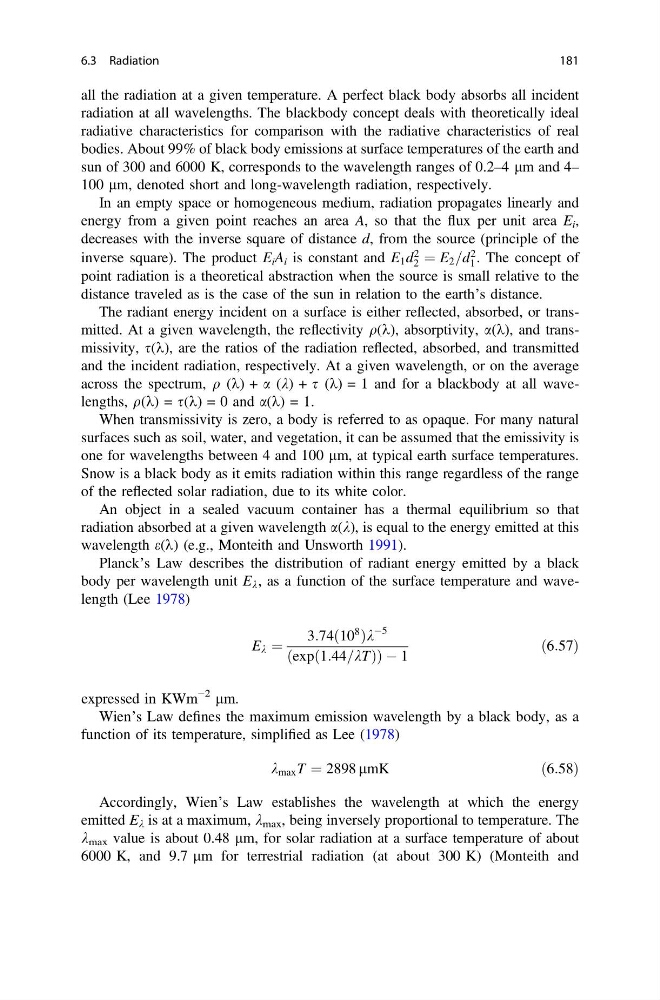
Planck’s Law describes the distribution of radiant energy emitted by a black
body per wavelength unit E k , as a function of the surface temperature and wavelength (Lee 1978)
E k ¼
3:74ð10
8
Þk
À5
expð1:44=kTÞ
ð
Þ À 1
ð6:57Þ
expressed in KWm
−2
lm.
Wien’s Law defines the maximum emission wavelength by a black body, as a
function of its temperature, simplified as Lee (1978)
k max T ¼ 2898 lmK
ð6:58Þ
Accordingly, Wien’s Law establishes the wavelength at which the energy
emitted E k is at a maximum, k max , being inversely proportional to temperature. The
k max value is about 0.48 lm, for solar radiation at a surface temperature of about
6000 K, and 9.7 lm for terrestrial radiation (at about 300 K) (Monteith and
6.3 Radiation
181
radiation at all wavelengths. The blackbody concept deals with theoretically ideal
radiative characteristics for comparison with the radiative characteristics of real
bodies. About 99% of black body emissions at surface temperatures of the earth and
sun of 300 and 6000 K, corresponds to the wavelength ranges of 0.2–4 lm and 4–
100 lm, denoted short and long-wavelength radiation, respectively.
In an empty space or homogeneous medium, radiation propagates linearly and
energy from a given point reaches an area A, so that the flux per unit area E i ,
decreases with the inverse square of distance d, from the source (principle of the
inverse square). The product E i A i is constant and E 1 d
2
2 ¼ E 2 =d
2
1 . The concept of
point radiation is a theoretical abstraction when the source is small relative to the
distance traveled as is the case of the sun in relation to the earth’s distance.
The radiant energy incident on a surface is either reflected, absorbed, or transmitted. At a given wavelength, the reflectivity q(k), absorptivity, a(k), and transmissivity, s(k), are the ratios of the radiation reflected, absorbed, and transmitted
and the incident radiation, respectively. At a given wavelength, or on the average
across the spectrum, q (k) + a (k) + s (k) = 1 and for a blackbody at all wavelengths, q(k) = s(k) = 0 and a(k) = 1.
When transmissivity is zero, a body is referred to as opaque. For many natural
surfaces such as soil, water, and vegetation, it can be assumed that the emissivity is
one for wavelengths between 4 and 100 lm, at typical earth surface temperatures.
Snow is a black body as it emits radiation within this range regardless of the range
of the reflected solar radiation, due to its white color.
An object in a sealed vacuum container has a thermal equilibrium so that
radiation absorbed at a given wavelength a(k), is equal to the energy emitted at this
wavelength e(k) (e.g., Monteith and Unsworth 1991).
Planck’s Law describes the distribution of radiant energy emitted by a black
body per wavelength unit E k , as a function of the surface temperature and wavelength (Lee 1978)
E k ¼
3:74ð10
8
Þk
À5
expð1:44=kTÞ
ð
Þ À 1
ð6:57Þ
expressed in KWm
−2
lm.
Wien’s Law defines the maximum emission wavelength by a black body, as a
function of its temperature, simplified as Lee (1978)
k max T ¼ 2898 lmK
ð6:58Þ
Accordingly, Wien’s Law establishes the wavelength at which the energy
emitted E k is at a maximum, k max , being inversely proportional to temperature. The
k max value is about 0.48 lm, for solar radiation at a surface temperature of about
6000 K, and 9.7 lm for terrestrial radiation (at about 300 K) (Monteith and
6.3 Radiation
181