

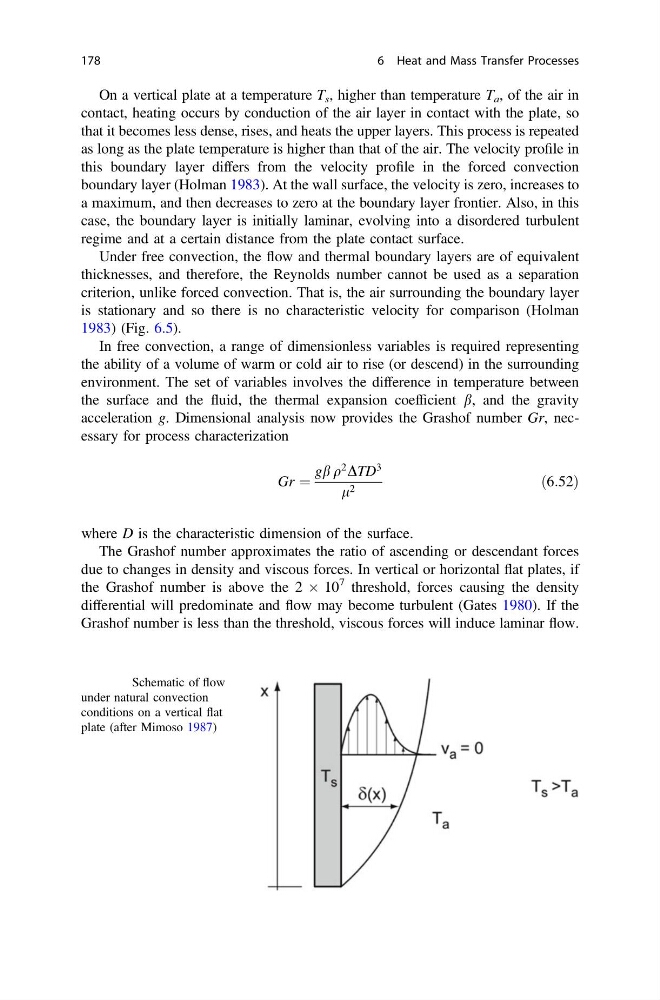
On a vertical plate at a temperature T s , higher than temperature T a , of the air in
contact, heating occurs by conduction of the air layer in contact with the plate, so
that it becomes less dense, rises, and heats the upper layers. This process is repeated
as long as the plate temperature is higher than that of the air. The velocity profile in
this boundary layer differs from the velocity profile in the forced convection
boundary layer (Holman 1983). At the wall surface, the velocity is zero, increases to
a maximum, and then decreases to zero at the boundary layer frontier. Also, in this
case, the boundary layer is initially laminar, evolving into a disordered turbulent
regime and at a certain distance from the plate contact surface.
Under free convection, the flow and thermal boundary layers are of equivalent
thicknesses, and therefore, the Reynolds number cannot be used as a separation
criterion, unlike forced convection. That is, the air surrounding the boundary layer
is stationary and so there is no characteristic velocity for comparison (Holman
1983) (Fig. 6.5).
In free convection, a range of dimensionless variables is required representing
the ability of a volume of warm or cold air to rise (or descend) in the surrounding
environment. The set of variables involves the difference in temperature between
the surface and the fluid, the thermal expansion coefficient b, and the gravity
acceleration g. Dimensional analysis now provides the Grashof number Gr, necessary for process characterization
Gr ¼
gb q
2
DTD
3
l 2
ð6:52Þ
where D is the characteristic dimension of the surface.
The Grashof number approximates the ratio of ascending or descendant forces
due to changes in density and viscous forces. In vertical or horizontal flat plates, if
the Grashof number is above the 2 Â 10
7 threshold, forces causing the density
differential will predominate and flow may become turbulent (Gates 1980). If the
Grashof number is less than the threshold, viscous forces will induce laminar flow.
Fig. 6.5 Schematic of flow
under natural convection
conditions on a vertical flat
plate (after Mimoso 1987)
178
6 Heat and Mass Transfer Processes
contact, heating occurs by conduction of the air layer in contact with the plate, so
that it becomes less dense, rises, and heats the upper layers. This process is repeated
as long as the plate temperature is higher than that of the air. The velocity profile in
this boundary layer differs from the velocity profile in the forced convection
boundary layer (Holman 1983). At the wall surface, the velocity is zero, increases to
a maximum, and then decreases to zero at the boundary layer frontier. Also, in this
case, the boundary layer is initially laminar, evolving into a disordered turbulent
regime and at a certain distance from the plate contact surface.
Under free convection, the flow and thermal boundary layers are of equivalent
thicknesses, and therefore, the Reynolds number cannot be used as a separation
criterion, unlike forced convection. That is, the air surrounding the boundary layer
is stationary and so there is no characteristic velocity for comparison (Holman
1983) (Fig. 6.5).
In free convection, a range of dimensionless variables is required representing
the ability of a volume of warm or cold air to rise (or descend) in the surrounding
environment. The set of variables involves the difference in temperature between
the surface and the fluid, the thermal expansion coefficient b, and the gravity
acceleration g. Dimensional analysis now provides the Grashof number Gr, necessary for process characterization
Gr ¼
gb q
2
DTD
3
l 2
ð6:52Þ
where D is the characteristic dimension of the surface.
The Grashof number approximates the ratio of ascending or descendant forces
due to changes in density and viscous forces. In vertical or horizontal flat plates, if
the Grashof number is above the 2 Â 10
7 threshold, forces causing the density
differential will predominate and flow may become turbulent (Gates 1980). If the
Grashof number is less than the threshold, viscous forces will induce laminar flow.
Fig. 6.5 Schematic of flow
under natural convection
conditions on a vertical flat
plate (after Mimoso 1987)
178
6 Heat and Mass Transfer Processes