

The results of the dimensional analysis for free convection give a general
expression of the type
Nu ¼ fðGr; PrÞ % BGr
m
ð6:53Þ
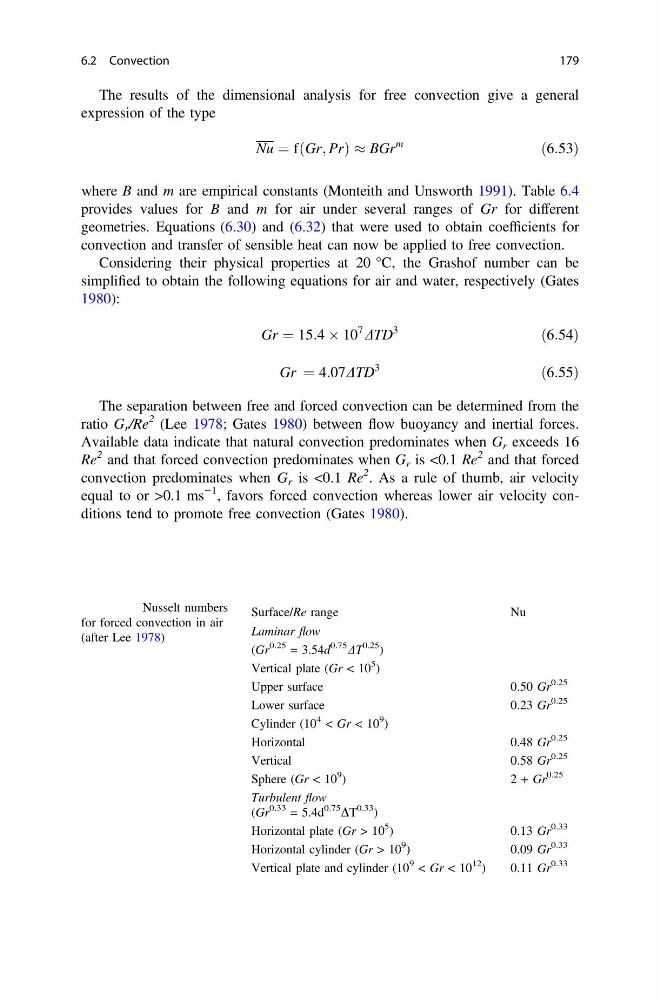
where B and m are empirical constants (Monteith and Unsworth 1991). Table 6.4
provides values for B and m for air under several ranges of Gr for different
geometries. Equations (6.30) and (6.32) that were used to obtain coefficients for
convection and transfer of sensible heat can now be applied to free convection.
Considering their physical properties at 20 °C, the Grashof number can be
simplified to obtain the following equations for air and water, respectively (Gates
1980):
Gr ¼ 15:4 Â 10
7 DTD
3
ð6:54Þ
Gr ¼ 4:07DTD
3
ð6:55Þ
The separation between free and forced convection can be determined from the
ratio G r /Re
2 (Lee 1978; Gates 1980) between flow buoyancy and inertial forces.
Available data indicate that natural convection predominates when G r exceeds 16
Re
2 and that forced convection predominates when G r is <0.1 Re
2 and that forced
convection predominates when G r is <0.1 Re
2 . As a rule of thumb, air velocity
equal to or >0.1 ms
−1 , favors forced convection whereas lower air velocity conditions tend to promote free convection (Gates 1980).
Table 6.4 Nusselt numbers
for forced convection in air
(after Lee 1978)
Surface/Re range
Nu
Laminar flow
(Gr
0.25 = 3.54d
0.75
DT
0.25
)
Vertical plate (Gr < 10
5
)
Upper surface
0.50 Gr
0.25
Lower surface
0.23 Gr
0.25
Cylinder (10
4 < Gr < 10
9
)
Horizontal
0.48 Gr
0.25
Vertical
0.58 Gr
0.25
Sphere (Gr < 10
9
)
2 + Gr
0.25
Turbulent flow
(Gr
0.33 = 5.4d
0.75
DT
0.33
)
Horizontal plate (Gr > 10
5
)
0.13 Gr
0.33
Horizontal cylinder (Gr > 10
9
)
0.09 Gr
0.33
Vertical plate and cylinder (10
9 < Gr < 10
12
)
0.11 Gr
0.33
6.2 Convection
179
expression of the type
Nu ¼ fðGr; PrÞ % BGr
m
ð6:53Þ
where B and m are empirical constants (Monteith and Unsworth 1991). Table 6.4
provides values for B and m for air under several ranges of Gr for different
geometries. Equations (6.30) and (6.32) that were used to obtain coefficients for
convection and transfer of sensible heat can now be applied to free convection.
Considering their physical properties at 20 °C, the Grashof number can be
simplified to obtain the following equations for air and water, respectively (Gates
1980):
Gr ¼ 15:4 Â 10
7 DTD
3
ð6:54Þ
Gr ¼ 4:07DTD
3
ð6:55Þ
The separation between free and forced convection can be determined from the
ratio G r /Re
2 (Lee 1978; Gates 1980) between flow buoyancy and inertial forces.
Available data indicate that natural convection predominates when G r exceeds 16
Re
2 and that forced convection predominates when G r is <0.1 Re
2 and that forced
convection predominates when G r is <0.1 Re
2 . As a rule of thumb, air velocity
equal to or >0.1 ms
−1 , favors forced convection whereas lower air velocity conditions tend to promote free convection (Gates 1980).
Table 6.4 Nusselt numbers
for forced convection in air
(after Lee 1978)
Surface/Re range
Nu
Laminar flow
(Gr
0.25 = 3.54d
0.75
DT
0.25
)
Vertical plate (Gr < 10
5
)
Upper surface
0.50 Gr
0.25
Lower surface
0.23 Gr
0.25
Cylinder (10
4 < Gr < 10
9
)
Horizontal
0.48 Gr
0.25
Vertical
0.58 Gr
0.25
Sphere (Gr < 10
9
)
2 + Gr
0.25
Turbulent flow
(Gr
0.33 = 5.4d
0.75
DT
0.33
)
Horizontal plate (Gr > 10
5
)
0.13 Gr
0.33
Horizontal cylinder (Gr > 10
9
)
0.09 Gr
0.33
Vertical plate and cylinder (10
9 < Gr < 10
12
)
0.11 Gr
0.33
6.2 Convection
179