

cross-section to about 90° and the adverse pressure gradient is formed outside the
boundary layer where viscosity is negligible.
The pressure gradient is established by analogy with the flow in the absence of
viscosity, in which the velocity corresponds to pressure decreases and flow separation, leading to a wake. The complexity of convection lies in the fact that wake
turbulence promotes recirculation of the fluid and is not very effective in transferring heat.
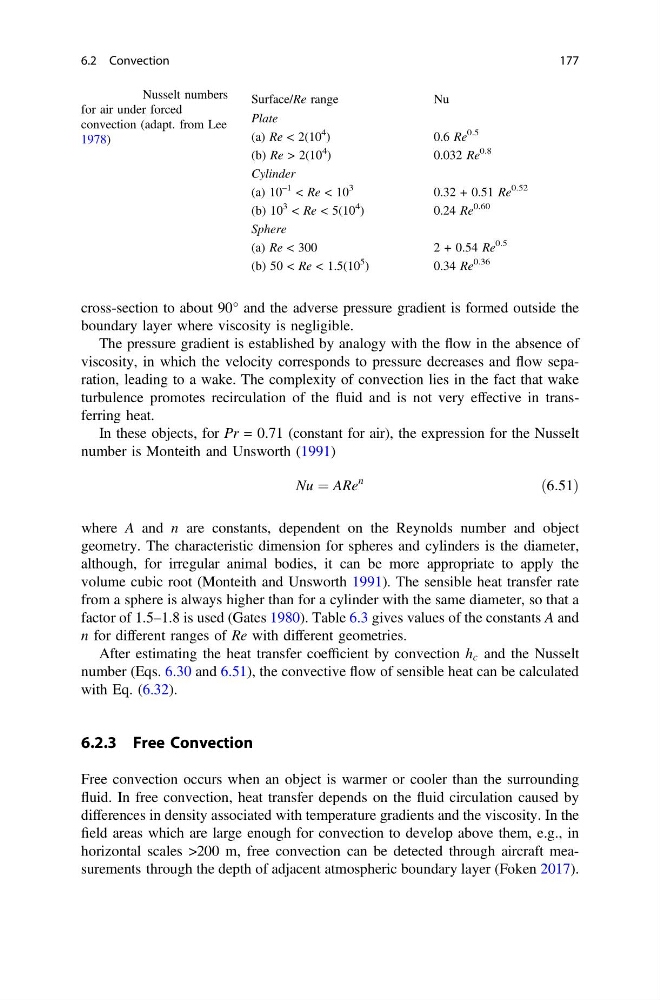
In these objects, for Pr = 0.71 (constant for air), the expression for the Nusselt
number is Monteith and Unsworth (1991)
Nu ¼ ARe
n
ð6:51Þ
where A and n are constants, dependent on the Reynolds number and object
geometry. The characteristic dimension for spheres and cylinders is the diameter,
although, for irregular animal bodies, it can be more appropriate to apply the
volume cubic root (Monteith and Unsworth 1991). The sensible heat transfer rate
from a sphere is always higher than for a cylinder with the same diameter, so that a
factor of 1.5–1.8 is used (Gates 1980). Table 6.3 gives values of the constants A and
n for different ranges of Re with different geometries.
After estimating the heat transfer coefficient by convection h c and the Nusselt
number (Eqs. 6.30 and 6.51), the convective flow of sensible heat can be calculated
with Eq. (6.32).
6.2.3 Free Convection
Free convection occurs when an object is warmer or cooler than the surrounding
fluid. In free convection, heat transfer depends on the fluid circulation caused by
differences in density associated with temperature gradients and the viscosity. In the
field areas which are large enough for convection to develop above them, e.g., in
horizontal scales >200 m, free convection can be detected through aircraft measurements through the depth of adjacent atmospheric boundary layer (Foken 2017).
Table 6.3 Nusselt numbers
for air under forced
convection (adapt. from Lee
1978)
Surface/Re range
Nu
Plate
(a) Re < 2(10
4
)
0.6 Re
0.5
(b) Re > 2(10
4
)
0.032 Re
0.8
Cylinder
(a) 10
–1 < Re < 10
3
0.32 + 0.51 Re
0.52
(b) 10
3 < Re < 5(10
4
)
0.24 Re
0.60
Sphere
(a) Re < 300
2 + 0.54 Re
0.5
(b) 50 < Re < 1.5(10
5
)
0.34 Re
0.36
6.2 Convection
177
boundary layer where viscosity is negligible.
The pressure gradient is established by analogy with the flow in the absence of
viscosity, in which the velocity corresponds to pressure decreases and flow separation, leading to a wake. The complexity of convection lies in the fact that wake
turbulence promotes recirculation of the fluid and is not very effective in transferring heat.
In these objects, for Pr = 0.71 (constant for air), the expression for the Nusselt
number is Monteith and Unsworth (1991)
Nu ¼ ARe
n
ð6:51Þ
where A and n are constants, dependent on the Reynolds number and object
geometry. The characteristic dimension for spheres and cylinders is the diameter,
although, for irregular animal bodies, it can be more appropriate to apply the
volume cubic root (Monteith and Unsworth 1991). The sensible heat transfer rate
from a sphere is always higher than for a cylinder with the same diameter, so that a
factor of 1.5–1.8 is used (Gates 1980). Table 6.3 gives values of the constants A and
n for different ranges of Re with different geometries.
After estimating the heat transfer coefficient by convection h c and the Nusselt
number (Eqs. 6.30 and 6.51), the convective flow of sensible heat can be calculated
with Eq. (6.32).
6.2.3 Free Convection
Free convection occurs when an object is warmer or cooler than the surrounding
fluid. In free convection, heat transfer depends on the fluid circulation caused by
differences in density associated with temperature gradients and the viscosity. In the
field areas which are large enough for convection to develop above them, e.g., in
horizontal scales >200 m, free convection can be detected through aircraft measurements through the depth of adjacent atmospheric boundary layer (Foken 2017).
Table 6.3 Nusselt numbers
for air under forced
convection (adapt. from Lee
1978)
Surface/Re range
Nu
Plate
(a) Re < 2(10
4
)
0.6 Re
0.5
(b) Re > 2(10
4
)
0.032 Re
0.8
Cylinder
(a) 10
–1 < Re < 10
3
0.32 + 0.51 Re
0.52
(b) 10
3 < Re < 5(10
4
)
0.24 Re
0.60
Sphere
(a) Re < 300
2 + 0.54 Re
0.5
(b) 50 < Re < 1.5(10
5
)
0.34 Re
0.36
6.2 Convection
177