

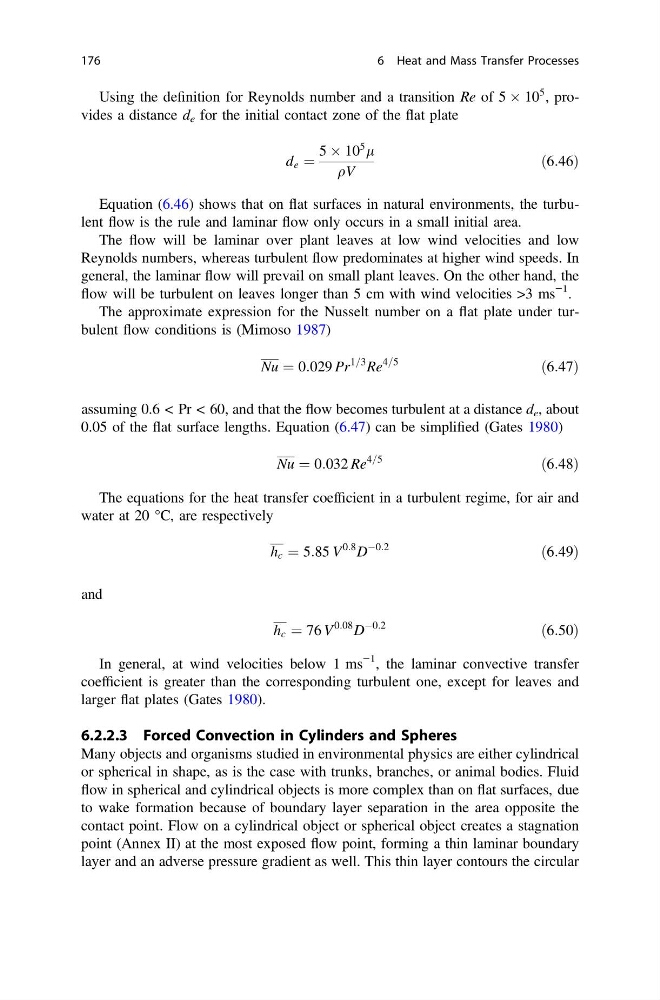
Using the definition for Reynolds number and a transition Re of 5 Â 10
5 , provides a distance d e for the initial contact zone of the flat plate
d e ¼
5 Â 10
5 l
qV
ð6:46Þ
Equation (6.46) shows that on flat surfaces in natural environments, the turbulent flow is the rule and laminar flow only occurs in a small initial area.
The flow will be laminar over plant leaves at low wind velocities and low
Reynolds numbers, whereas turbulent flow predominates at higher wind speeds. In
general, the laminar flow will prevail on small plant leaves. On the other hand, the
flow will be turbulent on leaves longer than 5 cm with wind velocities >3 ms
−1 .
The approximate expression for the Nusselt number on a flat plate under turbulent flow conditions is (Mimoso 1987)
Nu ¼ 0:029 Pr
1=3 Re
4=5
ð6:47Þ
assuming 0.6 < Pr < 60, and that the flow becomes turbulent at a distance d e , about
0.05 of the flat surface lengths. Equation (6.47) can be simplified (Gates 1980)
Nu ¼ 0:032 Re
4=5
ð6:48Þ
The equations for the heat transfer coefficient in a turbulent regime, for air and
water at 20 °C, are respectively
h c ¼ 5:85 V
0:8 D
À0:2
ð6:49Þ
and
h c ¼ 76 V
0:08 D
À0:2
ð6:50Þ
In general, at wind velocities below 1 ms
−1
, the laminar convective transfer
coefficient is greater than the corresponding turbulent one, except for leaves and
larger flat plates (Gates 1980).
6.2.2.3 Forced Convection in Cylinders and Spheres
Many objects and organisms studied in environmental physics are either cylindrical
or spherical in shape, as is the case with trunks, branches, or animal bodies. Fluid
flow in spherical and cylindrical objects is more complex than on flat surfaces, due
to wake formation because of boundary layer separation in the area opposite the
contact point. Flow on a cylindrical object or spherical object creates a stagnation
point (Annex II) at the most exposed flow point, forming a thin laminar boundary
layer and an adverse pressure gradient as well. This thin layer contours the circular
176
6 Heat and Mass Transfer Processes
5 , provides a distance d e for the initial contact zone of the flat plate
d e ¼
5 Â 10
5 l
qV
ð6:46Þ
Equation (6.46) shows that on flat surfaces in natural environments, the turbulent flow is the rule and laminar flow only occurs in a small initial area.
The flow will be laminar over plant leaves at low wind velocities and low
Reynolds numbers, whereas turbulent flow predominates at higher wind speeds. In
general, the laminar flow will prevail on small plant leaves. On the other hand, the
flow will be turbulent on leaves longer than 5 cm with wind velocities >3 ms
−1 .
The approximate expression for the Nusselt number on a flat plate under turbulent flow conditions is (Mimoso 1987)
Nu ¼ 0:029 Pr
1=3 Re
4=5
ð6:47Þ
assuming 0.6 < Pr < 60, and that the flow becomes turbulent at a distance d e , about
0.05 of the flat surface lengths. Equation (6.47) can be simplified (Gates 1980)
Nu ¼ 0:032 Re
4=5
ð6:48Þ
The equations for the heat transfer coefficient in a turbulent regime, for air and
water at 20 °C, are respectively
h c ¼ 5:85 V
0:8 D
À0:2
ð6:49Þ
and
h c ¼ 76 V
0:08 D
À0:2
ð6:50Þ
In general, at wind velocities below 1 ms
−1
, the laminar convective transfer
coefficient is greater than the corresponding turbulent one, except for leaves and
larger flat plates (Gates 1980).
6.2.2.3 Forced Convection in Cylinders and Spheres
Many objects and organisms studied in environmental physics are either cylindrical
or spherical in shape, as is the case with trunks, branches, or animal bodies. Fluid
flow in spherical and cylindrical objects is more complex than on flat surfaces, due
to wake formation because of boundary layer separation in the area opposite the
contact point. Flow on a cylindrical object or spherical object creates a stagnation
point (Annex II) at the most exposed flow point, forming a thin laminar boundary
layer and an adverse pressure gradient as well. This thin layer contours the circular
176
6 Heat and Mass Transfer Processes