

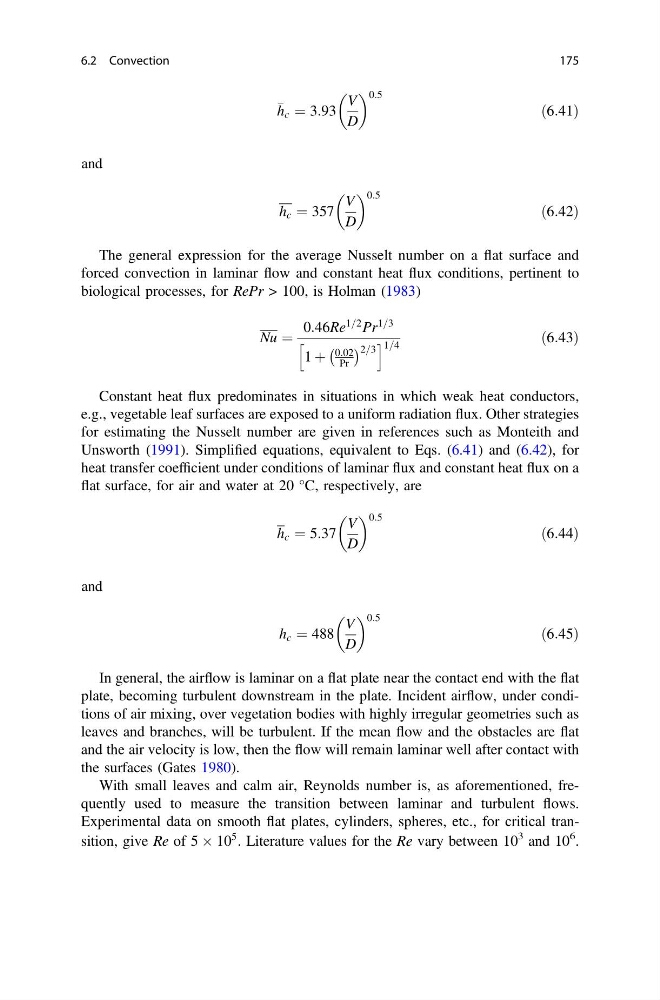
h c ¼ 3:93
V
D
0:5
ð6:41Þ
and
h c ¼ 357
V
D
0:5
ð6:42Þ
The general expression for the average Nusselt number on a flat surface and
forced convection in laminar flow and constant heat flux conditions, pertinent to
biological processes, for RePr > 100, is Holman (1983)
Nu ¼
0:46Re
1=2 Pr
1=3
1 þ
0:02
Pr
À Á 2=3
h
i 1=4
ð6:43Þ
Constant heat flux predominates in situations in which weak heat conductors,
e.g., vegetable leaf surfaces are exposed to a uniform radiation flux. Other strategies
for estimating the Nusselt number are given in references such as Monteith and
Unsworth (1991). Simplified equations, equivalent to Eqs. (6.41) and (6.42), for
heat transfer coefficient under conditions of laminar flux and constant heat flux on a
flat surface, for air and water at 20 °C, respectively, are
h c ¼ 5:37
V
D
0:5
ð6:44Þ
and
h c ¼ 488
V
D
0:5
ð6:45Þ
In general, the airflow is laminar on a flat plate near the contact end with the flat
plate, becoming turbulent downstream in the plate. Incident airflow, under conditions of air mixing, over vegetation bodies with highly irregular geometries such as
leaves and branches, will be turbulent. If the mean flow and the obstacles are flat
and the air velocity is low, then the flow will remain laminar well after contact with
the surfaces (Gates 1980).
With small leaves and calm air, Reynolds number is, as aforementioned, frequently used to measure the transition between laminar and turbulent flows.
Experimental data on smooth flat plates, cylinders, spheres, etc., for critical transition, give Re of 5 Â 10
5 . Literature values for the Re vary between 10
3 and 10
6 .
6.2 Convection
175
V
D
0:5
ð6:41Þ
and
h c ¼ 357
V
D
0:5
ð6:42Þ
The general expression for the average Nusselt number on a flat surface and
forced convection in laminar flow and constant heat flux conditions, pertinent to
biological processes, for RePr > 100, is Holman (1983)
Nu ¼
0:46Re
1=2 Pr
1=3
1 þ
0:02
Pr
À Á 2=3
h
i 1=4
ð6:43Þ
Constant heat flux predominates in situations in which weak heat conductors,
e.g., vegetable leaf surfaces are exposed to a uniform radiation flux. Other strategies
for estimating the Nusselt number are given in references such as Monteith and
Unsworth (1991). Simplified equations, equivalent to Eqs. (6.41) and (6.42), for
heat transfer coefficient under conditions of laminar flux and constant heat flux on a
flat surface, for air and water at 20 °C, respectively, are
h c ¼ 5:37
V
D
0:5
ð6:44Þ
and
h c ¼ 488
V
D
0:5
ð6:45Þ
In general, the airflow is laminar on a flat plate near the contact end with the flat
plate, becoming turbulent downstream in the plate. Incident airflow, under conditions of air mixing, over vegetation bodies with highly irregular geometries such as
leaves and branches, will be turbulent. If the mean flow and the obstacles are flat
and the air velocity is low, then the flow will remain laminar well after contact with
the surfaces (Gates 1980).
With small leaves and calm air, Reynolds number is, as aforementioned, frequently used to measure the transition between laminar and turbulent flows.
Experimental data on smooth flat plates, cylinders, spheres, etc., for critical transition, give Re of 5 Â 10
5 . Literature values for the Re vary between 10
3 and 10
6 .
6.2 Convection
175