

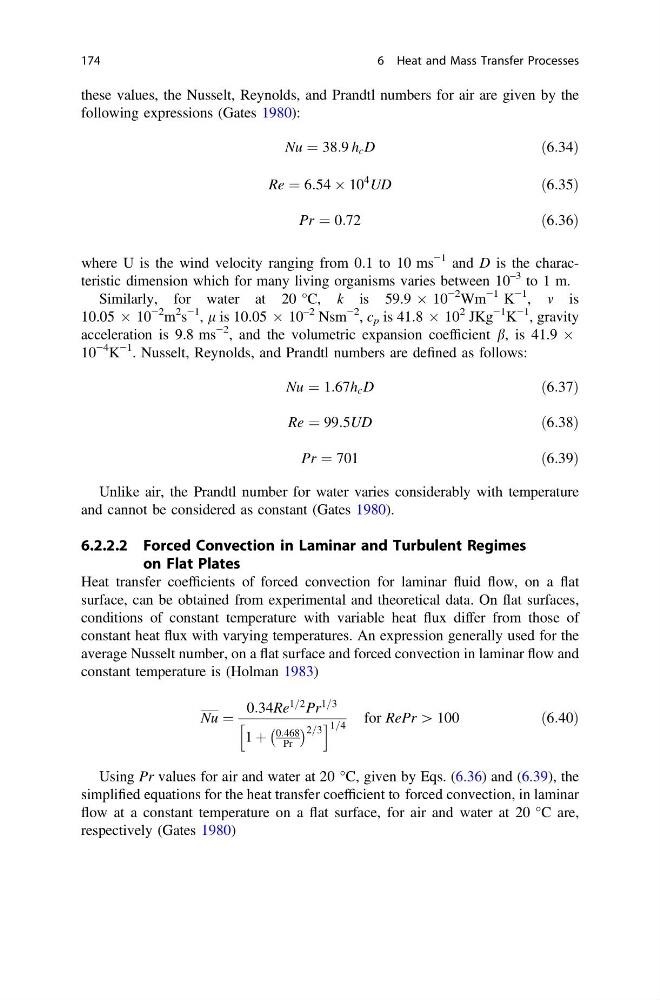
these values, the Nusselt, Reynolds, and Prandtl numbers for air are given by the
following expressions (Gates 1980):
Nu ¼ 38:9 h c D
ð6:34Þ
Re ¼ 6:54 Â 10
4 UD
ð6:35Þ
Pr ¼ 0:72
ð6:36Þ
where U is the wind velocity ranging from 0.1 to 10 ms
−1 and D is the characteristic dimension which for many living organisms varies between 10
–3 to 1 m.
Similarly, for water at 20 °C, k is 59.9 Â 10
−2 Wm
−1 K
−1 , m is
10.05 Â 10
−2 m
2 s
−1
, l is 10.05 Â 10
–2 Nsm
−2 , c p is 41.8 Â 10
2 JKg
−1 K
−1 , gravity
acceleration is 9.8 ms
−2 , and the volumetric expansion coefficient b, is 41.9 Â
10
−4 K
−1 . Nusselt, Reynolds, and Prandtl numbers are defined as follows:
Nu ¼ 1:67h c D
ð6:37Þ
Re ¼ 99:5UD
ð6:38Þ
Pr ¼ 701
ð6:39Þ
Unlike air, the Prandtl number for water varies considerably with temperature
and cannot be considered as constant (Gates 1980).
6.2.2.2 Forced Convection in Laminar and Turbulent Regimes
on Flat Plates
Heat transfer coefficients of forced convection for laminar fluid flow, on a flat
surface, can be obtained from experimental and theoretical data. On flat surfaces,
conditions of constant temperature with variable heat flux differ from those of
constant heat flux with varying temperatures. An expression generally used for the
average Nusselt number, on a flat surface and forced convection in laminar flow and
constant temperature is (Holman 1983)
Nu ¼
0:34Re
1=2 Pr
1=3
1 þ
0:468
Pr
À
Á 2=3
h
i 1=4 for RePr [ 100
ð6:40Þ
Using Pr values for air and water at 20 °C, given by Eqs. (6.36) and (6.39), the
simplified equations for the heat transfer coefficient to forced convection, in laminar
flow at a constant temperature on a flat surface, for air and water at 20 °C are,
respectively (Gates 1980)
174
6 Heat and Mass Transfer Processes
following expressions (Gates 1980):
Nu ¼ 38:9 h c D
ð6:34Þ
Re ¼ 6:54 Â 10
4 UD
ð6:35Þ
Pr ¼ 0:72
ð6:36Þ
where U is the wind velocity ranging from 0.1 to 10 ms
−1 and D is the characteristic dimension which for many living organisms varies between 10
–3 to 1 m.
Similarly, for water at 20 °C, k is 59.9 Â 10
−2 Wm
−1 K
−1 , m is
10.05 Â 10
−2 m
2 s
−1
, l is 10.05 Â 10
–2 Nsm
−2 , c p is 41.8 Â 10
2 JKg
−1 K
−1 , gravity
acceleration is 9.8 ms
−2 , and the volumetric expansion coefficient b, is 41.9 Â
10
−4 K
−1 . Nusselt, Reynolds, and Prandtl numbers are defined as follows:
Nu ¼ 1:67h c D
ð6:37Þ
Re ¼ 99:5UD
ð6:38Þ
Pr ¼ 701
ð6:39Þ
Unlike air, the Prandtl number for water varies considerably with temperature
and cannot be considered as constant (Gates 1980).
6.2.2.2 Forced Convection in Laminar and Turbulent Regimes
on Flat Plates
Heat transfer coefficients of forced convection for laminar fluid flow, on a flat
surface, can be obtained from experimental and theoretical data. On flat surfaces,
conditions of constant temperature with variable heat flux differ from those of
constant heat flux with varying temperatures. An expression generally used for the
average Nusselt number, on a flat surface and forced convection in laminar flow and
constant temperature is (Holman 1983)
Nu ¼
0:34Re
1=2 Pr
1=3
1 þ
0:468
Pr
À
Á 2=3
h
i 1=4 for RePr [ 100
ð6:40Þ
Using Pr values for air and water at 20 °C, given by Eqs. (6.36) and (6.39), the
simplified equations for the heat transfer coefficient to forced convection, in laminar
flow at a constant temperature on a flat surface, for air and water at 20 °C are,
respectively (Gates 1980)
174
6 Heat and Mass Transfer Processes