

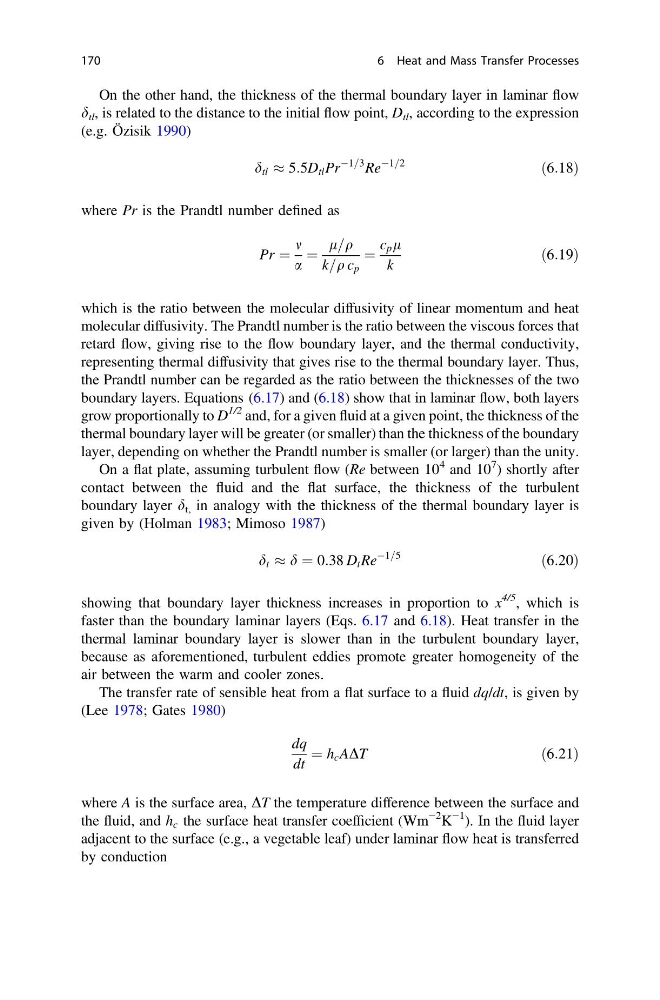
On the other hand, the thickness of the thermal boundary layer in laminar flow
d tl , is related to the distance to the initial flow point, D tl , according to the expression
(e.g. Özisik 1990)
d tl % 5:5D tl Pr
À1=3 Re
À1=2
ð6:18Þ
where Pr is the Prandtl number defined as
Pr ¼
m
a
¼
l=q
k=q c p
¼
c p l
k
ð6:19Þ
which is the ratio between the molecular diffusivity of linear momentum and heat
molecular diffusivity. The Prandtl number is the ratio between the viscous forces that
retard flow, giving rise to the flow boundary layer, and the thermal conductivity,
representing thermal diffusivity that gives rise to the thermal boundary layer. Thus,
the Prandtl number can be regarded as the ratio between the thicknesses of the two
boundary layers. Equations (6.17) and (6.18) show that in laminar flow, both layers
grow proportionally to D
1/2 and, for a given fluid at a given point, the thickness of the
thermal boundary layer will be greater (or smaller) than the thickness of the boundary
layer, depending on whether the Prandtl number is smaller (or larger) than the unity.
On a flat plate, assuming turbulent flow (Re between 10
4 and 10
7 ) shortly after
contact between the fluid and the flat surface, the thickness of the turbulent
boundary layer d t, in analogy with the thickness of the thermal boundary layer is
given by (Holman 1983; Mimoso 1987)
d t % d ¼ 0:38 D t Re
À1=5
ð6:20Þ
showing that boundary layer thickness increases in proportion to x
4/5 , which is
faster than the boundary laminar layers (Eqs. 6.17 and 6.18). Heat transfer in the
thermal laminar boundary layer is slower than in the turbulent boundary layer,
because as aforementioned, turbulent eddies promote greater homogeneity of the
air between the warm and cooler zones.
The transfer rate of sensible heat from a flat surface to a fluid dq/dt, is given by
(Lee 1978; Gates 1980)
dq
dt
¼ h c ADT
ð6:21Þ
where A is the surface area, DT the temperature difference between the surface and
the fluid, and h c the surface heat transfer coefficient (Wm
−2 K
−1 ). In the fluid layer
adjacent to the surface (e.g., a vegetable leaf) under laminar flow heat is transferred
by conduction
170
6 Heat and Mass Transfer Processes
d tl , is related to the distance to the initial flow point, D tl , according to the expression
(e.g. Özisik 1990)
d tl % 5:5D tl Pr
À1=3 Re
À1=2
ð6:18Þ
where Pr is the Prandtl number defined as
Pr ¼
m
a
¼
l=q
k=q c p
¼
c p l
k
ð6:19Þ
which is the ratio between the molecular diffusivity of linear momentum and heat
molecular diffusivity. The Prandtl number is the ratio between the viscous forces that
retard flow, giving rise to the flow boundary layer, and the thermal conductivity,
representing thermal diffusivity that gives rise to the thermal boundary layer. Thus,
the Prandtl number can be regarded as the ratio between the thicknesses of the two
boundary layers. Equations (6.17) and (6.18) show that in laminar flow, both layers
grow proportionally to D
1/2 and, for a given fluid at a given point, the thickness of the
thermal boundary layer will be greater (or smaller) than the thickness of the boundary
layer, depending on whether the Prandtl number is smaller (or larger) than the unity.
On a flat plate, assuming turbulent flow (Re between 10
4 and 10
7 ) shortly after
contact between the fluid and the flat surface, the thickness of the turbulent
boundary layer d t, in analogy with the thickness of the thermal boundary layer is
given by (Holman 1983; Mimoso 1987)
d t % d ¼ 0:38 D t Re
À1=5
ð6:20Þ
showing that boundary layer thickness increases in proportion to x
4/5 , which is
faster than the boundary laminar layers (Eqs. 6.17 and 6.18). Heat transfer in the
thermal laminar boundary layer is slower than in the turbulent boundary layer,
because as aforementioned, turbulent eddies promote greater homogeneity of the
air between the warm and cooler zones.
The transfer rate of sensible heat from a flat surface to a fluid dq/dt, is given by
(Lee 1978; Gates 1980)
dq
dt
¼ h c ADT
ð6:21Þ
where A is the surface area, DT the temperature difference between the surface and
the fluid, and h c the surface heat transfer coefficient (Wm
−2 K
−1 ). In the fluid layer
adjacent to the surface (e.g., a vegetable leaf) under laminar flow heat is transferred
by conduction
170
6 Heat and Mass Transfer Processes